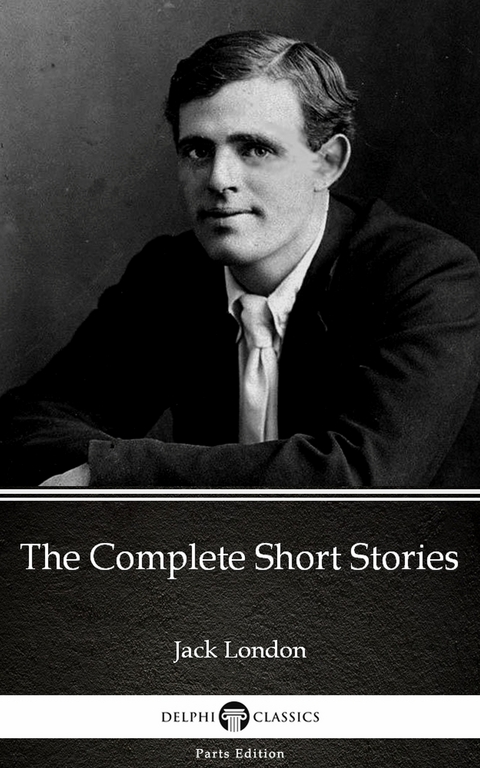
Complete Short Stories by Jack London (Illustrated) (eBook)
1709 Seiten
Publishdrive (Verlag)
978-1-78656-184-8 (ISBN)
Having established their name as the leading publisher of classic literature and art, Delphi Classics produce publications that are individually crafted with superior formatting, while introducing many rare texts for the first time in digital print. The Delphi Classics edition of London includes original annotations and illustrations relating to the life and works of the author, as well as individual tables of contents, allowing you to navigate eBooks quickly and easily.
eBook features:* The complete unabridged text of 'The Complete Short Stories'
* Beautifully illustrated with images related to London's works
* Individual contents table, allowing easy navigation around the eBook
* Excellent formatting of the textPlease visit www.delphiclassics.com to learn more about our wide range of titles
This eBook features the unabridged text of 'The Complete Short Stories' from the bestselling edition of 'The Complete Works of Jack London'. Having established their name as the leading publisher of classic literature and art, Delphi Classics produce publications that are individually crafted with superior formatting, while introducing many rare texts for the first time in digital print. The Delphi Classics edition of London includes original annotations and illustrations relating to the life and works of the author, as well as individual tables of contents, allowing you to navigate eBooks quickly and easily.eBook features:* The complete unabridged text of 'The Complete Short Stories'* Beautifully illustrated with images related to London's works* Individual contents table, allowing easy navigation around the eBook* Excellent formatting of the textPlease visit www.delphiclassics.com to learn more about our wide range of titles
An Adventure in the Upper Sea
I AM a retired captain of the upper sea. That is to say, when I was a younger man (which is not so long ago) I was an aeronaut and navigated that aerial ocean which is all around about us and above us. Naturally it is a hazardous profession, and naturally I have had many thrilling experiences, the most thrilling, or at least the most nerve-racking, being the one I am about to relate.
It happened before I went in for hydrogen gas balloons, all of varnished silk, doubled and lined, and all that, and fit for voyages of days instead of mere hours. The Little Nassau (named after the Great Nassau of many years back) was the balloon I was making ascents in at the time. It was a fair-sized, hot-air affair, of single thickness, good for an hour’s flight or so and capable of attaining an altitude of a mile or more. It answered my purpose, for my act at the time was making half-mile parachute jumps at recreation parks and country fairs. I was in Oakland, a California town, filling a summer’s engagement with a street railway company. The company owned a large park outside the city, and of course it was to its interest to provide attractions which would send the townspeople over its line when they went out to get a whiff of country air. My contract called for two ascensions weekly, and my act was an especially taking feature, for it was on my days that the largest crowds were drawn.
Before you can understand what happened, I must first explain a bit about the nature of the hot air balloon which is used for parachute jumping. If you have ever witnessed such a jump, you will remember that directly the parachute was cut loose the balloon turned upside down, emptied itself of its smoke and heated air, flattened out and fell straight down, beating the parachute to the ground. Thus there is no chasing a big deserted bag for miles and miles across the country, and much time, as well as trouble, is thereby saved. This maneuver is accomplished by attaching a weight, at the end of a long rope, to the top of the balloon. The aeronaut, with his parachute and trapeze, hangs to the bottom of the balloon, and, weighing more, keeps it right side down. But when he lets go, the weight attached to the top immediately drags the top down, and the bottom, which is the open mouth, goes up, the heated air pouring out. The weight used for this purpose on the Little Nassau was a bag of sand.
On the particular day I have in mind there was an unusually large crowd in attendance, and the police had their hands full keeping the people back. There was much pushing and shoving, and the ropes were bulging with the pressure of men, women and children. As I came down from the dressing room I noticed two girls outside the ropes, of about fourteen and sixteen, and inside the rope a youngster of eight or nine. They were holding him by the hands, and he was struggling, excitedly and half in laughter, to get away from them. I thought nothing of it at the time — just a bit of childish play, no more; and it was only in the light of after events that the scene was impressed vividly upon me.
“Keep them cleared out, George!” I called to my assistant. “We don’t want any accidents.”
“Ay,” he answered, “that I will, Charley.”
George Guppy had helped me in no end of ascents, and because of his coolness, judgment and absolute reliability I had come to trust my life in his hands with the utmost confidence. His business it was to overlook the inflating of the balloon, and to see that everything about the parachute was in perfect working order.
The Little Nassau was already filled and straining at the guys. The parachute lay flat along the ground and beyond it the trapeze. I tossed aside my overcoat, took my position, and gave the signal to let go. As you know, the first rush upward from the earth is very sudden, and this time the balloon, when it first caught the wind, heeled violently over and was longer than usual in righting. I looked down at the old familiar sight of the world rushing away from me. And there were the thousands of people, every face silently upturned. And the silence startled me, for, as crowds went, this was the time for them to catch their first breath and send up a roar of applause. But there was no hand-clapping, whistling, cheering-only silence. And instead, clear as a bell and distinct, without the slightest shake or quaver, came George’s voice through the megaphone:
“Ride her down, Charley! Ride the balloon down!”
What had happened? I waved my hand to show that I had heard, and began to think. Had something gone wrong with the parachute? Why should I ride the balloon down instead of making the jump which thousands were waiting to see? What was the matter? And as I puzzled, I received another start. The earth was a thousand feet beneath, and yet I heard a child crying softly, and seemingly very close to hand. And though the Little Nassau was shooting skyward like a rocket, the crying did not grow fainter and fainter and die away. I confess I was almost on the edge of a funk, when, unconsciously following up the noise with my eyes, I looked above me and saw a boy astride the sandbag which was to bring the Little Nassau to earth. And it was the same little boy I had seen struggling with the two girls — his sisters, as I afterward learned.
There he was, astride the sandbag and holding on to the rope for dear life. A puff of wind heeled the balloon slightly, and he swung out into space for ten or a dozen feet, and back again, fetching up against the tight canvas with a thud which even shook me, thirty feet or more beneath. I thought to see him dashed loose, but he clung on and whimpered. They told me afterward, how, at the moment they were casting off the balloon, the little fellow had torn away from his sisters, ducked under the rope, and deliberately jumped astride the sandbag. It has always been a wonder to me that he was not jerked off in the first rush.
Well, I felt sick all over as I looked at him there, and I understood why the balloon had taken longer to right itself, and why George had called after me to ride her down. Should I cut loose with the parachute, the bag would at once turn upside down, empty itself, and begin its swift descent. The only hope lay in my riding her down and in the boy holding on. There was no possible way for me to reach him. No man could climb the slim, closed parachute; and even if a man could, and made the mouth of the balloon, what could he do? Straight out, and fifteen feet away, trailed the boy on his ticklish perch, and those fifteen feet were empty space.
I thought far more quickly than it takes to tell all this, and realized on the instant that the boy’s attention must be called away from his terrible danger. Exercising all the self-control I possessed, and striving to make myself very calm, I said cheerily:
“Hello, up there, who are you?”
He looked down at me, choking back his tears and brightening up, but just then the balloon ran into a cross-current, turned half around and lay over. This set him swinging back and forth, and he fetched the canvas another bump. Then he began to cry again.
“Isn’t it great?” I asked heartily, as though it was the most enjoyable thing in the world; and, without waiting for him to answer: “What’s your name?”
“Tommy Dermott,” he answered.
“Glad to make your acquaintance, Tommy Dermott,” I went on. “But I’d like to know who said you could ride up with me?”
He laughed and said he just thought he’d ride up for the fun of it. And so we went on, I sick with fear for him, and cudgeling my brains to keep up the conversation. I knew that it was all I could do, and that his life depended upon my ability to keep his mind off his danger. I pointed out to him the great panorama spreading away to the horizon and four thousand feet beneath us. There lay San Francisco Bay like a great placid lake, the haze of smoke over the city, the Golden Gate, the ocean fog-rim beyond, and Mount Tamalpais over all, clear-cut and sharp against the sky. Directly below us I could see a buggy, apparently crawling, but I knew from experience that the men in it were lashing the horses on our trail.
But he grew tired of looking around, and I could see he was beginning to get frightened.
“How would you like to go in for the business?” I asked.
He cheered up at once and asked “Do you get good pay?”
But the Little Nassau, beginning to cool, had started on its long descent, and ran into counter currents which bobbed it roughly about. This swung the boy around pretty lively, smashing him into the bag once quite severely. His lip began to tremble at this, and he was crying again. I tried to joke and laugh, but it was no use. His pluck was oozing out, and at any moment I was prepared to see him go shooting past me.
I was in despair. Then, suddenly, I remembered how one fright could destroy another fright, and I frowned up at him and shouted sternly:
“You just hold on to that rope! If you don’t I’ll thrash you within an inch of your life when I get you down on the ground! Understand?”
“Ye-ye-yes, sir,” he whimpered, and I saw that the thing had worked. I was nearer to him than the earth, and he was more afraid of me than of falling.
“Why, you’ve got a snap up there on that soft bag,” I rattled on.
“Yes;” I assured him, “this bar down here is hard and narrow, and it hurts to sit on it.”
Then a thought struck him, and he forgot all about his aching...
| Erscheint lt. Verlag | 17.7.2017 |
|---|---|
| Reihe/Serie | Delphi Parts Edition (Jack London) | Delphi Parts Edition (Jack London) |
| Sprache | englisch |
| Themenwelt | Literatur ► Anthologien |
| Literatur ► Klassiker / Moderne Klassiker | |
| Literatur ► Romane / Erzählungen | |
| Schlagworte | burning • Call • Cruise • Fang • Novels • Sea • Stories • Twain |
| ISBN-10 | 1-78656-184-0 / 1786561840 |
| ISBN-13 | 978-1-78656-184-8 / 9781786561848 |
| Informationen gemäß Produktsicherheitsverordnung (GPSR) | |
| Haben Sie eine Frage zum Produkt? |
 EPUB (Adobe DRM)
Größe: 3,8 MB
Kopierschutz: Adobe-DRM
Adobe-DRM ist ein Kopierschutz, der das eBook vor Mißbrauch schützen soll. Dabei wird das eBook bereits beim Download auf Ihre persönliche Adobe-ID autorisiert. Lesen können Sie das eBook dann nur auf den Geräten, welche ebenfalls auf Ihre Adobe-ID registriert sind.
Details zum Adobe-DRM
Dateiformat: EPUB (Electronic Publication)
EPUB ist ein offener Standard für eBooks und eignet sich besonders zur Darstellung von Belletristik und Sachbüchern. Der Fließtext wird dynamisch an die Display- und Schriftgröße angepasst. Auch für mobile Lesegeräte ist EPUB daher gut geeignet.
Systemvoraussetzungen:
PC/Mac: Mit einem PC oder Mac können Sie dieses eBook lesen. Sie benötigen eine
eReader: Dieses eBook kann mit (fast) allen eBook-Readern gelesen werden. Mit dem amazon-Kindle ist es aber nicht kompatibel.
Smartphone/Tablet: Egal ob Apple oder Android, dieses eBook können Sie lesen. Sie benötigen eine
Geräteliste und zusätzliche Hinweise
Buying eBooks from abroad
For tax law reasons we can sell eBooks just within Germany and Switzerland. Regrettably we cannot fulfill eBook-orders from other countries.
EPUB (Ohne DRM)Digital Rights Management: ohne DRM
Dieses eBook enthält kein DRM oder Kopierschutz. Eine Weitergabe an Dritte ist jedoch rechtlich nicht zulässig, weil Sie beim Kauf nur die Rechte an der persönlichen Nutzung erwerben.
Dateiformat: EPUB (Electronic Publication)
EPUB ist ein offener Standard für eBooks und eignet sich besonders zur Darstellung von Belletristik und Sachbüchern. Der Fließtext wird dynamisch an die Display- und Schriftgröße angepasst. Auch für mobile Lesegeräte ist EPUB daher gut geeignet.
Systemvoraussetzungen:
PC/Mac: Mit einem PC oder Mac können Sie dieses eBook lesen. Sie benötigen dafür die kostenlose Software Adobe Digital Editions.
eReader: Dieses eBook kann mit (fast) allen eBook-Readern gelesen werden. Mit dem amazon-Kindle ist es aber nicht kompatibel.
Smartphone/Tablet: Egal ob Apple oder Android, dieses eBook können Sie lesen. Sie benötigen dafür eine kostenlose App.
Geräteliste und zusätzliche Hinweise
Buying eBooks from abroad
For tax law reasons we can sell eBooks just within Germany and Switzerland. Regrettably we cannot fulfill eBook-orders from other countries.
aus dem Bereich