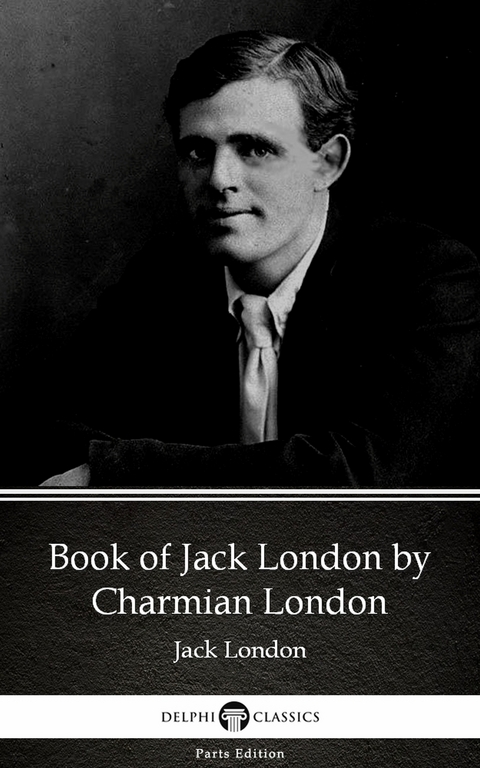
Book of Jack London by Charmian London (Illustrated) (eBook)
471 Seiten
Publishdrive (Verlag)
978-1-78656-185-5 (ISBN)
Having established their name as the leading publisher of classic literature and art, Delphi Classics produce publications that are individually crafted with superior formatting, while introducing many rare texts for the first time in digital print. The Delphi Classics edition of London includes original annotations and illustrations relating to the life and works of the author, as well as individual tables of contents, allowing you to navigate eBooks quickly and easily.
eBook features:* The complete unabridged text of 'Book of Jack London by Charmian London'
* Beautifully illustrated with images related to London's works
* Individual contents table, allowing easy navigation around the eBook
* Excellent formatting of the textPlease visit www.delphiclassics.com to learn more about our wide range of titles
This eBook features the unabridged text of 'Book of Jack London by Charmian London' from the bestselling edition of 'The Complete Works of Jack London'. Having established their name as the leading publisher of classic literature and art, Delphi Classics produce publications that are individually crafted with superior formatting, while introducing many rare texts for the first time in digital print. The Delphi Classics edition of London includes original annotations and illustrations relating to the life and works of the author, as well as individual tables of contents, allowing you to navigate eBooks quickly and easily.eBook features:* The complete unabridged text of 'Book of Jack London by Charmian London'* Beautifully illustrated with images related to London's works* Individual contents table, allowing easy navigation around the eBook* Excellent formatting of the textPlease visit www.delphiclassics.com to learn more about our wide range of titles
THE STUFF OF STARS
VOLUME I — CHAPTER I
ALL in all, it is a happy fate that places in one’s keeping the rudimental material, blood-drift and magical spirit-stuff, that went into the syntheses of this resultant entity whom men knew as Jack London; who in his time was loved or hated as they reacted to his spacious nature with its varying levels of humannesses, its winging heights, its drowning depths.
In sifting and assembling the details bearing upon Jack London’s origin, the keen enjoyment of serving his readers joins with a keener zest in singing his pride of race; in sounding the pean, manifest throughout his work, of his very own Anglo-Saxon breed, upon which he gambled his faith. And the pleasure increases as additional verification is uncovered bearing upon his direct British ancestry.
From the heart of the city of London there sprang two large families that bore the city’s name, one of which branches was from Semitic seed, as witness Meyer London, erstwhile Socialist congressman at Washington, D. C., and many another in America; while in England one of my correspondents is a Jewess whom I address as “Mrs. Jack London.”
The Gentile group, it seems, owned the land of which Chatham Square is now part. One of the early Londons had a sister Elizabeth, who married a Wellington, and lived at Chatham. When Jack London’s sister Eliza was a child, she heard her father say, referring to politics in his part of Pennsylvania: “If the Wellingtons and McLoughlins stood together, they’d carry the elections!” In Jack’s direct ancestry, the first person in my available record is Sir William London, who foreswore allegiance to Great Britain and betook himself to America. Here, under General George Washington, he fought valiantly for his ideals, thereby sacrificing no mean estates in the tight little island; for these were promptly confiscated by the jealous Crown, and thereafter figured in the mill of Chancery. I can remember Jack London saying: “One of my childhood recollections is of mysterious sessions held by my mother and father, from which I gathered that he had been approached across the water by the London heirs to lend a hand in fighting for his great-grandfather’s seized properties.”
But a letter from one Mary London Wilson, seventy years old, writing from Lackawanna County, Pennsylvania, in 1904, gives the following: That nearly thirty years before, an advertisement had been run in the papers, calling for information of London heirs in America. For Lord Russell London had died in England, the last of his line, leaving a half million for the American heirs if they could be located. From this letter one learns that none of the Londons knew of this advertisement for nearly two years; when a Charley London, with a lawyer, voyaged overseas, only to find that the estate had gone from Chancery to the Crown.
Sir William London’s son William named his son Manley. Manley London married Sarah Hess, and became the sire of eight: Mary, Sarah, Rebecca, George, Martha, Eliza, Joseph, and John London, with whom the direct life-story of Jack London begins. And these Londons, one and all, from the redoubtable knight down to and including his great-grandson John, took part in each and every warlike uprising for American liberty. It would not be out of place here to add that the last of the paternal line, nephews of Jack London, namely, Irving Shepard and John Miller, did their part on sea and land in this twentieth century greatest of all struggles.
John London, great-grandson of Sir William, first saw the light in Springfield County, Pennsylvania, on January 11, 1828. He grew up on a farm, receiving the education attainable in small rural schools nearly a century ago, while he learned the hard, empirical way of agriculture at that early date.
He comes next into view at the age of nineteen, as boss of a section gang in the construction of a great railroad system through Pennsylvania. One day, John reported at the big farm residence of an official of the road, one Hugh Cavett, The latter being absent, his daughter Anna Jane took the message. Eyes and hands struck fire, and in two weeks the pair were married; for John London was a bonnie lad, six feet in his homespun socks, square-shouldered, well-limbed, fine-skinned, with comely hands and feet, and a wealth of soft, wavy brown hair — one of Jack London’s own physical characteristics. “Finest head of hair I ever barbered!” old Barber Smith of San Francisco declared of John’s luxuriant mane thirty years later. And, like Jack’s, John’s wide-set, gray-blue, dancing eyes and sweeping ways were not to be resisted by mortal woman. What mattered it to him, when kind called to kind, that Anna Jane’s father was his employer and a rich man! He was the owner of profitable farmlands, not only in Westmorel, but in Township Patton, Alleghany County; a stockholder in the Wheeling Bridge property in Virginia, and an investor in various other lucrative schemes that were bringing fortunes to foreseeing men of Hugh Cavett’s type. Besides, over and above the love that drew the man and maid so quickly together, was not the comely girl John’s very ideal of a capable country-house mistress?
After the wedding John London came to live for a time in the big house, where he began the founding of his own line — a generous contribution of eleven olive branches, some sprouting twin-buds, to the family tree. He was absent frequently, sent out, I gather, by his father-in-law on business connected with the railroad. If the other man was at all put out by the forthright methods of the young couple in matters matrimonial, evidently he made the best of the situation and advanced the unexpected son-in-law in line with his abilities. Moreover, the sedately arriving yearly babies, beginning with Tom and Mary, could not have failed to erase any last vestige of their grandfather’s pique.
John London’s life-long gallantry is illustrated by a little incident that took place upon his homecoming from one of these trips. Finding his bride over-strained by the housewifely labor of entertaining for weeks a full complement of relatives, he expressed his solicitude by dismiss ing the whole tribe, stating his reasons. He then turned to and helped Anna Jane clear up after them. In quite another setting, half a century later, Jack London said to me:
“When we are married, much as I love an open house, if I cannot afford servants, we’ll live in tents so there can’t be any entertaining! No domestic drudgery for wife of mine. It’s your life and my life, first. Our need of each other lies in different ways than circumscribed domesticity.”
Very congenial seem to have been John and Anna Jane. “No one ever saw Jane angry or disagreeable,” reads the yellowed fragment of a letter, “nor John London cross or harsh. He was always protecting some one.” A roving spirit characterized the London strain, and Anna Jane appears to have been in no wise backward in aiding and abetting its development in her spouse. From the fact that she is not mentioned in Hugh Cavett’s will, and by other data, one is led to conclude that he had settled her portion upon her before she and John presently went adventuring up through Wisconsin, with an eye for an abiding-place, thence drifting down to Illinois, where John’s mother, a remarkable woman, managed her own stockfarm. Five sons she gave to the Civil War, meanwhile she continued to develop her holdings.
When John London enlisted in the War of the Rebellion, it was from a Missouri farm, and he left behind Anna Jane with seven children. At the close of the war, with one lung out of action as the result of a combined siege of pneumonia and smallpox, he lived with his family in the town of Moscow, Muscatine County, Iowa, in a two-story white house on the town square. Here Eliza was born. On the opposite side of the square stood the flourmill, and John, among other building work, superintended the construction of a bridge across Cedar Eiver, the stream that furnished power to the mill. Eliza remembers well the close proximity of the watercourse. Priscilla was washing and getting dinner, and asked her wee sister to run and see if papa was coming. Eliza toddled to the bench on which she was wont to climb to the window, and pulled over upon herself the steaming tub of clothing big sister had set there. She never forgot how quickly papa, returning from his bridge-building, answered the summons to aid his scalded baby. Later, they migrated to a quarter section of government land outside of Moscow. When his wife was discovered with consumption, John arranged affairs so that he could devote himself to her, and it fell in with their mutual dreams to play at gipsying. For two years they moved over the prairies in a “schooner,” and during this time John came into pleasant contact with the Pawnees, by whom he swore stoutly to his dying day. “Play fair with an Indian,” he held, “and you can trust him with anything, anywhere. It’s wrong treatment that’s made sly devils of ‘em.”
With the redskins this born out-doors man hunted and trapped raccoons and other prairie game; and, in bee-hunting, proved of keener sight than the aborigines in following to its honey store the flight of a homing worker. Later, when the Indians were camping near the farm, John branded his stock, and, unlike some of his neighbors, never lost a single head to any marauder. Play the game squarely, was his philosophy, and you stand to win.
That Anna Jane did not entirely subscribe to this whole sale confidence in...
| Erscheint lt. Verlag | 17.7.2017 |
|---|---|
| Reihe/Serie | Delphi Parts Edition (Jack London) | Delphi Parts Edition (Jack London) |
| Sprache | englisch |
| Themenwelt | Literatur ► Anthologien |
| Literatur ► Klassiker / Moderne Klassiker | |
| Literatur ► Romane / Erzählungen | |
| Schlagworte | burning • Call • Cruise • Fang • Novels • Sea • Stories • Twain |
| ISBN-10 | 1-78656-185-9 / 1786561859 |
| ISBN-13 | 978-1-78656-185-5 / 9781786561855 |
| Informationen gemäß Produktsicherheitsverordnung (GPSR) | |
| Haben Sie eine Frage zum Produkt? |
 EPUB (Adobe DRM)
Größe: 2,1 MB
Kopierschutz: Adobe-DRM
Adobe-DRM ist ein Kopierschutz, der das eBook vor Mißbrauch schützen soll. Dabei wird das eBook bereits beim Download auf Ihre persönliche Adobe-ID autorisiert. Lesen können Sie das eBook dann nur auf den Geräten, welche ebenfalls auf Ihre Adobe-ID registriert sind.
Details zum Adobe-DRM
Dateiformat: EPUB (Electronic Publication)
EPUB ist ein offener Standard für eBooks und eignet sich besonders zur Darstellung von Belletristik und Sachbüchern. Der Fließtext wird dynamisch an die Display- und Schriftgröße angepasst. Auch für mobile Lesegeräte ist EPUB daher gut geeignet.
Systemvoraussetzungen:
PC/Mac: Mit einem PC oder Mac können Sie dieses eBook lesen. Sie benötigen eine
eReader: Dieses eBook kann mit (fast) allen eBook-Readern gelesen werden. Mit dem amazon-Kindle ist es aber nicht kompatibel.
Smartphone/Tablet: Egal ob Apple oder Android, dieses eBook können Sie lesen. Sie benötigen eine
Geräteliste und zusätzliche Hinweise
Buying eBooks from abroad
For tax law reasons we can sell eBooks just within Germany and Switzerland. Regrettably we cannot fulfill eBook-orders from other countries.
EPUB (Ohne DRM)Digital Rights Management: ohne DRM
Dieses eBook enthält kein DRM oder Kopierschutz. Eine Weitergabe an Dritte ist jedoch rechtlich nicht zulässig, weil Sie beim Kauf nur die Rechte an der persönlichen Nutzung erwerben.
Dateiformat: EPUB (Electronic Publication)
EPUB ist ein offener Standard für eBooks und eignet sich besonders zur Darstellung von Belletristik und Sachbüchern. Der Fließtext wird dynamisch an die Display- und Schriftgröße angepasst. Auch für mobile Lesegeräte ist EPUB daher gut geeignet.
Systemvoraussetzungen:
PC/Mac: Mit einem PC oder Mac können Sie dieses eBook lesen. Sie benötigen dafür die kostenlose Software Adobe Digital Editions.
eReader: Dieses eBook kann mit (fast) allen eBook-Readern gelesen werden. Mit dem amazon-Kindle ist es aber nicht kompatibel.
Smartphone/Tablet: Egal ob Apple oder Android, dieses eBook können Sie lesen. Sie benötigen dafür eine kostenlose App.
Geräteliste und zusätzliche Hinweise
Buying eBooks from abroad
For tax law reasons we can sell eBooks just within Germany and Switzerland. Regrettably we cannot fulfill eBook-orders from other countries.
aus dem Bereich