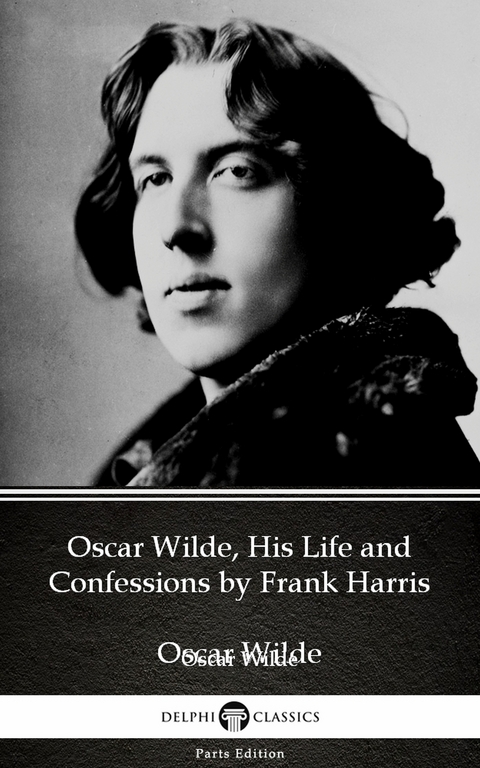
Oscar Wilde, His Life and Confessions by Frank Harris (Illustrated) (eBook)
274 Seiten
Publishdrive (Verlag)
978-1-78656-167-1 (ISBN)
Having established their name as the leading publisher of classic literature and art, Delphi Classics produce publications that are individually crafted with superior formatting, while introducing many rare texts for the first time in digital print. The Delphi Classics edition of Wilde includes original annotations and illustrations relating to the life and works of the author, as well as individual tables of contents, allowing you to navigate eBooks quickly and easily.
eBook features:* The complete unabridged text of 'Oscar Wilde, His Life and Confessions by Frank Harris'
* Beautifully illustrated with images related to Wilde's works
* Individual contents table, allowing easy navigation around the eBook
* Excellent formatting of the textPlease visit www.delphiclassics.com to learn more about our wide range of titles
This eBook features the unabridged text of 'Oscar Wilde, His Life and Confessions by Frank Harris' from the bestselling edition of 'The Complete Works of Oscar Wilde'. Having established their name as the leading publisher of classic literature and art, Delphi Classics produce publications that are individually crafted with superior formatting, while introducing many rare texts for the first time in digital print. The Delphi Classics edition of Wilde includes original annotations and illustrations relating to the life and works of the author, as well as individual tables of contents, allowing you to navigate eBooks quickly and easily.eBook features:* The complete unabridged text of 'Oscar Wilde, His Life and Confessions by Frank Harris'* Beautifully illustrated with images related to Wilde's works* Individual contents table, allowing easy navigation around the eBook* Excellent formatting of the textPlease visit www.delphiclassics.com to learn more about our wide range of titles
CHAPTER II
The Wildes had three children, two sons and a daughter. The first son was born in 1852, a year after the marriage, and was christened after his father William Charles Kingsbury Wills. The second son was born two years later, in 1854 and the names given to him seem to reveal the Nationalist sympathies and pride of his mother. He was christened Oscar Fingal O’Flahertie Wills Wilde; but he appears to have suffered from the pompous string only in extreme youth. At school he concealed the “Fingal,” as a young man he found it advisable to omit the “O’Flahertie.”
In childhood and early boyhood Oscar was not considered as quick or engaging or handsome as his brother, Willie. Both boys had the benefit of the best schooling of the time. They were sent as boarders to the Portora School at Enniskillen, one of the four Royal schools of Ireland. Oscar went to Portora in 1864 at the age of nine, a couple of years after his brother. He remained at the school for seven years and left it on winning an Exhibition for Trinity College, Dublin, when he was just seventeen.
The facts hitherto collected and published about Oscar as a schoolboy are sadly meagre and insignificant. Fortunately for my readers I have received from Sir Edward Sullivan, who was a contemporary of Oscar both at school and college, an exceedingly vivid and interesting pen-picture of the lad, one of those astounding masterpieces of portraiture only to be produced by the plastic sympathies of boyhood and the intimate intercourse of years lived in common. It is love alone which in later life can achieve such a miracle of representment. I am very glad to be allowed to publish this realistic miniature, in the very words of the author.
“I first met Oscar Wilde in the early part of 1868 at Portora Royal School. He was thirteen or fourteen years of age. His long straight fair hair was a striking feature of his appearance. He was then, as he remained for some years after, extremely boyish in nature, very mobile, almost restless when out of the schoolroom. Yet he took no part in the school games at any time. Now and then he would be seen in one of the school boats on Loch Erne: yet he was a poor hand at an oar.
“Even as a schoolboy he was an excellent talker: his descriptive power being far above the average, and his humorous exaggerations of school occurrences always highly amusing.
“A favourite place for the boys to sit and gossip in the late afternoon in winter time was round a stove which stood in ‘The Stone Hall.’ Here Oscar was at his best; although his brother Willie was perhaps in those days even better than he was at telling a story.
“Oscar would frequently vary the entertainment by giving us extremely quaint illustrations of holy people in stained-glass attitudes: his power of twisting his limbs into weird contortions being very great. (I am told that Sir William Wilde, his father, possessed the same power.) It must not be thought, however, that there was any suggestion of irreverence in the exhibition.
“At one of these gatherings, about the year 1870, I remember a discussion taking place about an ecclesiastical prosecution that made a considerable stir at the time. Oscar was present, and full of the mysterious nature of the Court of Arches; he told us there was nothing he would like better in after life than to be the hero of such a cause celèbre and to go down to posterity as the defendant in such a case as ‘Regina versus Wilde!’
“At school he was almost always called ‘Oscar’ — but he had a nick-name, ‘Grey-crow,’ which the boys would call him when they wished to annoy him, and which he resented greatly. It was derived in some mysterious way from the name of an island in the Upper Loch Erne, within easy reach of the school by boat.
“It was some little time before he left Portora that the boys got to know of his full name, Oscar Fingal O’Flahertie Wills Wilde. Just at the close of his school career he won the ‘Carpenter’ Greek Testament Prize, — and on presentation day was called up to the dais by Dr. Steele, by all his names — much to Oscar’s annoyance; for a great deal of schoolboy chaff followed.
“He was always generous, kindly, good-tempered. I remember he and myself were on one occasion mounted as opposing jockeys on the backs of two bigger boys in what we called a ‘tournament,’ held in one of the class-rooms. Oscar and his horse were thrown, and the result was a broken arm for Wilde. Knowing that it was an accident, he did not let it make any difference in our friendship.
“He had, I think, no very special chums while at school. I was perhaps as friendly with him all through as anybody, though his junior in class by a year....
“Willie Wilde was never very familiar with him, treating him always, in those days, as a younger brother....
“When in the head class together, we with two other boys were in the town of Enniskillen one afternoon, and formed part of an audience who were listening to a street orator. One of us, for the fun of the thing, got near the speaker and with a stick knocked his hat off and then ran for home followed by the other three. Several of the listeners, resenting the impertinence, gave chase, and Oscar in his hurry collided with an aged cripple and threw him down — a fact which was duly reported to the boys when we got safely back. Oscar was afterwards heard telling how he found his way barred by an angry giant with whom he fought through many rounds and whom he eventually left for dead in the road after accomplishing prodigies of valour on his redoubtable opponent. Romantic imagination was strong in him even in those schoolboy days; but there was always something in his telling of such a tale to suggest that he felt his hearers were not really being taken in; it was merely the romancing indulged in so humorously by the two principal male characters in ‘The Importance of Being Earnest.’...
“He never took any interest in mathematics either at school or college. He laughed at science and never had a good word for a mathematical or science master, but there was nothing spiteful or malignant in anything he said against them; or indeed against anybody.
“The romances that impressed him most when at school were Disraeli’s novels. He spoke slightingly of Dickens as a novelist....
“The classics absorbed almost his whole attention in his later school days, and the flowing beauty of his oral translations in class, whether of Thucydides, Plato or Virgil, was a thing not easily to be forgotten.”
This photograph, so to speak, of Oscar as a schoolboy is astonishingly clear and lifelike; but I have another portrait of him from another contemporary, who has since made for himself a high name as a scholar at Trinity, which, while confirming the general traits sketched by Sir Edward Sullivan, takes somewhat more notice of certain mental qualities which came later to the fruiting.
This observer who does not wish his name given, writes:
“Oscar had a pungent wit, and nearly all the nicknames in the school were given by him. He was very good on the literary side of scholarship, with a special leaning to poetry....
“We noticed that he always liked to have editions of the classics that were of stately size with large print.... He was more careful in his dress than any other boy.
“He was a wide reader and read very fast indeed; how much he assimilated I never could make out. He was poor at music.
“We thought him a fair scholar but nothing extraordinary. However, he startled everyone the last year at school in the classical medal examination, by walking easily away from us all in the viva voce of the Greek play (‘The Agamemnon’).”
I may now try and accentuate a trait or two of these photographs, so to speak, and then realise the whole portrait by adding an account given to me by Oscar himself. The joy in humorous romancing and the sweetness of temper recorded by Sir Edward Sullivan were marked traits in Oscar’s character all through his life. His care in dressing too, and his delight in stately editions; his love of literature “with a special leaning to poetry” were all qualities which distinguished him to the end.
“Until the last year of my school life at Portora,” he said to me once, “I had nothing like the reputation of my brother Willie. I read too many English novels, too much poetry, dreamed away too much time to master the school tasks.
“Knowledge came to me through pleasure, as it always comes, I imagine....
“I was nearly sixteen when the wonder and beauty of the old Greek life began to dawn upon me. Suddenly I seemed to see the white figures throwing purple shadows on the sun-baked palæstra; ‘bands of nude youths and maidens’ — you remember Gautier’s words— ‘moving across a background of deep blue as on the frieze of the Parthenon.’ I began to read Greek eagerly for love of it all, and the more I read the more I was enthralled:
Oh what golden hours were for us As we sat together there, While the white vests of the chorus Seemed to wave up a light air; While the cothurns trod majestic Down the deep iambic lines And the rolling anapæstics Curled like vapour over shrines.
“The head master was always holding my brother Willie up to me as an example; but even he admitted that in my last year at Portora I had made astounding progress. I laid the foundation there...
| Erscheint lt. Verlag | 17.7.2017 |
|---|---|
| Reihe/Serie | Delphi Parts Edition (Oscar Wilde) | Delphi Parts Edition (Oscar Wilde) |
| Sprache | englisch |
| Themenwelt | Literatur ► Anthologien |
| Literatur ► Klassiker / Moderne Klassiker | |
| Literatur ► Romane / Erzählungen | |
| Schlagworte | Ideal • importance • Lady • PLAYS • Poems • Poetry • Salome |
| ISBN-10 | 1-78656-167-0 / 1786561670 |
| ISBN-13 | 978-1-78656-167-1 / 9781786561671 |
| Informationen gemäß Produktsicherheitsverordnung (GPSR) | |
| Haben Sie eine Frage zum Produkt? |
 EPUB (Adobe DRM)
Größe: 1,7 MB
Kopierschutz: Adobe-DRM
Adobe-DRM ist ein Kopierschutz, der das eBook vor Mißbrauch schützen soll. Dabei wird das eBook bereits beim Download auf Ihre persönliche Adobe-ID autorisiert. Lesen können Sie das eBook dann nur auf den Geräten, welche ebenfalls auf Ihre Adobe-ID registriert sind.
Details zum Adobe-DRM
Dateiformat: EPUB (Electronic Publication)
EPUB ist ein offener Standard für eBooks und eignet sich besonders zur Darstellung von Belletristik und Sachbüchern. Der Fließtext wird dynamisch an die Display- und Schriftgröße angepasst. Auch für mobile Lesegeräte ist EPUB daher gut geeignet.
Systemvoraussetzungen:
PC/Mac: Mit einem PC oder Mac können Sie dieses eBook lesen. Sie benötigen eine
eReader: Dieses eBook kann mit (fast) allen eBook-Readern gelesen werden. Mit dem amazon-Kindle ist es aber nicht kompatibel.
Smartphone/Tablet: Egal ob Apple oder Android, dieses eBook können Sie lesen. Sie benötigen eine
Geräteliste und zusätzliche Hinweise
Buying eBooks from abroad
For tax law reasons we can sell eBooks just within Germany and Switzerland. Regrettably we cannot fulfill eBook-orders from other countries.
EPUB (Ohne DRM)Digital Rights Management: ohne DRM
Dieses eBook enthält kein DRM oder Kopierschutz. Eine Weitergabe an Dritte ist jedoch rechtlich nicht zulässig, weil Sie beim Kauf nur die Rechte an der persönlichen Nutzung erwerben.
Dateiformat: EPUB (Electronic Publication)
EPUB ist ein offener Standard für eBooks und eignet sich besonders zur Darstellung von Belletristik und Sachbüchern. Der Fließtext wird dynamisch an die Display- und Schriftgröße angepasst. Auch für mobile Lesegeräte ist EPUB daher gut geeignet.
Systemvoraussetzungen:
PC/Mac: Mit einem PC oder Mac können Sie dieses eBook lesen. Sie benötigen dafür die kostenlose Software Adobe Digital Editions.
eReader: Dieses eBook kann mit (fast) allen eBook-Readern gelesen werden. Mit dem amazon-Kindle ist es aber nicht kompatibel.
Smartphone/Tablet: Egal ob Apple oder Android, dieses eBook können Sie lesen. Sie benötigen dafür eine kostenlose App.
Geräteliste und zusätzliche Hinweise
Buying eBooks from abroad
For tax law reasons we can sell eBooks just within Germany and Switzerland. Regrettably we cannot fulfill eBook-orders from other countries.
aus dem Bereich