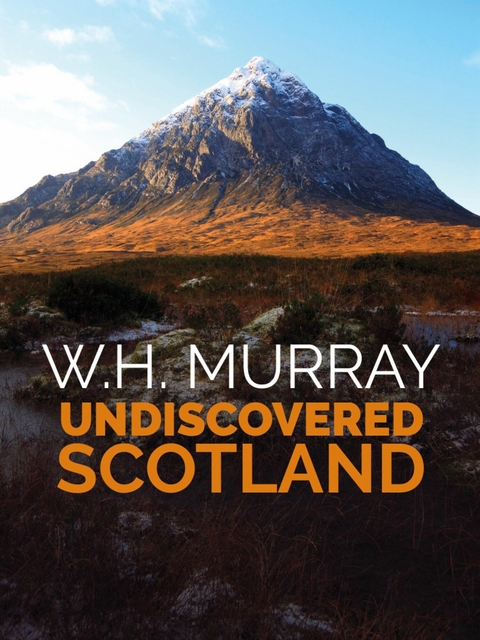
Undiscovered Scotland (eBook)
160 Seiten
Vertebrate Publishing (Verlag)
978-1-910240-29-8 (ISBN)
W.H. Murray was a Scottish mountaineer, writer and conservationist. Born in Liverpool in 1913, he grew up in Glasgow and began climbing in the mid-1930s, soon making numerous trips to Glen Coe and Ben Nevis. Captivated by winter climbing, he made a number of first ascents and early repeats of classic routes in the area. War interrupted Murray's climbing: 'To me and everyone I knew at the time, mobilisation spelled the ruin of everything we most valued in life.' Joining the Highland Light Infantry, he served as a captain in the Western Desert before being captured. A quote from Mountain magazine from 1979 describes the moment after his capture: 'To my astonishment, he [the German tank commander] forced a wry smile and asked in English, 'Aren't you feeling the cold?' ... I replied 'cold as a mountain top'. He looked at me, and his eyes brightened. 'Do you mean - you climb mountains?' He was a mountaineer. We both relaxed. He stuffed his gun away. After a few quick words - the Alps, Scotland, rock and ice - he could not do enough for me.' It was during his time in prison camps that he wrote his first book, Mountaineering in Scotland, using the only paper available to him - toilet paper. The Gestapo discovered and destroyed his first draft but, undeterred, Murray simply started again. After the war Murray lived and worked as a writer in Argyll. Mountaineering in Scotland was published in 1947 and hailed as a masterpiece Four years later came a companion volume dealing with his post-war climbs - Undiscovered Scotland. In the post-war years Murray took a major part in several Himalayan expeditions, most noticeably as a member of Eric Shipton's 1951 Everest Reconnaissance Expedition which explored the lower part of the route later used by the successful 1953 expedition. Murray was awarded an OBE in 1966, to go with numerous other awards which included the Mungo Park Medal of the Royal Geographical Society and honorary doctorates from the universities of Stirling and Strathclyde.
In Mountaineering in Scotland, climber and mountaineer W.H. Murray vividly describes some of the most sought-after and classic British climbs on rock and ice, including the Cuillin Ridge on Skye and Ben Nevis. The book written in secret on toilet paper in whilst Murray was a prisoner of war is infused with the sense of freedom and joy the author found in the mountains. He details the hardship and pleasure wrung from high camping in winter, climbs Clachaig Gully and makes the second winter ascent of Observatory Ridge. Murray recounts his adventures in Glencoe and the mountains beyond including a terrifying near-death experience at the falls of Falloch. Murray's first book, Mountaineering in Scotland is widely acknowledged as a classic of mountaineering literature. It inspirational prose as fresh now as when first published is bound to make a reader reach for their tent and head for the hills of Scotland. He asserts, 'Seeming danger ensures that on mountains, more than elsewhere, life may be lived at the full.'This is classic mountain climbing literature at its best.
Three years in central European prison camps. Release, April 1945.
During the fine weather of May I was unable to climb. At first if I walked for more than ten minutes I felt faint, and so felt no desire of mountains. My love of them was platonic, requiring of the body no act of outer expression. Four weeks later a first instalment of accumulating energy began to clamour for employment. My last climb in 1941 had been the Buachaille Etive Mor, and my first now could be none other. That is, if I could get up, which was exceedingly doubtful. My thoughts flew at once to Mackenzie. He was back in Glasgow. If any man could get me up Buachaille he could. So to Glasgow I went on 2nd June 1945.
After six years of war I could see no change at all in the Mackenzie – still lean and upright, hawk-eyed and brusque. He too was keen to get back to Glencoe. He had spent the last year or two in the School of Mountain Warfare, but not once had he enjoyed a good rock-climb. I told him gently that he could not get one now if he went with me. We must go up by the easiest possible route, go very slow, and not seriously expect to get to the top.
We left Glasgow in my old pre-war Morris eight very early in the morning. And a well nigh perfect morning it was. As the sun spread over Rannoch the genuine golden air of the good old days spread over the miles of moor (I had begun to wonder if my memories of such days were simple feats of imagination), and the liveliness of all spring mornings again entered into me. I felt now as Mackenzie always used to feel when the first snow of October came on the hills – days when MacAlpine drove us north from Glasgow, usually under rain clouds that boded ill for the weekend, but which had no damping effect on a Mackenzie wild with enthusiasm. His first sight of the snow-capped hills in Glencoe would conjure forth song and piercing whistles. ‘Bound along, Archie! – or the snow will be away before we get there!’ and similar exhortations inspired the driver.
So I ventured to suggest to Mackenzie that we must aim after all at getting to the summit. No half measures would do on a day like this. I would get to the top or drop dead trying. We came round the famous bend from the Blackmount – and there was Buachaille.
The day was again 8th September 1935, when the final entry in my diary reads: ‘I think that for me the most vivid experience was my first view of Buachaille Etive Mor. In the clear morning air every detail of the enormous, pointed cliffs stood out sharp. But the most striking moment was turning a corner of the road and seeing the great shape, black and intimidating, suddenly spring up in the moor. To me it was just unclimbable. I had never seen a hill like it before and my breath was taken away from me.’
Days of innocence! Maybe. But that was precisely how I felt now. As always before, we went straight to Coupall Bridge in Glen Etive, put on our boots, and started. It is the great advantage of this starting-point, as against that from Altnafeadh in Glencoe, that the long approach over the moor is lightened by the shapeliness of the peak, inspiring one from the front, drawing one on and up. Every crag and each long ridge points to the summit-cone. It is a symbolism not lost on the climber. What delight to the eye that was! To see again all the detail of the rocks, every crag of which I knew so well. The delight of recognition – a recognition of form, beauty, character, the lines of weakness and strength, every wrinkle, pit, and scar, on cliffs dove-grey and terracotta. From a distance only is the Buachaille black.
An avoidance of the cliffs, such as we contemplated, now seemed to me miserably inappropriate. Surely we might manage to get up an easy rock-climb? A very easy one – say Curved Ridge, if we roped? I made the suggestion somewhat timorously, for I feared to burden Mackenzie with a hundred and forty pounds of human baggage. He agreed and grinned. We changed direction slightly. The moor was drier underfoot than I ever remembered it – our very boots took on an unaccustomed bloom to the brush of old heather, and the swish, swish of the boots was a song of old, an heroic poetry and new live drama all rolled into one after the dead mud of the prison compounds. I reminded myself from time to time that I was free to go in any direction I wanted. I could turn right round and go right home. Glorious thought! So on I went, breathing in great draughts of moorland air, a free man with a free wind blowing on his right cheek, and sun smiting his left, the scent of the year’s new thyme at his nostril, and the swish of dry heather round his boots. Rock in front. I stopped. ‘Bill,’ I said, ‘maybe we could manage Central Buttress?’
‘Ha! now you ’re talking!’ exclaimed Mackenzie. ‘We could manage it if we kept to a V-diff.’ We changed direction.
We scrambled upwards over heathery outcrops to the base of Central Buttress, and moved rightward to the north face. We roped. I hesitated for a moment over the bowline knot, but tied it first time. I was greatly relieved. It would have embarrassed the Mackenzie to have had to tie it for me. He started up the first pitch and ran out about sixty feet. Then he turned and was ready for me. Now was the test. I looked at the rock, light-grey, crystalline, very rough – and so very steep. I stood back and chose my holds. What would happen? Was the old skill lost? – rock-climbing a thing of the past? I gave myself, as it were, a prod, and climbed.
At the very instant my hands and feet came on the rock six years rolled away in a flash. The rock was not strange, but familiar. At each move I was taking the right holds at the right time – but no, I did not ‘take’ the holds – of their own accord they came to me. Hand, foot, and eye – nerve and muscle – they were co-ordinating, and my climbing was effortless. I reached the top feeling trust in rock and, what in the circumstances was far more wonderful, trust in myself. And also, I should add, gratitude for the Mackenzie, from whom ten years ago I had learned much of my rock-snow-ice climbing.
The lower part of the north face goes up by a series of rough walls to the Heather Ledge, which divides the buttress about three hundred feet up. The last wall on this lower part is split near its top by a short crack at a high angle. The crack was my next important test – the test for exposure. For although the holds are good the body is forced out of balance over a long drop. When I came to make the move it certainly scared me, but the point was that I could control myself. I got up. The true testing question, of course, for progress in rock-, snow-, or ice-craft is not ‘Did you get up?’ but rather ‘Did you enjoy getting up?’ – if not always just as the moves are made, then very shortly afterwards. I was able to answer ‘Yes’ to my test, with the appropriate qualification. This meant that we could safely deal with the steeper and more difficult upper buttress.
We had a choice of four routes and I left the decision to Mackenzie. He chose his own Slanting Ledge route, which starts right in the middle of the buttress. This would certainly be less exacting than a continuation by the north face climb, the difficulties being not less in standard or exposure, but shorter in length.
On Heather Ledge we lay back and rested a while. It is the great merit of Central Buttress that it faces south-east – the sunniest cliff in Glencoe and Glen Etive. And Heather Ledge is a balcony, wide of prospect and fit for philosopher kings, where the governments of the earth are measured against the government of the firmament, and fall into perspective, and are made humble. To me, on the Heather Ledge, the fruits of the first were pitiful masses of humanity still crowding the barbed-wire compounds of Europe, and of the other, the mountain world. Everything that is wide and boundless and free, and which is therefore dear to the heart of a mountaineer, is here exemplified; the skies seem vaster than elsewhere, stretching to horizons too far to be identified. The very winds blow more fresh and clean. They purify – give health and life and power to the souls of men imprisoned in flesh and bone and long walled-up in the concrete of the barrack cities. They are purifying winds of the free firmament. To their influence aspire multitudes of men, ringed by the red-rusted wire of mud compounds, beyond and below the rim of the horizon, where governments of the earth sow and harvest. To such men they are true symbols of the winds of the spirit.
All men do not like mountains. It may be that many hate them. But they all love the free adventure and beauty to be found on mountains – or should I say to be won?
‘Time’s up!’ said Mackenzie. We walked to the highest point of Heather Ledge. On the nearly perpendicular face above, a ledge ran forty feet diagonally left. We climbed without much difficulty to its top end, where we turned a corner on to a face somewhat less steep. This wall had good holds, on which we climbed until the increasing angle forced Mackenzie to make a long right traverse on rocks little less than vertical, and most exposed (as much so as anything on Rannoch Wall). He halted; then climbed straight up, advancing slowly and obviously having trouble in getting suitable holds. I remembered that on the first ascent eight years ago Mackenzie had nailed the pitch twice. But that was during a rainstorm in the late afternoon, and the pitons had been removed. I watched him closely, saw him resist the temptation to hug the rock, and deliberately force his body away from it, so that he could go up in balance on holds that were not good...
| Erscheint lt. Verlag | 25.8.2015 |
|---|---|
| Verlagsort | London |
| Sprache | englisch |
| Themenwelt | Literatur ► Biografien / Erfahrungsberichte |
| Literatur ► Romane / Erzählungen | |
| Sachbuch/Ratgeber ► Geschichte / Politik | |
| Sachbuch/Ratgeber ► Sport | |
| Reisen ► Reiseführer ► Europa | |
| Reisen ► Sport- / Aktivreisen | |
| Schlagworte | alastair borthwick • ben nevis book • Eric Shipton • scottish climbing history • the history of rock climbing • wh murray the evidence of things not seen • wh murray undiscovered scotland • wh murray undiscovered scotland, wh murray the evidence of things not seen, scottish climbing history, the history of rock climbing, ben nevis book, alastair borthwick, eric shipton |
| ISBN-10 | 1-910240-29-X / 191024029X |
| ISBN-13 | 978-1-910240-29-8 / 9781910240298 |
| Informationen gemäß Produktsicherheitsverordnung (GPSR) | |
| Haben Sie eine Frage zum Produkt? |
 EPUB (Wasserzeichen)
DRM: Digitales Wasserzeichen
Dieses eBook enthält ein digitales Wasserzeichen und ist damit für Sie personalisiert. Bei einer missbräuchlichen Weitergabe des eBooks an Dritte ist eine Rückverfolgung an die Quelle möglich.
Dateiformat: EPUB (Electronic Publication)
EPUB ist ein offener Standard für eBooks und eignet sich besonders zur Darstellung von Belletristik und Sachbüchern. Der Fließtext wird dynamisch an die Display- und Schriftgröße angepasst. Auch für mobile Lesegeräte ist EPUB daher gut geeignet.
Systemvoraussetzungen:
PC/Mac: Mit einem PC oder Mac können Sie dieses eBook lesen. Sie benötigen dafür die kostenlose Software Adobe Digital Editions.
eReader: Dieses eBook kann mit (fast) allen eBook-Readern gelesen werden. Mit dem amazon-Kindle ist es aber nicht kompatibel.
Smartphone/Tablet: Egal ob Apple oder Android, dieses eBook können Sie lesen. Sie benötigen dafür eine kostenlose App.
Geräteliste und zusätzliche Hinweise
Buying eBooks from abroad
For tax law reasons we can sell eBooks just within Germany and Switzerland. Regrettably we cannot fulfill eBook-orders from other countries.
aus dem Bereich