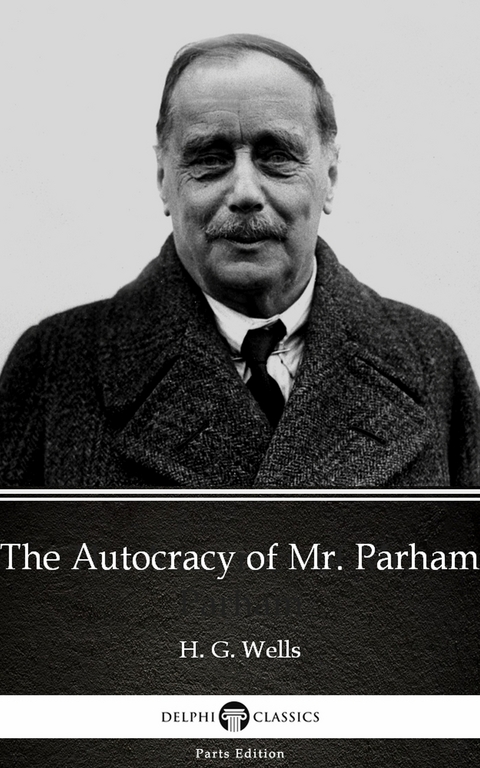
Autocracy of Mr. Parham by H. G. Wells (Illustrated) (eBook)
185 Seiten
Publishdrive (Verlag)
978-1-78656-596-9 (ISBN)
Having established their name as the leading publisher of classic literature and art, Delphi Classics produce publications that are individually crafted with superior formatting, while introducing many rare texts for the first time in digital print. The Delphi Classics edition of Wells includes original annotations and illustrations relating to the life and works of the author, as well as individual tables of contents, allowing you to navigate eBooks quickly and easily.
eBook features:* The complete unabridged text of 'The Autocracy of Mr. Parham'
* Beautifully illustrated with images related to Wells's works
* Individual contents table, allowing easy navigation around the eBook
* Excellent formatting of the textPlease visit www.delphiclassics.com to learn more about our wide range of titles
This eBook features the unabridged text of 'The Autocracy of Mr. Parham' from the bestselling edition of 'The Complete Works of H. G. Wells'. Having established their name as the leading publisher of classic literature and art, Delphi Classics produce publications that are individually crafted with superior formatting, while introducing many rare texts for the first time in digital print. The Delphi Classics edition of Wells includes original annotations and illustrations relating to the life and works of the author, as well as individual tables of contents, allowing you to navigate eBooks quickly and easily.eBook features:* The complete unabridged text of 'The Autocracy of Mr. Parham'* Beautifully illustrated with images related to Wells's works* Individual contents table, allowing easy navigation around the eBook* Excellent formatting of the textPlease visit www.delphiclassics.com to learn more about our wide range of titles
I. — INTRODUCES MR. PARHAM AND SIR BUSSY WOODCOCK
For a time Mr. Parham was extremely coy about Sir Bussy Woodcock’s invitation to assist at a séance.
Mr. Parham did not want to be drawn into this séance business. At the same time he did not want to fall out of touch with Sir Bussy Woodcock.
Sir Bussy Woodcock was one of those crude plutocrats with whom men of commanding intelligence, if they have the slightest ambition to be more than lookers-on at the spectacle of life, are obliged to associate nowadays. These rich adventurers are, under modern conditions, the necessary interpreters between high thought and low reality. It is regrettable that such difficult and debasing intervention should be unavoidable, but it seems to be so in this inexplicable world. Man of thought and man of action are mutually necessary — or, at any rate, the cooperation seems to be necessary to the man of thought. Plato, Confucius, Machiavelli had all to seek their princes. Nowadays, when the stuffing is out of princes, men of thought must do their best to use rich men.
Rich men amenable to use are hard to find and often very intractable when found. There was much in Sir Bussy, for example, that a fine intelligence, were it not equipped with a magnificent self-restraint, might easily have found insupportable. He was a short ruddy freckled man with a nose sculptured in the abrupt modern style and a mouth like a careless gash; he was thickset, a thing irritating in itself to an associate of long slender lines, and he moved with an impulsive rapidity of movement that was startling often and testified always to a total lack of such inhibitions as are inseparable from a cultivated mind. His manners were — voracious. When you talked to him he would jump suddenly into your pauses, and Mr. Parham, having long been accustomed to talk to muted undergraduates, had, if anything, developed his pauses. Half the good had gone from Mr. Parham if you robbed him of these significant silences. But Sir Bussy had no sense of significant silences. When you came to a significant silence, he would ask, “Meantersay?” in an entirely devastating manner. And he was always saying, “Gaw.” Continually he said it with a variety of intonations, and it never seemed to be addressed to anyone in particular. It meant nothing, or, what was more annoying, it might mean anything.
The fellow was of lowly extraction. His father had driven a hansom cab in London, while his mother was a nurse in a consumption hospital at Hampstead — the “Bussy” came from one of her more interesting patients — and their son, already ambitious at fourteen, had given up a strenuous course of Extension Lectures for an all-time job with a garrulous advertisement contractor, because, said he, there was “no GO in the other stuff.” The other “stuff,” if you please, was Wordsworth, the Reformation, Vegetable Morphology, and Economic History as interpreted by fastidious-minded and obscurely satirical young gentlemen from the elder universities.
Mr. Parham, tolerant, broad-minded, and deliberately quite modern, was always trying to forget these things. He never really forgot them, but whenever he and Sir Bussy were together he was always trying very hard to do so. Sir Bussy’s rise to wealth and power from such beginnings was one of the endless romances of modern business. Mr. Parham made a point of knowing as little about it as possible.
There the man was. In a little less than a quarter of a century, while Mr. Parham had been occupied chiefly with imperishable things — and marking examination papers upon them — Sir Bussy had become the master of a vast quantity of transitory but tangible phenomena which included a great advertising organization, an important part of the retail provision trade, a group of hotels, plantations in the tropics, cinema theatres, and many other things felt rather than known by Mr. Parham. Over these ephemerons Sir Bussy presided during those parts of his days that were withdrawn from social life, and occasionally even when he was existing socially he was summoned to telephones or indulged in inaudible asides to mysterious young men who sprang from nowhere on their account. As a consequence of these activities, always rather obscure to Mr. Parham, Sir Bussy lived in the midst of a quite terrific comfort and splendour surrounded by an obedience and a dignified obsequiousness that might have overawed a weaker or a vulgarer mind than Mr. Parham’s altogether. He appeared in a doorway at night, and marvellous chauffeurs sprang out of the darkness to the salute at his appearance; he said “Gaw,” and great butlers were ashamed. In a more luminous world things might have been different, but in this one Sir Bussy’s chauffeurs plainly regarded Mr. Parham as a rather unaccountable parcel which Sir Bussy was pleased to send about, and though the household manservants at Buntincombe, Carfex House, Marmion House, and the Hangar treated Mr. Parham as a gentleman, manifestly they did so rather through training than perception. A continual miracle, Sir Bussy was. He had acquired a colossal power of ordering people about, and it was evident to Mr. Parham that he had not the slightest idea what on the whole he wanted them to do. Meanwhile he just ordered them about. It was natural for Mr. Parham to think, “If I had the power he has, what wonderful things I could achieve.”
For instance, Sir Bussy might make history.
Mr. Parham was a lifelong student and exponent of history and philosophy. He had produced several studies — mainly round and about Richelieu and going more deeply into the mind of Richelieu than anyone has ever done before — and given short special courses upon historical themes; he had written a small volume of essays; he was general editor of Fosdyke’s popular “Philosophy of History” series, and he would sometimes write reviews upon works of scholarly distinction, reviews that appeared (often shockingly cut and mutilated) in the Empire, the Weekly Philosopher, and the Georgian Review. No one could deal with a new idea struggling to take form and wave it out of existence again more neatly and smilingly than Mr. Parham. And loving history and philosophy as he did, it was a trouble to his mind to feel how completely out of tune was the confusion of current events with anything that one could properly call fine history or fine philosophy. The Great War he realized was History, though very lumpish, brutalized, and unmanageable, and the Conference of Versailles was history also — in further declination. One could still put that Conference as a drama between this Power and that, talk of the conflict for “ascendency,” explain the “policy” of this or that man or this or that foreign office subtly and logically.
But from about 1919 onward everything had gone from bad to worse. Persons, events, had been deprived of more and more significance. Discordance, a disarray of values, invaded the flow of occurrence. Take Mr. Lloyd George, for example. How was one to treat a man like that? After a climax of the Versailles type the proper way was to culminate and let the historians get to work, as Woodrow Wilson indeed had done, and as Lincoln or Sulla or Cæsar or Alexander did before him. They culminated and rounded off, inconvenient facts fell off them bit by bit, and more and more surely could they be treated HISTORICALLY. The reality of history broke through superficial appearance; the logic of events was made visible.
But now, where were the Powers and what were the forces? In the face of such things as happen to-day this trained historian felt like a skilled carver who was asked to cut up soup. Where were the bones? — any bones? A man like Sir Bussy ought to be playing a part in a great struggle between the New Rich and the Older Oligarchy; he ought to be an Equestrian pitted against the Patricians. He ought to round off the Close of Electoral Democracy. He ought to embody the New Phase in British affairs — the New Empire. But did he? Did he stand for anything at all? There were times when Mr. Parham felt that if he could not make Sir Bussy stand for something, something definitely, formally and historically significant, his mind would give way altogether.
Surely the ancient and time-honoured processes of history were going on still — surely they were going on. Or what could be going on? Security and predominance — in Europe, in Asia, in finance — were gravely discussed by Mr. Parham and his kindred souls in the more serious weekly and monthly reviews. There were still governments and foreign offices everywhere, and they went through the motions of a struggle for world ascendency according to the rules, decently and in order. Nothing of the slightest importance occurred now between the Powers that was not strictly confidential. Espionage had never been so universal, conscientious, and respected, and the double cross of Christian diplomacy ruled the skies from Washington to Tokio. Britain and France, America, Germany, Moscow cultivated navies and armies and carried on high dignified diplomacies and made secret agreements with and against each other just as though there had never been that stupid talk about “a war to end war.” Bolshevik Moscow, after an alarming opening phase, had settled down into the best tradition of the Czar’s Foreign Office. If Mr. Parham had been privileged to enjoy the intimacy of statesmen like Sir Austen Chamberlain and Mr. Winston Churchill or M. Poincaré, and if he could have dined with some of them, he felt sure that after dinner, with the curtains drawn and the port and the cigars moving with a pensive...
| Erscheint lt. Verlag | 17.7.2017 |
|---|---|
| Reihe/Serie | Delphi Parts Edition (H. G. Wells) | Delphi Parts Edition (H. G. Wells) |
| Sprache | englisch |
| Themenwelt | Literatur ► Anthologien |
| Literatur ► Klassiker / Moderne Klassiker | |
| Literatur ► Romane / Erzählungen | |
| Schlagworte | complete • Island • Kipps • Polly • Science • Time • war |
| ISBN-10 | 1-78656-596-X / 178656596X |
| ISBN-13 | 978-1-78656-596-9 / 9781786565969 |
| Informationen gemäß Produktsicherheitsverordnung (GPSR) | |
| Haben Sie eine Frage zum Produkt? |
 EPUB (Adobe DRM)
Größe: 1,2 MB
Kopierschutz: Adobe-DRM
Adobe-DRM ist ein Kopierschutz, der das eBook vor Mißbrauch schützen soll. Dabei wird das eBook bereits beim Download auf Ihre persönliche Adobe-ID autorisiert. Lesen können Sie das eBook dann nur auf den Geräten, welche ebenfalls auf Ihre Adobe-ID registriert sind.
Details zum Adobe-DRM
Dateiformat: EPUB (Electronic Publication)
EPUB ist ein offener Standard für eBooks und eignet sich besonders zur Darstellung von Belletristik und Sachbüchern. Der Fließtext wird dynamisch an die Display- und Schriftgröße angepasst. Auch für mobile Lesegeräte ist EPUB daher gut geeignet.
Systemvoraussetzungen:
PC/Mac: Mit einem PC oder Mac können Sie dieses eBook lesen. Sie benötigen eine
eReader: Dieses eBook kann mit (fast) allen eBook-Readern gelesen werden. Mit dem amazon-Kindle ist es aber nicht kompatibel.
Smartphone/Tablet: Egal ob Apple oder Android, dieses eBook können Sie lesen. Sie benötigen eine
Geräteliste und zusätzliche Hinweise
Buying eBooks from abroad
For tax law reasons we can sell eBooks just within Germany and Switzerland. Regrettably we cannot fulfill eBook-orders from other countries.
EPUB (Ohne DRM)Digital Rights Management: ohne DRM
Dieses eBook enthält kein DRM oder Kopierschutz. Eine Weitergabe an Dritte ist jedoch rechtlich nicht zulässig, weil Sie beim Kauf nur die Rechte an der persönlichen Nutzung erwerben.
Dateiformat: EPUB (Electronic Publication)
EPUB ist ein offener Standard für eBooks und eignet sich besonders zur Darstellung von Belletristik und Sachbüchern. Der Fließtext wird dynamisch an die Display- und Schriftgröße angepasst. Auch für mobile Lesegeräte ist EPUB daher gut geeignet.
Systemvoraussetzungen:
PC/Mac: Mit einem PC oder Mac können Sie dieses eBook lesen. Sie benötigen dafür die kostenlose Software Adobe Digital Editions.
eReader: Dieses eBook kann mit (fast) allen eBook-Readern gelesen werden. Mit dem amazon-Kindle ist es aber nicht kompatibel.
Smartphone/Tablet: Egal ob Apple oder Android, dieses eBook können Sie lesen. Sie benötigen dafür eine kostenlose App.
Geräteliste und zusätzliche Hinweise
Buying eBooks from abroad
For tax law reasons we can sell eBooks just within Germany and Switzerland. Regrettably we cannot fulfill eBook-orders from other countries.
aus dem Bereich