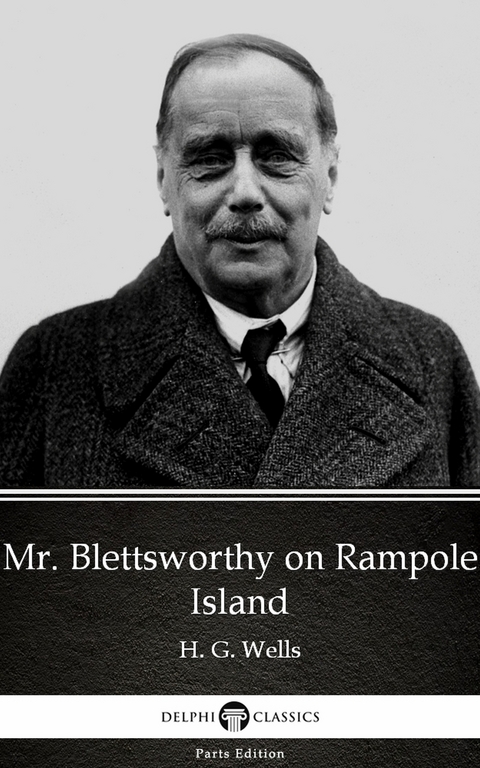
Mr. Blettsworthy on Rampole Island by H. G. Wells (Illustrated) (eBook)
163 Seiten
Publishdrive (Verlag)
978-1-78656-595-2 (ISBN)

Having established their name as the leading publisher of classic literature and art, Delphi Classics produce publications that are individually crafted with superior formatting, while introducing many rare texts for the first time in digital print. The Delphi Classics edition of Wells includes original annotations and illustrations relating to the life and works of the author, as well as individual tables of contents, allowing you to navigate eBooks quickly and easily.
eBook features:* The complete unabridged text of 'Mr. Blettsworthy on Rampole Island'
* Beautifully illustrated with images related to Wells's works
* Individual contents table, allowing easy navigation around the eBook
* Excellent formatting of the textPlease visit www.delphiclassics.com to learn more about our wide range of titles
This eBook features the unabridged text of 'Mr. Blettsworthy on Rampole Island' from the bestselling edition of 'The Complete Works of H. G. Wells'. Having established their name as the leading publisher of classic literature and art, Delphi Classics produce publications that are individually crafted with superior formatting, while introducing many rare texts for the first time in digital print. The Delphi Classics edition of Wells includes original annotations and illustrations relating to the life and works of the author, as well as individual tables of contents, allowing you to navigate eBooks quickly and easily.eBook features:* The complete unabridged text of 'Mr. Blettsworthy on Rampole Island'* Beautifully illustrated with images related to Wells's works* Individual contents table, allowing easy navigation around the eBook* Excellent formatting of the textPlease visit www.delphiclassics.com to learn more about our wide range of titles
CHAPTER THE SECOND
Tells how Mr. Blettsworthy put out to Sea and of his Voyage and how he was Shipwrecked and left on a Derelict Ship and how Savages appeared and captured him.
§ 1. MR BLETTSWORTHY CHOOSES A SHIP
IN the presence of Mr. Ferndyke I could be almost the Blettsworthy I had been before my disillusionment, but when after a second interview in London in which his suggestion was more fully developed and accepted, I went out from his office across the pleasant spaces of Lincoln’s Inn into the busy gully of Chancery Lane, I felt a very insecure and uncertain being indeed, with a desolating need of reassurance. The echoes of hard laughter and foul memories clung to me from my days of anonymous vice, and I had learnt something of the meanness of trusted fellow-creatures, and something also of the vile cellars in my own foundations. Mr. Ferndyke, on this second occasion, had given me exactly twenty minutes of his time, glanced up at his clock and bowed me out. He was very helpful, but he was a transitory helper. I wanted a Friend. I wanted a Friend who would listen unendingly and with comforting interpretations to my personal exposition of my perplexities.
“The sea! The round world! Mankind!” Fine words they were, but I wished I had made a better response, wished I had been able to make a better response.
For example I might have said; “Right you are, sir. Trust a Blettsworthy to make good.”
Queer how one can think of saying to a man things one could never possibly say to him.
I liked young Romer, who was not a dozen years my senior, and he too gave me all the help he could in the time at his disposal. In his case that was nearly half a day. He talked of ships that were going here and there, and their reputations and merits. Should he give me letters of introduction to people at the ports of call? Mostly they would be business correspondents, but some I might find pleasant He fingered a list Would I like to go to Manaos right up the Amazons? That I could do quite soon. An interesting line would be the Canaries, and then across to Brazil and down to Rio. Or — yes — we could skip the Canaries. Or I could go East. A big consignment of stoppered bottles and cheap sewing machines, celluloid dolls, brass images, paraffin lamps and cotton thread, patent medicines, infant food and German clocks were going to Burmah. What of Burmah? Would I like to look at an Atlas in his anteroom for a bit, with his list before me?
It was heartening, it gave me a fine sense of mastery to take the whole world and peruse it like a bill of fare.
In the end we settled on the Golden Lion, bound in the first instance for Pernambuco and Rio.
§ 2. MR. BLETTSWORTHY PUTS OUT TO SEA
HOW many thousands of men must have shared with me the delusion of enlargement I experienced as I stood on the quivering deck of the Golden Lion and watched the shores of Kent and Essex gliding past me and reefing themselves up towards the London I had left behind! It seemed to me that evening that I was passing out from a little life to freedom and adventure, and that the man I was going to find was bound to be all the better for the taste of salt in the search.
The vast, low, crowded realms of the docks on either hand, where houses, inns and churches appear to float on the water amongst ships and barges, had gone; where Tilbury’s ferryboat pants across to Gravesend, little yellow lights popped out one by one and soon multiplied abundantly, and now the great city itself was no more than a fuliginous smear beneath the afterglow, and the flats of Canvey Island were streaming by on one hand and the low soft hills of Kent upon the other. The blues of twilight deepened towards darkness and Southend’s glittering sea-front was in line with us, and the long pier pointed at us and then turned its aim towards London. The Kentish watering-places, mere stains of illumination upon the selvage of the night, drifted by and passed away. Vivid eyes of light, yellow and red, that winked out and returned and winked out again in significant rhythm, and sweeping beams of whiteness, guided our outward course, closed in behind us and receded and sank, and at last, save for a remote uncommunicative musing ship or so, lit without regard to us, lit egotistically for its own protection, we were alone and at sea.
And I felt that night that I had come out into something vast, whereas indeed I was for the first time in my life a prisoner.
The literature of the world, and particularly the literature of us who read English, is full of the assumption that to go to sea in a ship is to go out into the “open.” But there is in truth no “open “ in the world but the roads and paths in a land of kindly people. The lights and multitude are left behind, the ample space in which one can move, the events and the changing scene. Nothing remains at last but night — blank night. You go below, come up again, pace the restricted deck, feeling that you savour immensity. You turn in and sleep. The creaking dawn seeps into your darkness and makes the swinging oil-lamp smoky yellow.
You stare about you before you realise your new circumstances. You recognise your things still half unpacked. Everything is engaged in mysteriously pivoted motions and slowly changing its level towards you. The sky outside and the horizon have joined in that slow unending dance. You get up and dress staggeringly, and blunder up the gangway to the deck and clutch the rail. Water. An immeasurable quantity and extent of water about you and below, and wet and windy air above; these are the enormous and invisible walls of your still unrealised incarceration. Every prison on land has at least a door upon the world, even though that door is locked, but this prison needs no locks to enforce your complete captivity.
Mr. Ferndyke had meant well in sending me to sea. I think he had judged me very acutely, but he had no judgment about the sea. He believed by habit and tradition that to go to sea, and particularly in a ship not adapted to passengers, is in itself a lovely and exalting experience. So my uncle would have thought also. Britannia our land rules and is ruled by the waves, and the wounded soul of the Briton in trouble returns to them as a child to its mother. The sea winds search our island from end to end, and it is the peculiar blessedness of England never to be a hundred miles from the redeeming waters. All of us Blettsworthys, it is understood, revert to the sea by instinct. Directly we get our sea legs we are happy and at home. I did my best to feel happy and at home, but that morning my sea legs had still to mature. Yet I clung to the rail and waved my head from side to side like a sea dog, and hummed the refrain of a nautical song — the only nautical song I knew. I can still recall the words, because suddenly I became aware of their peculiar incongruity to my circumstances, and broke off in mid-refrain.
“See there she stands and waves her hands to Jack at sea,
And every day while I’m away she’ll watch for me.
A sailor’s lass, a sailor’s star should be.
Ye ho, my lads, heave ho!”
I was crooning that extremely inappropriate song to keep my doubts off. Already there were doubts. I must be in the key of my shipmates whom I knew from every writer in our language, were specially, distinctively and even extravagantly, men; salted men; hard and tough upon the exterior no doubt, but tender and delicate beyond description at the core. A certain ungraciousness in the captain’s overnight reception of me, a certain vileness and violence in his diction — he had interfered to contradict the mate as the ship had manoeuvred down the river, were merely the superficial roughness on the rind of this precious human fruit.
Our wake trailed away like an ineffective story and lost itself behind, and our smoke streamed far to leeward. Someone was partly visible at the wheel in the little house upon the bridge, and there was a remote head and back forward; otherwise I could see no shipmates at all. Swaying and tumbling water, a greyish-blue sky and nothing but ourselves.
This, with a few variations of sky and wave, was, I reflected, the appearance of three-quarters of the globe. This was the normal scenery of the planet Earth. Landscape was the exception. It was well to remember that. The poor crowded souls ashore were turning their backs on three-quarters of our world. I felt a moral disapproval of such behaviour.
I did my best to appreciate the honest manliness of the five fellow-creatures who shared this detached fragment of man’s world with me. For five souls was now for an indefinite time the full tale of my kind. Of the rest of the population of the ship, with the exception of Vett, our deft little steward, I saw hardly anything before our landing at Pernambuco.
A glimpse of a stoker taking the air or of three or four men engaged upon some incomprehensible job under the direction of the second officer, or the sound of a concertina laboriously acquiring and never achieving a music-hall tune and suffering sudden and apparently violent extinctions, and small knots of men forward sitting about on a fine evening or so, gossiping and sewing and the like, were all the reminders I had of the lower classes in our little sample of human society. Between them and ourselves a great gulf was fixed. Their motives, it was understood, were not our motives, nor their thoughts our thoughts. We six were of a finer clay and led a higher life. We spoke to them sparingly and distantly. It was as...
| Erscheint lt. Verlag | 17.7.2017 |
|---|---|
| Reihe/Serie | Delphi Parts Edition (H. G. Wells) | Delphi Parts Edition (H. G. Wells) |
| Sprache | englisch |
| Themenwelt | Literatur ► Anthologien |
| Literatur ► Klassiker / Moderne Klassiker | |
| Literatur ► Romane / Erzählungen | |
| Schlagworte | complete • Island • Kipps • Polly • Science • Time • war |
| ISBN-10 | 1-78656-595-1 / 1786565951 |
| ISBN-13 | 978-1-78656-595-2 / 9781786565952 |
| Informationen gemäß Produktsicherheitsverordnung (GPSR) | |
| Haben Sie eine Frage zum Produkt? |
 EPUB (Adobe DRM)
Größe: 1,2 MB
Kopierschutz: Adobe-DRM
Adobe-DRM ist ein Kopierschutz, der das eBook vor Mißbrauch schützen soll. Dabei wird das eBook bereits beim Download auf Ihre persönliche Adobe-ID autorisiert. Lesen können Sie das eBook dann nur auf den Geräten, welche ebenfalls auf Ihre Adobe-ID registriert sind.
Details zum Adobe-DRM
Dateiformat: EPUB (Electronic Publication)
EPUB ist ein offener Standard für eBooks und eignet sich besonders zur Darstellung von Belletristik und Sachbüchern. Der Fließtext wird dynamisch an die Display- und Schriftgröße angepasst. Auch für mobile Lesegeräte ist EPUB daher gut geeignet.
Systemvoraussetzungen:
PC/Mac: Mit einem PC oder Mac können Sie dieses eBook lesen. Sie benötigen eine
eReader: Dieses eBook kann mit (fast) allen eBook-Readern gelesen werden. Mit dem amazon-Kindle ist es aber nicht kompatibel.
Smartphone/Tablet: Egal ob Apple oder Android, dieses eBook können Sie lesen. Sie benötigen eine
Geräteliste und zusätzliche Hinweise
Buying eBooks from abroad
For tax law reasons we can sell eBooks just within Germany and Switzerland. Regrettably we cannot fulfill eBook-orders from other countries.
EPUB (Ohne DRM)Digital Rights Management: ohne DRM
Dieses eBook enthält kein DRM oder Kopierschutz. Eine Weitergabe an Dritte ist jedoch rechtlich nicht zulässig, weil Sie beim Kauf nur die Rechte an der persönlichen Nutzung erwerben.
Dateiformat: EPUB (Electronic Publication)
EPUB ist ein offener Standard für eBooks und eignet sich besonders zur Darstellung von Belletristik und Sachbüchern. Der Fließtext wird dynamisch an die Display- und Schriftgröße angepasst. Auch für mobile Lesegeräte ist EPUB daher gut geeignet.
Systemvoraussetzungen:
PC/Mac: Mit einem PC oder Mac können Sie dieses eBook lesen. Sie benötigen dafür die kostenlose Software Adobe Digital Editions.
eReader: Dieses eBook kann mit (fast) allen eBook-Readern gelesen werden. Mit dem amazon-Kindle ist es aber nicht kompatibel.
Smartphone/Tablet: Egal ob Apple oder Android, dieses eBook können Sie lesen. Sie benötigen dafür eine kostenlose App.
Geräteliste und zusätzliche Hinweise
Buying eBooks from abroad
For tax law reasons we can sell eBooks just within Germany and Switzerland. Regrettably we cannot fulfill eBook-orders from other countries.
aus dem Bereich