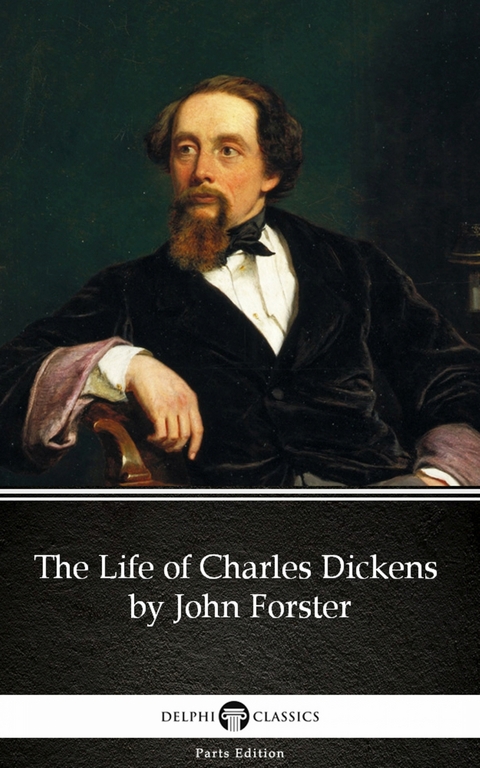
Life of Charles Dickens by John Forster (Illustrated) (eBook)
623 Seiten
Publishdrive (Verlag)
978-1-78656-734-5 (ISBN)
This eBook features the unabridged text of 'The Life of Charles Dickens by John Forster' from the bestselling edition of 'The Complete Works of Charles Dickens'.
Having established their name as the leading publisher of classic literature and art, Delphi Classics produce publications that are individually crafted with superior formatting, while introducing many rare texts for the first time in digital print. The Delphi Classics edition of Dickens includes original annotations and illustrations relating to the life and works of the author, as well as individual tables of contents, allowing you to navigate eBooks quickly and easily.
eBook features:
* The complete unabridged text of 'The Life of Charles Dickens by John Forster'
* Beautifully illustrated with images related to Dickens's works
* Individual contents table, allowing easy navigation around the eBook
* Excellent formatting of the textPlease visit www.delphiclassics.com to learn more about our wide range of titles
This eBook features the unabridged text of 'The Life of Charles Dickens by John Forster' from the bestselling edition of 'The Complete Works of Charles Dickens'. Having established their name as the leading publisher of classic literature and art, Delphi Classics produce publications that are individually crafted with superior formatting, while introducing many rare texts for the first time in digital print. The Delphi Classics edition of Dickens includes original annotations and illustrations relating to the life and works of the author, as well as individual tables of contents, allowing you to navigate eBooks quickly and easily.eBook features:* The complete unabridged text of The Life of Charles Dickens by John Forster * Beautifully illustrated with images related to Dickens s works* Individual contents table, allowing easy navigation around the eBook* Excellent formatting of the textPlease visit www.delphiclassics.com to learn more about our wide range of titles
CHAPTER I. CHILDHOOD
1812-1822.
Birth at Landport in Portsea — Family of John Dickens — Powers of Observation in Children — Two Years Old — In London, æt. 2-3 — In Chatham, æt. 4-9 — Vision of Boyhood — The Queer Small Child — Mother’s Teaching — Day-School in Rome Lane — Retrospects of Childhood — David Copperfield and Charles Dickens — Access to Small but Good Library — Tragedy-Writing — Comic-Song Singing — Cousin James Lamert — First taken to Theatre — At Mr. Giles’s School — Encored in the Recitations — Boyish Recollections — Birthplace of his Fancy — Last Night in Chatham — In London — First Impressions — Bayham Street, Camden-town — Faculty of Early Observation — His Description of his Father — Small Theatre made for him — Sister Fanny at Royal Academy of Music — Walks about London — Biography and Autobiography — At his Godfather’s and his Uncle’s — First Efforts at Description— “Res Angusta Domi” — Mother exerting Herself — Father in the Marshalsea — Visit to the Prison — Captain Porter — Old Friends disposed of — At the Pawnbroker’s.
Charles Dickens, the most popular novelist of the century, and one of the greatest humorists that England has produced, was born at Landport in Portsea on Friday, the 7th of February, 1812.
His father, John Dickens, a clerk in the Navy-pay office, was at this time stationed in the Portsmouth dockyard. He had made acquaintance with the lady, Elizabeth Barrow, who became afterwards his wife, through her elder brother, Thomas Barrow, also engaged on the establishment at Somerset House; and she bore him in all a family of eight children, of whom two died in infancy. The eldest, Fanny (born 1810), was followed by Charles (entered in the baptismal register of Portsea as Charles John Huffham, though on the very rare occasions when he subscribed that name he wrote Huffam); by another son, named Alfred, who died in childhood; by Letitia (born 1816); by another daughter, Harriet, who died also in childhood; by Frederick (born 1820); by Alfred Lamert (born 1822); and by Augustus (born 1827); of all of whom only the second daughter now survives.
Walter Scott tells us, in his fragment of autobiography, speaking of the strange remedies applied to his lameness, that he remembered lying on the floor in the parlor of his grandfather’s farm-house, swathed up in a sheepskin warm from the body of the sheep, being then not three years old. David Copperfield’s memory goes beyond this. He represents himself seeing so far back into the blank of his infancy as to discern therein his mother and her servant, dwarfed to his sight by stooping down or kneeling on the floor, and himself going unsteadily from the one to the other. He admits this may be fancy, though he believes the power of observation in numbers of very young children to be quite wonderful for its closeness and accuracy, and thinks that the recollection of most of us can go farther back into such times than many of us suppose. But what he adds is certainly not fancy. “If it should appear from anything I may set down in this narrative that I was a child of close observation, or that as a man I have a strong memory of my childhood, I undoubtedly lay claim to both of these characteristics.” Applicable as it might be to David Copperfield, this was simply and unaffectedly true of Charles Dickens.
He has often told me that he remembered the small front garden to the house at Portsea, from which he was taken away when he was two years old, and where, watched by a nurse through a low kitchen-window almost level with the gravel walk, he trotted about with something to eat, and his little elder sister with him. He was carried from the garden one day to see the soldiers exercise; and I perfectly recollect that, on our being at Portsmouth together while he was writing Nickleby, he recognized the exact shape of the military parade seen by him as a very infant, on the same spot, a quarter of a century before.
When his father was again brought up by his duties to London from Portsmouth, they went into lodgings in Norfolk Street, Middlesex Hospital; and it lived also in the child’s memory that they had come away from Portsea in the snow. Their home, shortly after, was again changed, on the elder Dickens being placed upon duty in Chatham dockyard; and the house where he lived in Chatham, which had a plain-looking whitewashed plaster front and a small garden before and behind, was in St. Mary’s Place, otherwise called the Brook, and next door to a Baptist meeting-house called Providence Chapel, of which a Mr. Giles, to be presently mentioned, was minister. Charles at this time was between four and five years old; and here he stayed till he was nine. Here the most durable of his early impressions were received; and the associations that were around him when he died were those which at the outset of his life had affected him most strongly.
The house called Gadshill Place stands on the strip of highest ground in the main road between Rochester and Gravesend. Often had we traveled past it together, years and years before it became his home, and never without some allusion to what he told me when first I saw it in his company, that amid the recollections connected with his childhood it held always a prominent place, for, upon first seeing it as he came from Chatham with his father, and looking up at it with much admiration, he had been promised that he might himself live in it, or in some such house, when he came to be a man, if he would only work hard enough. Which for a long time was his ambition. The story is a pleasant one, and receives authentic confirmation at the opening of one of his essays on traveling abroad, when as he passes along the road to Canterbury there crosses it a vision of his former self:
“So smooth was the old high-road, and so fresh were the horses, and so fast went I, that it was midway between Gravesend and Rochester, and the widening river was bearing the ships, white-sailed or black-smoked, out to sea, when I noticed by the wayside a very queer small boy.
“‘Holloa!’ said I to the very queer small boy, ‘where do you live?’
“‘At Chatham,’ says he.
“‘What do you do there?’ says I.
“‘I go to school,’ says he.
“I took him up in a moment, and we went on. Presently, the very queer small boy says, ‘This is Gadshill we are coming to, where Falstaff went out to rob those travelers, and ran away.’
“‘You know something about Falstaff, eh?’ said I.
“‘All about him,’ said the very queer small boy. ‘I am old (I am nine), and I read all sorts of books. But do let us stop at the top of the hill, and look at the house there, if you please!’
“‘You admire that house?’ said I.
“‘Bless you, sir,’ said the very queer small boy, ‘when I was not more than half as old as nine, it used to be a treat for me to be brought to look at it. And now I am nine, I come by myself to look at it. And ever since I can recollect, my father, seeing me so fond of it, has often said to me, If you were to be very persevering and were to work hard, you might some day come to live in it. Though that’s impossible!’ said the very queer small boy, drawing a low breath, and now staring at the house out of window with all his might.
“I was rather amazed to be told this by the very queer small boy; for that house happens to be my house, and I have reason to believe that what he said was true.”
The queer small boy was indeed his very self. He was a very little and a very sickly boy. He was subject to attacks of violent spasm which disabled him for any active exertion. He was never a good little cricket-player. He was never a first-rate hand at marbles, or peg-top, or prisoner’s base. But he had great pleasure in watching the other boys, officers’ sons for the most part, at these games, reading while they played; and he had always the belief that this early sickness had brought to himself one inestimable advantage, in the circumstance of his weak health having strongly inclined him to reading. It will not appear, as my narrative moves on, that he owed much to his parents, or was other than in his first letter to Washington Irving he described himself to have been, a “very small and not-over-particularly-taken-care-of boy;” but he has frequently been heard to say that his first desire for knowledge, and his earliest passion for reading, were awakened by his mother, who taught him the first rudiments not only of English, but also, a little later, of Latin. She taught him regularly every day for a long time, and taught him, he was convinced, thoroughly well. I once put to him a question in connection with this to which he replied in almost exactly the words he placed five years later in the mouth of David Copperfield: “I faintly remember her teaching me the alphabet; and when I look upon the fat black letters in the primer, the puzzling novelty of their shapes, and the easy good nature of O and S, always seem to present themselves before me as they used to do.”
Then followed the preparatory day-school, a school for girls and boys to which he went with his sister Fanny, and which was in a place called Rome (pronounced Room) Lane. Revisiting Chatham in his manhood, and looking for the place,...
| Erscheint lt. Verlag | 17.7.2017 |
|---|---|
| Reihe/Serie | Delphi Parts Edition (Charles Dickens) | Delphi Parts Edition (Charles Dickens) |
| Sprache | englisch |
| Themenwelt | Literatur ► Anthologien |
| Literatur ► Klassiker / Moderne Klassiker | |
| Literatur ► Romane / Erzählungen | |
| Schlagworte | bleak • Copperfield • Expectations • Nickleby • Novels • pickwick • Twist |
| ISBN-10 | 1-78656-734-2 / 1786567342 |
| ISBN-13 | 978-1-78656-734-5 / 9781786567345 |
| Informationen gemäß Produktsicherheitsverordnung (GPSR) | |
| Haben Sie eine Frage zum Produkt? |
 EPUB (Adobe DRM)
Größe: 2,8 MB
Kopierschutz: Adobe-DRM
Adobe-DRM ist ein Kopierschutz, der das eBook vor Mißbrauch schützen soll. Dabei wird das eBook bereits beim Download auf Ihre persönliche Adobe-ID autorisiert. Lesen können Sie das eBook dann nur auf den Geräten, welche ebenfalls auf Ihre Adobe-ID registriert sind.
Details zum Adobe-DRM
Dateiformat: EPUB (Electronic Publication)
EPUB ist ein offener Standard für eBooks und eignet sich besonders zur Darstellung von Belletristik und Sachbüchern. Der Fließtext wird dynamisch an die Display- und Schriftgröße angepasst. Auch für mobile Lesegeräte ist EPUB daher gut geeignet.
Systemvoraussetzungen:
PC/Mac: Mit einem PC oder Mac können Sie dieses eBook lesen. Sie benötigen eine
eReader: Dieses eBook kann mit (fast) allen eBook-Readern gelesen werden. Mit dem amazon-Kindle ist es aber nicht kompatibel.
Smartphone/Tablet: Egal ob Apple oder Android, dieses eBook können Sie lesen. Sie benötigen eine
Geräteliste und zusätzliche Hinweise
Buying eBooks from abroad
For tax law reasons we can sell eBooks just within Germany and Switzerland. Regrettably we cannot fulfill eBook-orders from other countries.
EPUB (Ohne DRM)Digital Rights Management: ohne DRM
Dieses eBook enthält kein DRM oder Kopierschutz. Eine Weitergabe an Dritte ist jedoch rechtlich nicht zulässig, weil Sie beim Kauf nur die Rechte an der persönlichen Nutzung erwerben.
Dateiformat: EPUB (Electronic Publication)
EPUB ist ein offener Standard für eBooks und eignet sich besonders zur Darstellung von Belletristik und Sachbüchern. Der Fließtext wird dynamisch an die Display- und Schriftgröße angepasst. Auch für mobile Lesegeräte ist EPUB daher gut geeignet.
Systemvoraussetzungen:
PC/Mac: Mit einem PC oder Mac können Sie dieses eBook lesen. Sie benötigen dafür die kostenlose Software Adobe Digital Editions.
eReader: Dieses eBook kann mit (fast) allen eBook-Readern gelesen werden. Mit dem amazon-Kindle ist es aber nicht kompatibel.
Smartphone/Tablet: Egal ob Apple oder Android, dieses eBook können Sie lesen. Sie benötigen dafür eine kostenlose App.
Geräteliste und zusätzliche Hinweise
Buying eBooks from abroad
For tax law reasons we can sell eBooks just within Germany and Switzerland. Regrettably we cannot fulfill eBook-orders from other countries.
aus dem Bereich