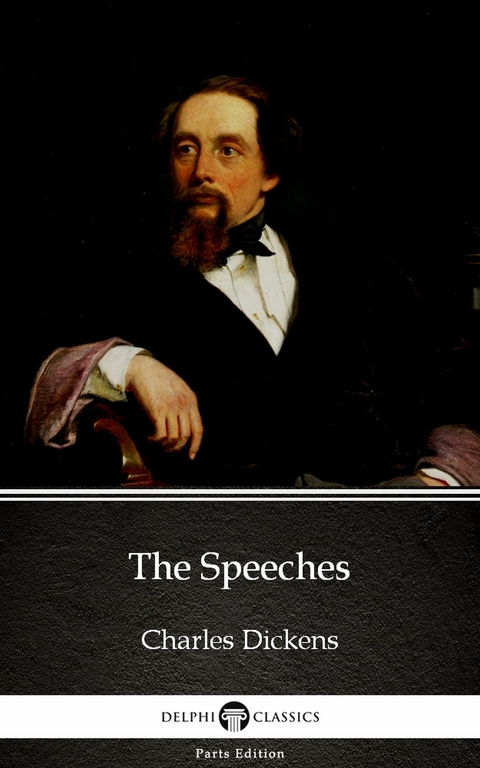
Speeches by Charles Dickens (Illustrated) (eBook)
205 Seiten
Publishdrive (Verlag)
978-1-78656-731-4 (ISBN)
Having established their name as the leading publisher of classic literature and art, Delphi Classics produce publications that are individually crafted with superior formatting, while introducing many rare texts for the first time in digital print. The Delphi Classics edition of Dickens includes original annotations and illustrations relating to the life and works of the author, as well as individual tables of contents, allowing you to navigate eBooks quickly and easily.
eBook features:* The complete unabridged text of 'The Speeches'
* Beautifully illustrated with images related to Dickens's works
* Individual contents table, allowing easy navigation around the eBook
* Excellent formatting of the textPlease visit www.delphiclassics.com to learn more about our wide range of titles
This eBook features the unabridged text of 'The Speeches' from the bestselling edition of 'The Complete Works of Charles Dickens'. Having established their name as the leading publisher of classic literature and art, Delphi Classics produce publications that are individually crafted with superior formatting, while introducing many rare texts for the first time in digital print. The Delphi Classics edition of Dickens includes original annotations and illustrations relating to the life and works of the author, as well as individual tables of contents, allowing you to navigate eBooks quickly and easily.eBook features:* The complete unabridged text of 'The Speeches'* Beautifully illustrated with images related to Dickens's works* Individual contents table, allowing easy navigation around the eBook* Excellent formatting of the textPlease visit www.delphiclassics.com to learn more about our wide range of titles
INTRODUCTION.
Charles Dickens was born at Landport, Portsmouth, on February 7, 1812. At that time his father, Mr. John Dickens, held an office in the Navy Pay Department, the duties of which obliged him to reside alternately at the principal naval stations of England. But on the conclusion of peace in 1815 a considerable reduction was made by Government in this branch of the public service. Mr. John Dickens, among others, was pensioned off, and he removed to London with his wife and children, when his son Charles was hardly four years of age.
No doubt the varied bustling scenes of life witnessed by Charles Dickens in his early years, had an influence on his mind that gave him a taste for observing the manners and mental peculiarities of different classes of people engaged in the active pursuits of life, and quickened a naturally lively perception of the ridiculous, for which he was distinguished even in boyhood.
It is curious to observe how similar opportunities of becoming acquainted practically with life, and the busy actors on its varied scenes, in very early life, appear to influence the minds of thinking and imaginative men in after-years. Goldsmith’s pedestrian excursions on the Continent, Bulwer’s youthful rambles on foot in England, and equestrian expeditions in France, and Maclise’s extensive walks in boyhood over his native county, and the mountains and valleys of Wicklow a little later, were fraught with similar results.
Charles Dickens was intended by his father to be an attorney. Nature and Mr. John Dickens happily differed on that point. London law may have sustained little injury in losing Dickens for “a limb.” English literature would have met with an irreparable loss, had she been deprived of him whom she delights to own as a favourite son.
Dickens, having decided against the law, began his career in “the gallery,” as a reporter on The True Sun; and from the first made himself distinguished and distinguishable among “the corps,” for his ability, promptness, and punctuality.
Remaining for a short term on the staff of this periodical, he seceded to The Mirror of Parliament, which was started with the express object of furnishing verbatim reports of the debates. It only lived, however, for two sessions.
The influence of his father, who on settling in the metropolis, had become connected with the London press, procured for Charles Dickens an appointment as short-hand reporter on the Morning Chronicle. To this period of his life he has made some graceful and interesting allusions in a speech delivered at the Second Anniversary of the Newspaper Press Fund, about five years ago.
It was in The Monthly Magazine of January, 1834, before he had quite attained his twenty-second year, that Charles Dickens made his first appearance in print as a story-teller. Neither the editor of the magazine, nor the readers, nor even the ardent and gratified young author himself (who has described in the preface to the “Pickwick Papers” his sensations on finding his little contribution accepted), then dreamt that he would become in five short years from that time one of the most popular and widely-read of English authors, that his name would shortly become familiar as a household word, and that his praise would be on every tongue on both sides of the Atlantic.
Encouraged by his success, Charles Dickens continued to send sketches in the same vein, and for the next twelve months was a tolerably constant contributor to the Magazine. All, or nearly all, of these little papers were reprinted in the collection of Sketches by Boz; but as it will perhaps be interesting to some of our readers to trace their original appearance in the magazine, we give a list of them here: —
| February, 1834, | Horatio Sparkins. |
|
| Marriage a-la-Mode. |
| April „ | The Bloomsbury Christening. |
| May „ | The Boarding-House. |
| August „ | Ibid. (No II.) |
| September „ | The Goings-on at Bramsby Hall. |
| October „ | The Steam Excursion. |
| January, 1835. | Passage in the Life of Mr. Watkins Tottle. |
| February „ | Ib. Chapter Second. |
A similar series was afterwards contributed to the evening edition of The Morning Chronicle, then edited by Mr. John Black, and on which Dickens was engaged as parliamentary reporter.
While writing the “Sketches,” a strong inclination towards the stage induced Mr. Charles Dickens to test his powers as a dramatist, and his first piece, a farce called The Strange Gentleman, was produced at the St. James’s Theatre on the opening night of the season, September 29, 1836. The late Mr. Harley was the hero of the farce, which was received with great favour. This was followed by an opera, called The Village Coquettes, for which Mr. Hullah composed the music, and which was brought out at the same establishment, on Tuesday, December 6, 1836. The quaint humour, unaffected pathos, and graceful lyrics of this production found prompt recognition, and the piece enjoyed a prosperous run. The Village Coquettes took its title from two village girls, Lucy and Rose, led away by vanity, coquetting with men above them in station, and discarding their humble, though worthy lovers. Before, however, it is too late they see their error, and the piece terminates happily. Miss Rainforth and Miss Julia Smith were the heroines, and Mr. Bennet and Mr. Gardner were their betrothed lovers. Braham was the Lord of the Manor, who would have led astray the fair Lucy. There was a capital scene, where he was detected by Lucy’s father, played by Strickland, urging an elopement. Harley had a trifling part in the piece, rendered highly amusing by his admirable acting.
On March 6, 1837, was brought out at the St. James’s Theatre a farce, called Is She His Wife; or, Something Singular, in which Harley played the principal character, Felix Tapkins, a flirting bachelor, and sang a song in the character of Pickwick, “written expressly for him by Boz.”
Under the pseudonym of Timothy Sparks Charles Dickens published about this time a wholesome, wise, and cleverly written little pamphlet against Sabbatarianism, in which he cogently and forcibly advocated more liberal views respecting the observance of Sunday than generally obtain in this country.
In March, 1836, appeared the first number of “Pickwick,” with illustrations by Seymour. It was continued in monthly shilling numbers until its completion, and this has been Mr. Dickens’s favourite and usual form of publication ever since. The success and popularity of the work — which, in freshness and vigour, he has never surpassed in his later and maturer writings — were unmistakeable. Several playwrights dramatised it, with more or less success; and a swarm of obscure scribblers flooded the town with imitations and sequels, which, like Avanelleda’s second part of “Don Quixote,” came mostly to grief, and were quickly forgotten.
Before the work had reached its third number, the talented artist who had undertaken the illustrations, and who has immortalised the features of Mr. Pickwick, was unfortunately removed by death, and Mr. Hablot Browne (the well-known Phiz) was chosen to replace him, and continued to illustrate most of Mr. Dickens’s novels for many years after. During the years 1837–1838, Mr. Dickens carried on the editorship of Bentley’s Miscellany, where his novel of “Oliver Twist” (illustrated by George Cruikshank) first appeared. To this magazine, during the time that he conducted it, he also contributed some humorous papers, entitled “Full Report of the Meetings of the Mudfog Association for the Advancement of Everything.” But, finding his editorial office irksome, he soon abandoned it.
During his engagement with Mr. Bentley, he edited and partly wrote the “Memoirs of Joseph Grimaldi,” a book now almost forgotten, though not without passages of pathos and humour. Dickens, in the introductory chapter (dated February, 1838), gives the following account of his share in the work: —
“For about a year before his death, Grimaldi was employed in writing a full account of his life and adventures, and as people who write their own lives often find time to extend them to a most inordinate length, it is no wonder that his account of himself was exceedingly voluminous.
“This manuscript was confided to Mr. Thomas Egerton Wilks, to alter and revise, with a view to its publication. While he was thus engaged, Grimaldi died; and Mr. Wilks having, by the commencement of September (1837), concluded his labours, offered the manuscript to Mr. Bentley, by whom it was shortly afterwards purchased.
“The present editor of these volumes has felt it...
| Erscheint lt. Verlag | 17.7.2017 |
|---|---|
| Reihe/Serie | Delphi Parts Edition (Charles Dickens) | Delphi Parts Edition (Charles Dickens) |
| Sprache | englisch |
| Themenwelt | Literatur ► Anthologien |
| Literatur ► Klassiker / Moderne Klassiker | |
| Literatur ► Romane / Erzählungen | |
| Schlagworte | bleak • Copperfield • Expectations • Nickleby • Novels • pickwick • Twist |
| ISBN-10 | 1-78656-731-8 / 1786567318 |
| ISBN-13 | 978-1-78656-731-4 / 9781786567314 |
| Informationen gemäß Produktsicherheitsverordnung (GPSR) | |
| Haben Sie eine Frage zum Produkt? |
 EPUB (Adobe DRM)
Größe: 1,2 MB
Kopierschutz: Adobe-DRM
Adobe-DRM ist ein Kopierschutz, der das eBook vor Mißbrauch schützen soll. Dabei wird das eBook bereits beim Download auf Ihre persönliche Adobe-ID autorisiert. Lesen können Sie das eBook dann nur auf den Geräten, welche ebenfalls auf Ihre Adobe-ID registriert sind.
Details zum Adobe-DRM
Dateiformat: EPUB (Electronic Publication)
EPUB ist ein offener Standard für eBooks und eignet sich besonders zur Darstellung von Belletristik und Sachbüchern. Der Fließtext wird dynamisch an die Display- und Schriftgröße angepasst. Auch für mobile Lesegeräte ist EPUB daher gut geeignet.
Systemvoraussetzungen:
PC/Mac: Mit einem PC oder Mac können Sie dieses eBook lesen. Sie benötigen eine
eReader: Dieses eBook kann mit (fast) allen eBook-Readern gelesen werden. Mit dem amazon-Kindle ist es aber nicht kompatibel.
Smartphone/Tablet: Egal ob Apple oder Android, dieses eBook können Sie lesen. Sie benötigen eine
Geräteliste und zusätzliche Hinweise
Buying eBooks from abroad
For tax law reasons we can sell eBooks just within Germany and Switzerland. Regrettably we cannot fulfill eBook-orders from other countries.
EPUB (Ohne DRM)Digital Rights Management: ohne DRM
Dieses eBook enthält kein DRM oder Kopierschutz. Eine Weitergabe an Dritte ist jedoch rechtlich nicht zulässig, weil Sie beim Kauf nur die Rechte an der persönlichen Nutzung erwerben.
Dateiformat: EPUB (Electronic Publication)
EPUB ist ein offener Standard für eBooks und eignet sich besonders zur Darstellung von Belletristik und Sachbüchern. Der Fließtext wird dynamisch an die Display- und Schriftgröße angepasst. Auch für mobile Lesegeräte ist EPUB daher gut geeignet.
Systemvoraussetzungen:
PC/Mac: Mit einem PC oder Mac können Sie dieses eBook lesen. Sie benötigen dafür die kostenlose Software Adobe Digital Editions.
eReader: Dieses eBook kann mit (fast) allen eBook-Readern gelesen werden. Mit dem amazon-Kindle ist es aber nicht kompatibel.
Smartphone/Tablet: Egal ob Apple oder Android, dieses eBook können Sie lesen. Sie benötigen dafür eine kostenlose App.
Geräteliste und zusätzliche Hinweise
Buying eBooks from abroad
For tax law reasons we can sell eBooks just within Germany and Switzerland. Regrettably we cannot fulfill eBook-orders from other countries.
aus dem Bereich