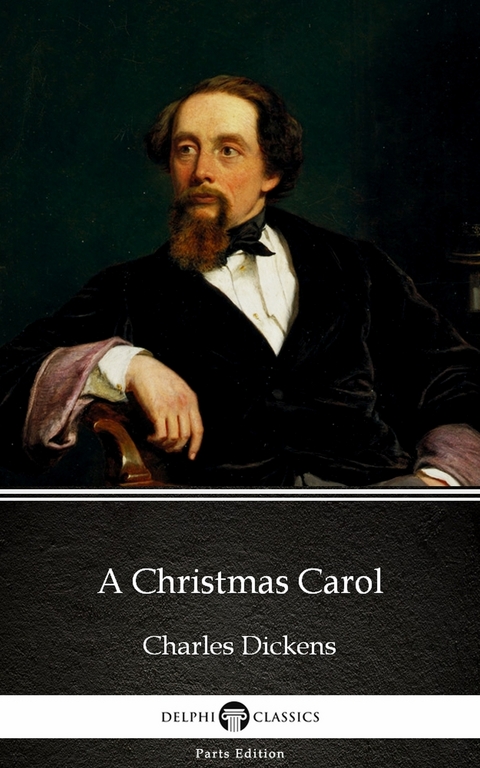
Christmas Carol by Charles Dickens (Illustrated) (eBook)
89 Seiten
Publishdrive (Verlag)
978-1-78656-706-2 (ISBN)
Having established their name as the leading publisher of classic literature and art, Delphi Classics produce publications that are individually crafted with superior formatting, while introducing many rare texts for the first time in digital print. The Delphi Classics edition of Dickens includes original annotations and illustrations relating to the life and works of the author, as well as individual tables of contents, allowing you to navigate eBooks quickly and easily.
eBook features:* The complete unabridged text of 'A Christmas Carol'
* Beautifully illustrated with images related to Dickens's works
* Individual contents table, allowing easy navigation around the eBook
* Excellent formatting of the textPlease visit www.delphiclassics.com to learn more about our wide range of titles
This eBook features the unabridged text of 'A Christmas Carol' from the bestselling edition of 'The Complete Works of Charles Dickens'. Having established their name as the leading publisher of classic literature and art, Delphi Classics produce publications that are individually crafted with superior formatting, while introducing many rare texts for the first time in digital print. The Delphi Classics edition of Dickens includes original annotations and illustrations relating to the life and works of the author, as well as individual tables of contents, allowing you to navigate eBooks quickly and easily.eBook features:* The complete unabridged text of 'A Christmas Carol'* Beautifully illustrated with images related to Dickens's works* Individual contents table, allowing easy navigation around the eBook* Excellent formatting of the textPlease visit www.delphiclassics.com to learn more about our wide range of titles
A Christmas Carol
Charles Dickens is forever associated with Christmas. It was reported that when he died in 1870 a costermonger’s daughter was overheard to say, “Mr. Dickens dead? Then will Father Christmas die too?”
Perhaps his feelings about Christmas are best summed up by one of his children who recorded that for Dickens, Christmas was “a great time, a really jovial time, and my father was always at his best, a splendid host, bright and jolly as a boy and throwing his heart and soul into everything that was going on...”
Dickens himself defined its essence through the words he placed in the mouth of Scrooge’s nephew, Fred, in A Christmas Carol, when he describes the season as “a good time: a kind, forgiving, charitable, pleasant time: the only time I know of in the long calendar of the year, when men and women seem by one consent to open their shut-up hearts freely, and to think of other people below them as if they really were fellow-passengers to the grave, and not another race of creatures bound on other journeys.” For the author this speech was to encapsulate what became known as his ‘Carol Philosophy.’
The tradition of Christmas celebration had gradually declined in the early nineteenth century and as Thomas Hervey noted in his writings, ‘The revels of merry England are fast subsiding into silence and her many customs are wearing gradually away.’ He blamed it on the urban drift by the rural population as towns and cities became the providers of work. Dickens did not invent Christmas, but he certainly helped to resurrect it by moving it to an urban setting — London to be precise — and replacing the manorial hall with the town house while still rousing nostalgia for the Christmas spirit he evoked at Dingley Dell. The idyllic winter countryside had been replaced by the claustrophobic fogbound city of London and the old squirearchy by the burgeoning middle class and the urban working poor. As Professor Richard Kelly points out in his edition of A Christmas Carol, ‘Dickens seems to be saying Christmas can now be celebrated by anyone; its rituals and joys are no longer the exclusive province of the upper classes in their country estates.’
Washington Irving, an American writer greatly admired by Dickens, was a significant influence upon his Christmas writings. Irving travelled extensively in Europe and in Bracebridge Hall he celebrated the Christmas festivities and traditions of rural England. Although Prince Albert had introduced the Christmas tree to English households, the first Christmas card was sent in 1843 and the singing of carols was undergoing a revival, the real catalyst was the publication of A Christmas Carol on 6 December, 1843. It had been written between October and November of that year in six weeks. As he wrote to his American friend, Cornelius Felton, ‘Over which Christmas Carol, Charles Dickens wept, and laughed, and wept again, and excited himself in a most extraordinary manner, in the composition; and thinking whereof, he walked about the black streets of London, fifteen and twenty miles, many a night when all sober folks had gone to bed.’
Although Dickens was to write several stories and articles upon the theme of Christmas, the best of these and the one that helped to re-establish this festive occasion as an important tradition was this one. The novella grew out of a visit to Cornish tin mines that used child labour and a visit in September to Field Lane Ragged School. As he wrote to his friend and philanthropist Miss Burdett-Coutts with whom he was to work with in the future, he had not seen almost anywhere ‘anything so shocking as the dire neglect of soul and body exhibited in these children’. Initially, he intended to write a pamphlet entitled an ‘Appeal to the People of England on behalf of the Poor Man’s child’ but thankfully for us he realised that his skills as a novelist would create a greater impact on his readers and so it proved.
The genesis of the novel may well have been a short story which was recounted by Mr. Wardle at Dingley Dell on Christmas Eve from the famous scene in The Pickwick Papers. Gabriel Grub, a sexton and gravedigger is a misanthropic character, who prefers digging graves to celebrating Christmas. However, he is confronted by goblins that present him with terrifying visions, which alter him as a man and help to redeem him. This was the precursor of his supreme expression of the Christmas ideal which was to follow in 1843, during what was aptly called the ‘Hungry Forties.’
His other purpose in writing this story was to secure his finances as his latest novel, Martin Chuzzlewit, had not sold as well as he had hoped. Sadly, neither did he make much money from A Christmas Carol, due to the lavish edition he designed with its red cloth cover with gilt lettering, gilt edges to the pages and the Punch artist John Leech’s eight illustrations, four of which were full colour etchings. Added to which it sold for the moderate price of five shillings. Even though it sold well it made little money at first, for which he blamed his publishers Chapman and Hall, whom he left soon after. Dickens called it ‘a most prodigious success – the greatest, I think, I have ever achieved.’ And brisk sales ensured that by 24 December 6,000 copies had been sold.
Peter Ackroyd, one of Dickens’ outstanding biographers, has noted the similarities between some of the characters and themes of Martin Chuzzlewit and A Christmas Carol, seeing the latter as a reworking of the former, but in fantasy form where the common themes of greed, selfishness and their impact on the commercial world appear. Michael Slater in his magisterial work, Charles Dickens, suggests the theme of ‘moral conversion’ should be added as it applies to both young Martin and to Scrooge.
The growth of the autobiographical elements in Dickens’ writing is apparent, particularly in Stave 2 where the Ghost of Christmas Past returns Scrooge to his schooldays where it is apparent we are presented with the image of the neglected child or in Michael Slater’s words ‘the abandoned child, Scrooge’ who seeks solace in the imaginary worlds of Robinson Crusoe and The Arabian Nights. Scrooge’s later misanthropy and miserliness is connected to this picture of him as ‘his poor forgotten self as he used to be’ [Stave 2]. The suffering of children is a key theme and the Ghost of Christmas Present’s introduction of the two children, ‘Want’ and ‘Ignorance’ in Stave 3 are a powerful signal to his readers of the cost of neglect. As he warns ‘Beware them both, and all of their degree, but most of all beware this boy, for on his brow I see that written which is Doom, unless the writing be erased.’ For Dickens the only solution to the effects and impact of poverty was education.
In contrast to the redemption of Scrooge and the celebration and conviviality of the festive time is the dark side represented by poverty, ignorance and suffering. Typical of Dickens the novel is a hybrid of styles including elements of the fairy tale, the excesses of the pantomime, the Gothic ingredient of the ghost story and melodrama. Set against this is an element of realism as Dickens explores the social questions of the day, which were to form the basis of the condition of England novel. Sentimentality is never far from the surface and of course is epitomised in the idealised representation of the Cratchit family and Tiny Tim, in particular. But before we become too dismissive of this sentimentality we should remember that child death was ever present, where over half the funerals in London in 1839 were for children. Therefore, child mortality was common in the lives of the Victorians and many of the readers will have experienced such a loss.
Scrooge is a superb literary creation — a majestic Victorian stage villain that steps straight out of the melodramatic mode with Dickens’ physical description of him in Stave One, where his miserly and miserable nature is reinforced by a hyperbolic torrent of adjectives. He is the antithesis of the joy of Christmas. Nevertheless, he is redeemable and even at the height of his miserliness his dry, mordant humour in his conversation suggests there is more to him than our initial meeting would suggest. The Ghost of Christmas Past acts as the catalyst that emphasises Scrooge’s obsession with wealth and awakens his sense of loss, loneliness and guilt. The two other Ghosts, one of the Present and the Ghost of Christmas Yet to Come guide Scrooge towards redemption.
Dickens does not suggest the need for societal change, merely that if man exercises kindness and Christian charity the world would be a better place. As George Orwell perceptively notes, ‘There is no clear sign that [Dickens] wants the existing order to be overthrown, or believes that it would make very much difference if it were overthrown.’ His response is essentially emotional and Dickens is a moralist rather that a political animal and what he wants to change is human nature rather than society. So at the end of A Christmas Carol Scrooge transforms into the benign paternal employer of Bob Cratchit, ‘a second father’ to Tiny Tim and ‘as good a man, as the good old city knew.’ Yet the world of Malthusian philosophy, Utilitarianism and laissez-faire capitalism remains intact.
A Christmas Carol was incredibly well-received by contemporary...
| Erscheint lt. Verlag | 17.7.2017 |
|---|---|
| Reihe/Serie | Delphi Parts Edition (Charles Dickens) | Delphi Parts Edition (Charles Dickens) |
| Sprache | englisch |
| Themenwelt | Literatur ► Anthologien |
| Literatur ► Klassiker / Moderne Klassiker | |
| Literatur ► Romane / Erzählungen | |
| Schlagworte | bleak • Copperfield • Expectations • Nickleby • Novels • pickwick • Twist |
| ISBN-10 | 1-78656-706-7 / 1786567067 |
| ISBN-13 | 978-1-78656-706-2 / 9781786567062 |
| Informationen gemäß Produktsicherheitsverordnung (GPSR) | |
| Haben Sie eine Frage zum Produkt? |
 EPUB (Adobe DRM)
Größe: 2,0 MB
Kopierschutz: Adobe-DRM
Adobe-DRM ist ein Kopierschutz, der das eBook vor Mißbrauch schützen soll. Dabei wird das eBook bereits beim Download auf Ihre persönliche Adobe-ID autorisiert. Lesen können Sie das eBook dann nur auf den Geräten, welche ebenfalls auf Ihre Adobe-ID registriert sind.
Details zum Adobe-DRM
Dateiformat: EPUB (Electronic Publication)
EPUB ist ein offener Standard für eBooks und eignet sich besonders zur Darstellung von Belletristik und Sachbüchern. Der Fließtext wird dynamisch an die Display- und Schriftgröße angepasst. Auch für mobile Lesegeräte ist EPUB daher gut geeignet.
Systemvoraussetzungen:
PC/Mac: Mit einem PC oder Mac können Sie dieses eBook lesen. Sie benötigen eine
eReader: Dieses eBook kann mit (fast) allen eBook-Readern gelesen werden. Mit dem amazon-Kindle ist es aber nicht kompatibel.
Smartphone/Tablet: Egal ob Apple oder Android, dieses eBook können Sie lesen. Sie benötigen eine
Geräteliste und zusätzliche Hinweise
Buying eBooks from abroad
For tax law reasons we can sell eBooks just within Germany and Switzerland. Regrettably we cannot fulfill eBook-orders from other countries.
EPUB (Ohne DRM)Digital Rights Management: ohne DRM
Dieses eBook enthält kein DRM oder Kopierschutz. Eine Weitergabe an Dritte ist jedoch rechtlich nicht zulässig, weil Sie beim Kauf nur die Rechte an der persönlichen Nutzung erwerben.
Dateiformat: EPUB (Electronic Publication)
EPUB ist ein offener Standard für eBooks und eignet sich besonders zur Darstellung von Belletristik und Sachbüchern. Der Fließtext wird dynamisch an die Display- und Schriftgröße angepasst. Auch für mobile Lesegeräte ist EPUB daher gut geeignet.
Systemvoraussetzungen:
PC/Mac: Mit einem PC oder Mac können Sie dieses eBook lesen. Sie benötigen dafür die kostenlose Software Adobe Digital Editions.
eReader: Dieses eBook kann mit (fast) allen eBook-Readern gelesen werden. Mit dem amazon-Kindle ist es aber nicht kompatibel.
Smartphone/Tablet: Egal ob Apple oder Android, dieses eBook können Sie lesen. Sie benötigen dafür eine kostenlose App.
Geräteliste und zusätzliche Hinweise
Buying eBooks from abroad
For tax law reasons we can sell eBooks just within Germany and Switzerland. Regrettably we cannot fulfill eBook-orders from other countries.
aus dem Bereich