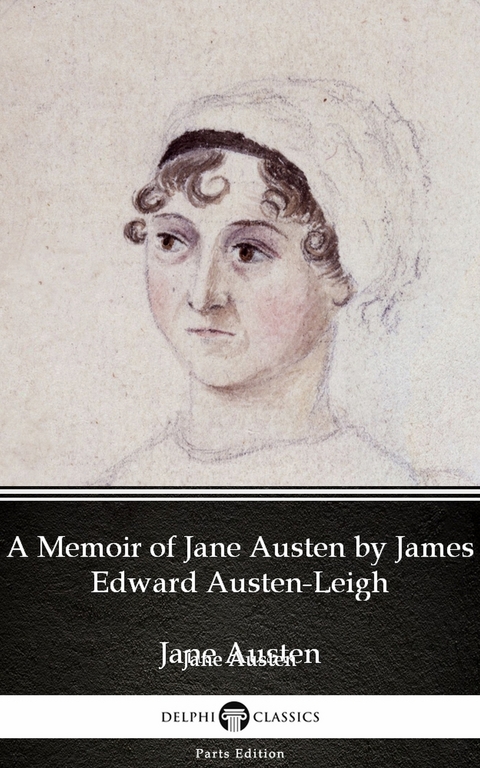
Memoir of Jane Austen by James Edward Austen-Leigh by Jane Austen (Illustrated) (eBook)
118 Seiten
Publishdrive (Verlag)
978-1-78656-629-4 (ISBN)
Having established their name as the leading publisher of classic literature and art, Delphi Classics produce publications that are individually crafted with superior formatting, while introducing many rare texts for the first time in digital print. The Delphi Classics edition of Austen includes original annotations and illustrations relating to the life and works of the author, as well as individual tables of contents, allowing you to navigate eBooks quickly and easily.
eBook features:* The complete unabridged text of 'A Memoir of Jane Austen by James Edward Austen-Leigh'
* Beautifully illustrated with images related to Austen's works
* Individual contents table, allowing easy navigation around the eBook
* Excellent formatting of the textPlease visit www.delphiclassics.com to learn more about our wide range of titles
This eBook features the unabridged text of 'A Memoir of Jane Austen by James Edward Austen-Leigh' from the bestselling edition of 'The Complete Works of Jane Austen'. Having established their name as the leading publisher of classic literature and art, Delphi Classics produce publications that are individually crafted with superior formatting, while introducing many rare texts for the first time in digital print. The Delphi Classics edition of Austen includes original annotations and illustrations relating to the life and works of the author, as well as individual tables of contents, allowing you to navigate eBooks quickly and easily.eBook features:* The complete unabridged text of 'A Memoir of Jane Austen by James Edward Austen-Leigh'* Beautifully illustrated with images related to Austen's works* Individual contents table, allowing easy navigation around the eBook* Excellent formatting of the textPlease visit www.delphiclassics.com to learn more about our wide range of titles
CHAPTER I.
Introductory Remarks — Birth of Jane Austen — Her Family Connections — Their Influence on her Writings.
More than half a century has passed away since I, the youngest of the mourners, attended the funeral of my dear aunt Jane in Winchester Cathedral; and now, in my old age, I am asked whether my memory will serve to rescue from oblivion any events of her life or any traits of her character to satisfy the enquiries of a generation of readers who have been born since she died. Of events her life was singularly barren: few changes and no great crisis ever broke the smooth current of its course. Even her fame may be said to have been posthumous: it did not attain to any vigorous life till she had ceased to exist. Her talents did not introduce her to the notice of other writers, or connect her with the literary world, or in any degree pierce through the obscurity of her domestic retirement. I have therefore scarcely any materials for a detailed life of my aunt; but I have a distinct recollection of her person and character; and perhaps many may take an interest in a delineation, if any such can be drawn, of that prolific mind whence sprung the Dashwoods and Bennets, the Bertrams and Woodhouses, the Thorpes and Musgroves, who have been admitted as familiar guests to the firesides of so many families, and are known there as individually and intimately as if they were living neighbours. Many may care to know whether the moral rectitude, the correct taste, and the warm affections with which she invested her ideal characters, were really existing in the native source whence those ideas flowed, and were actually exhibited by her in the various relations of life. I can indeed bear witness that there was scarcely a charm in her most delightful characters that was not a true reflection of her own sweet temper and loving heart. I was young when we lost her; but the impressions made on the young are deep, and though in the course of fifty years I have forgotten much, I have not forgotten that ‘Aunt Jane’ was the delight of all her nephews and nieces. We did not think of her as being clever, still less as being famous; but we valued her as one always kind, sympathising, and amusing. To all this I am a living witness, but whether I can sketch out such a faint outline of this excellence as shall be perceptible to others may be reasonably doubted. Aided, however, by a few survivors who knew her, I will not refuse to make the attempt. I am the more inclined to undertake the task from a conviction that, however little I may have to tell, no one else is left who could tell so much of her.
Jane Austen was born on December 16, 1775, at the Parsonage House of Steventon in Hampshire. Her father, the Rev. George Austen, was of a family long established in the neighbourhood of Tenterden and Sevenoaks in Kent. I believe that early in the seventeenth century they were clothiers. Hasted, in his history of Kent, says: ‘The clothing business was exercised by persons who possessed most of the landed property in the Weald, insomuch that almost all the ancient families of these parts, now of large estates and genteel rank in life, and some of them ennobled by titles, are sprung from ancestors who have used this great staple manufacture, now almost unknown here.’ In his list of these families Hasted places the Austens, and he adds that these clothiers ‘were usually called the Gray Coats of Kent; and were a body so numerous and united that at county elections whoever had their vote and interest was almost certain of being elected.’ The family still retains a badge of this origin; for their livery is of that peculiar mixture of light blue and white called Kentish gray, which forms the facings of the Kentish militia.
Mr. George Austen had lost both his parents before he was nine years old. He inherited no property from them; but was happy in having a kind uncle, Mr. Francis Austen, a successful lawyer at Tunbridge, the ancestor of the Austens of Kippington, who, though he had children of his own, yet made liberal provision for his orphan nephew. The boy received a good education at Tunbridge School, whence he obtained a scholarship, and subsequently a fellowship, at St. John’s College, Oxford. In 1764 he came into possession of the two adjoining Rectories of Deane and Steventon in Hampshire; the former purchased for him by his generous uncle Francis, the latter given by his cousin Mr. Knight. This was no very gross case of plurality, according to the ideas of that time, for the two villages were little more than a mile apart, and their united populations scarcely amounted to three hundred. In the same year he married Cassandra, youngest daughter of the Rev. Thomas Leigh, of the family of Leighs of Warwickshire, who, having been a fellow of All Souls, held the College living of Harpsden, near Henley-upon-Thames. Mr. Thomas Leigh was a younger brother of Dr. Theophilus Leigh, a personage well known at Oxford in his day, and his day was not a short one, for he lived to be ninety, and held the Mastership of Balliol College for above half a century. He was a man more famous for his sayings than his doings, overflowing with puns and witticisms and sharp retorts; but his most serious joke was his practical one of living much longer than had been expected or intended. He was a fellow of Corpus, and the story is that the Balliol men, unable to agree in electing one of their own number to the Mastership, chose him, partly under the idea that he was in weak health and likely soon to cause another vacancy. It was afterwards said that his long incumbency had been a judgment on the Society for having elected an Out-College Man. I imagine that the front of Balliol towards Broad Street which has recently been pulled down must have been built, or at least restored, while he was Master, for the Leigh arms were placed under the cornice at the corner nearest to Trinity gates. The beautiful building lately erected has destroyed this record, and thus ‘monuments themselves memorials need.’
His fame for witty and agreeable conversation extended beyond the bounds of the University. Mrs. Thrale, in a letter to Dr. Johnson, writes thus: ‘Are you acquainted with Dr. Leigh, the Master of Balliol College, and are you not delighted with his gaiety of manners and youthful vivacity, now that he is eighty-six years of age? I never heard a more perfect or excellent pun than his, when some one told him how, in a late dispute among the Privy Councillors, the Lord Chancellor struck the table with such violence that he split it. “No, no, no,” replied the Master; “I can hardly persuade myself that he split the table, though I believe he divided the Board.”‘
Some of his sayings of course survive in family tradition. He was once calling on a gentleman notorious for never opening a book, who took him into a room overlooking the Bath Road, which was then a great thoroughfare for travellers of every class, saying rather pompously, ‘This, Doctor, I call my study.’ The Doctor, glancing his eye round the room, in which no books were to be seen, replied, ‘And very well named too, sir, for you know Pope tells us, “The proper study of mankind is Man.”‘ When my father went to Oxford he was honoured with an invitation to dine with this dignified cousin. Being a raw undergraduate, unaccustomed to the habits of the University, he was about to take off his gown, as if it were a great coat, when the old man, then considerably turned eighty, said, with a grim smile, ‘Young man, you need not strip: we are not going to fight.’ This humour remained in him so strongly to the last that he might almost have supplied Pope with another instance of ‘the ruling passion strong in death,’ for only three days before he expired, being told that an old acquaintance was lately married, having recovered from a long illness by eating eggs, and that the wits said that he had been egged on to matrimony, he immediately trumped the joke, saying, ‘Then may the yoke sit easy on him.’ I do not know from what common ancestor the Master of Balliol and his great-niece Jane Austen, with some others of the family, may have derived the keen sense of humour which they certainly possessed.
Mr. and Mrs. George Austen resided first at Deane, but removed in 1771 to Steventon, which was their residence for about thirty years. They commenced their married life with the charge of a little child, a son of the celebrated Warren Hastings, who had been committed to the care of Mr. Austen before his marriage, probably through the influence of his sister, Mrs. Hancock, whose husband at that time held some office under Hastings in India. Mr. Gleig, in his ‘Life of Hastings,’ says that his son George, the offspring of his first marriage, was sent to England in 1761 for his education, but that he had never been able to ascertain to whom this precious charge was entrusted, nor what became of him. I am able to state, from family tradition, that he died young, of what was then called putrid sore throat; and that Mrs. Austen had become so much attached to him that she always declared that his death had been as great a grief to her as if he had been a child of her own.
About this time, the grandfather of Mary Russell Mitford, Dr. Russell, was Rector of the adjoining parish of Ashe; so that the parents of two popular female writers must have been intimately acquainted with each other.
As my subject carries me back about a hundred years, it will afford...
| Erscheint lt. Verlag | 17.7.2017 |
|---|---|
| Reihe/Serie | Delphi Parts Edition (Jane Austen) | Delphi Parts Edition (Jane Austen) |
| Sprache | englisch |
| Themenwelt | Literatur ► Anthologien |
| Literatur ► Klassiker / Moderne Klassiker | |
| Literatur ► Romane / Erzählungen | |
| Schlagworte | Abbey • Bronte • Emma • Park • Persuasion • pride • Sense |
| ISBN-10 | 1-78656-629-X / 178656629X |
| ISBN-13 | 978-1-78656-629-4 / 9781786566294 |
| Informationen gemäß Produktsicherheitsverordnung (GPSR) | |
| Haben Sie eine Frage zum Produkt? |
 EPUB (Adobe DRM)
Größe: 1,8 MB
Kopierschutz: Adobe-DRM
Adobe-DRM ist ein Kopierschutz, der das eBook vor Mißbrauch schützen soll. Dabei wird das eBook bereits beim Download auf Ihre persönliche Adobe-ID autorisiert. Lesen können Sie das eBook dann nur auf den Geräten, welche ebenfalls auf Ihre Adobe-ID registriert sind.
Details zum Adobe-DRM
Dateiformat: EPUB (Electronic Publication)
EPUB ist ein offener Standard für eBooks und eignet sich besonders zur Darstellung von Belletristik und Sachbüchern. Der Fließtext wird dynamisch an die Display- und Schriftgröße angepasst. Auch für mobile Lesegeräte ist EPUB daher gut geeignet.
Systemvoraussetzungen:
PC/Mac: Mit einem PC oder Mac können Sie dieses eBook lesen. Sie benötigen eine
eReader: Dieses eBook kann mit (fast) allen eBook-Readern gelesen werden. Mit dem amazon-Kindle ist es aber nicht kompatibel.
Smartphone/Tablet: Egal ob Apple oder Android, dieses eBook können Sie lesen. Sie benötigen eine
Geräteliste und zusätzliche Hinweise
Buying eBooks from abroad
For tax law reasons we can sell eBooks just within Germany and Switzerland. Regrettably we cannot fulfill eBook-orders from other countries.
EPUB (Ohne DRM)Digital Rights Management: ohne DRM
Dieses eBook enthält kein DRM oder Kopierschutz. Eine Weitergabe an Dritte ist jedoch rechtlich nicht zulässig, weil Sie beim Kauf nur die Rechte an der persönlichen Nutzung erwerben.
Dateiformat: EPUB (Electronic Publication)
EPUB ist ein offener Standard für eBooks und eignet sich besonders zur Darstellung von Belletristik und Sachbüchern. Der Fließtext wird dynamisch an die Display- und Schriftgröße angepasst. Auch für mobile Lesegeräte ist EPUB daher gut geeignet.
Systemvoraussetzungen:
PC/Mac: Mit einem PC oder Mac können Sie dieses eBook lesen. Sie benötigen dafür die kostenlose Software Adobe Digital Editions.
eReader: Dieses eBook kann mit (fast) allen eBook-Readern gelesen werden. Mit dem amazon-Kindle ist es aber nicht kompatibel.
Smartphone/Tablet: Egal ob Apple oder Android, dieses eBook können Sie lesen. Sie benötigen dafür eine kostenlose App.
Geräteliste und zusätzliche Hinweise
Buying eBooks from abroad
For tax law reasons we can sell eBooks just within Germany and Switzerland. Regrettably we cannot fulfill eBook-orders from other countries.
aus dem Bereich