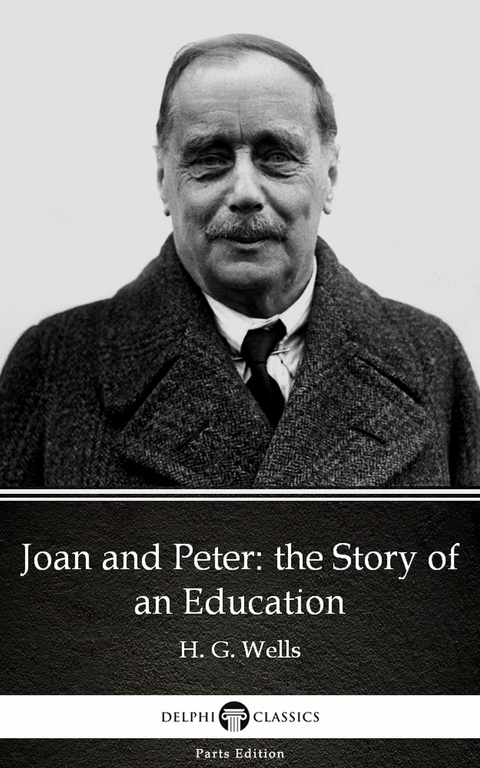
Joan and Peter: the Story of an Education by H. G. Wells (Illustrated) (eBook)
379 Seiten
Publishdrive (Verlag)
978-1-78656-587-7 (ISBN)
Having established their name as the leading publisher of classic literature and art, Delphi Classics produce publications that are individually crafted with superior formatting, while introducing many rare texts for the first time in digital print. The Delphi Classics edition of Wells includes original annotations and illustrations relating to the life and works of the author, as well as individual tables of contents, allowing you to navigate eBooks quickly and easily.
eBook features:* The complete unabridged text of 'Joan and Peter: the Story of an Education'
* Beautifully illustrated with images related to Wells's works
* Individual contents table, allowing easy navigation around the eBook
* Excellent formatting of the textPlease visit www.delphiclassics.com to learn more about our wide range of titles
This eBook features the unabridged text of 'Joan and Peter: the Story of an Education' from the bestselling edition of 'The Complete Works of H. G. Wells'. Having established their name as the leading publisher of classic literature and art, Delphi Classics produce publications that are individually crafted with superior formatting, while introducing many rare texts for the first time in digital print. The Delphi Classics edition of Wells includes original annotations and illustrations relating to the life and works of the author, as well as individual tables of contents, allowing you to navigate eBooks quickly and easily.eBook features:* The complete unabridged text of 'Joan and Peter: the Story of an Education'* Beautifully illustrated with images related to Wells's works* Individual contents table, allowing easy navigation around the eBook* Excellent formatting of the textPlease visit www.delphiclassics.com to learn more about our wide range of titles
CHAPTER I. — PETER’S PARENTAGE
§ 1
EARLY one summer morning in England, in the year 1808 in the reign — which seemed in those days to have been going on for ever and to be likely to go on for evermore — of Queen Victoria, there was born a little boy named Peter. Peter was a novel name then; he was before the great crop of Peters who derived their name from Peter Pan. He was born with some difficulty. His father, who had not been to bed all night, for the trouble of the birth had begun overnight at about nine o’clock, was walking about in the garden in a dewy dawn, thinking the world very dreadful and beautiful, when he first heard Peter cry. Peter, he thought, made a noise like a little frightened hen that something big had caught.... Peter’s mother had been moaning but now she moaned no more, and Peter’s father stood outside and whispered “Oh, God! Oh! Damn them and damn them! why don’t they tell met”
Then the nurse put her head out of the window; it was a casement window with white roses about it; said “Everything’s all right. I’ll tell you when to come in,” and vanished again.
Peter’s father turned about very sharply so that she should not see he was fool enough to weep, and went along the flagged path to the end of the garden, where was the little summer-house that looked over the Weald. But he could not see the Weald because his tears blinded him. All night Peter’s father had been thinking what an imperfect husband he had always been and how he had never really-told his wife how much he loved her, and how indeed until now he had never understood how very much he loved her, and he had been making good resolutions for the future in great abundance, in enormous abundance, the most remarkable good resolutions, and one waking nightmare after another had been chasing across his mind nightmares of a dreadful dark-grey world in which there would be no Dolly, no Dolly at all anywhere, even if you went out into the garden and whistled your utmost, and he would be a widower with only one little lonely child to console him. He could not imagine any other woman for him but Dolly.
The last trailing vestige of those twilight distresses vanished when presently he saw Dolly looking tired indeed but pink and healthy, with her hair almost roguishly astray, and the room full of warm daylight from the dawn-flushed sky, full of fresh south-west air from the Sussex downs, full of the sense of invincible life, and young master Peter, very puckered and ugly and red and pitiful, in a blanket in the nurse’s arms, and Dr. Fremisson smirking behind her, entirely satisfied with himself and the universe and every detail of it.
When Dolly had been kissed and whispered to they gave Peter to his father to hold.
Peter’s father had never understood before that a baby is an exquisite thing.
§ 2
The parents of Peter were modern young people, and Peter was no accidental intruder. Their heads were full of new ideas, new that is in the days when Queen Victoria seemed immortal and the world settled for ever. They put Peter in their two sunniest rooms; rarely were the windows shut; his nursery was white and green, bright with pretty pictures and never without flowers. It had a cork carpet and a rug displaying amusing black cats on pink, and he was weighed carefully first once a week and then once a month until he was four years old.
His father, whom everybody called Stubbo, came of an old Quaker stock. Quakerism in its beginnings was a very fine and wonderful religion indeed, a real research for the Kingdom of Heaven on earth, a new way of thinking and living, but weaknesses of the mind and spirit brought it back very soon to a commoner texture. The Stubland family was among those which had been most influenced by the evangelical wave of the Wesleyan time. Peter’s great- grandfather, old Stubland, the West-of-England cloth manufacturer, was an emotional person with pietistic inclinations that nearly carried him over at different times to the Plymouth Brethren, to the Wesleyan Methodists, and to the Countess of Huntingdon’s connexion. Religion was his only social recreation, most other things he held to be sinful, and his surplus energies went all into the business. He had an aptitude for mechanical organization and started the Yorkshire factory; his son, still more evangelical and still more successful, left a business worth well over two hundred thousand pounds among thirteen children, of whom Peter’s father was the youngest. “Stublands” became a limited company with uncles Rigby and John as directors, and the rest of the family was let loose, each one with a nice little secure six hundred a year or thereabouts from Stubland debentures and Stubland ordinary shares, to do what it liked in the world.
It wasn’t, of course, told that it could do what it liked in the world. That it found out for itself — in the teeth of much early teaching to the contrary. That early teaching had been predominantly prohibitive, there had been no end of “thou shalt not” and very little of “thou shalt,” an irksome teaching for young people destined to leisure. Mankind was presented waiting about for the Judgment Day, with Satan as busy as a pickpocket in a crowd. Also he offered roundabouts and coconut-shies.... This family doctrine tallied so little with the manifest circumstances and natural activity of the young Stublands that it just fell off their young minds. The keynote of Stubbo’s upbringing had been a persistent unanswered “Why not?” to all the things he was told not to do. “Why not dance? Why not go to theatres and music-halls? Why not make love? Why not read and quote this exciting new poetry of Swinburne’s?”...
The early ‘nineties were a period of careless diastole in British affairs. There seemed to be enough and to spare for every one, given only a little generosity. Peace dwelt on the earth for ever. It was difficult to prove the proprietorship of Satan in the roundabouts and the coconut-shies. There was a general belief that one’s parents and grandparents had taken life far too grimly and suspiciously, a belief which, indeed, took possession of Stubbo before he was in trousers.
His emancipation was greatly aided by his elder sister Phyllis, a girl with an abnormal sense of humour. It was Phyllis who brightened the Sunday afternoons, when she and her sister Phoebe and her brothers were supposed to be committing passages of scripture to memory in the attic, by the invention of increasingly irreligious Limericks. Phoebe would sometimes be dreadfully shocked and sometimes join in with great vigour and glory. Phyllis was also an artist in misquotation. She began by taking a facetious view of the ark and Jonah’s whale, and as her courage grew she went on to the Resurrection. She had a genius for asking seemingly respectful but really destructive questions about religious matters, that made her parents shy of instruction. The Stubland parents had learnt their faith with more reverence than intelligence from their parents, who had had it in a similar spirit from their parents, who had had it from their parents; so that nobody had looked into it closely for some generations, and something vital had evaporated unsuspected. It had evaporated so completely that when Peter’s father and Peter’s aunts and uncles came in their turn as children to examine the precious casket, they not only perceived that there was nothing in it, but they could very readily jump to the rash conclusion that there never had been anything in it. It seemed just an odd blend of empty resonant phrases and comical and sometimes slightly improper stories, that lent themselves very pleasantly to facetious illustration.
Stubbo, as he grew up under these circumstances, had not so much taken on the burthen of life as thrown it off. He decided he would not go into business — business struck him as a purely avaricious occupation — and after a pleasant year at Cambridge he became quite clear that the need of the world and his temperament was Art. The world was not beautiful enough. This was more particularly true of the human contribution. So he went into Art to make the world more beautiful, and came up to London to study and to wear a highly decorative blue linen blouse in private and to collect posters — people then were just beginning to collect posters.
From the last stage of Quakerism to the last extremity of decoration is but a step. Quite an important section of the art world in Britain owes itself to the Quakers and Plymouth Brethren, and to the drab and grey disposition of the sterner evangelicals. It is as if that elect strain in the race had shut its eyes for a generation or so, merely in order to open them again and see brighter. The reaction of the revolting generation has always been toward colour; the pyrotechnic display of the Omega workshops in London is but the last violent outbreak of the Quaker spirit. Young Stubland, a quarter of a century before the Omega enterprise, was already slaking a thirst for chromatic richness behind the lead of William Morris and the Pre-Raphaelites. It took a year or so and several teachers and much friendly frankness to persuade him he could neither draw nor paint, and then he relapsed into decoration and craftsmanship. He beat out copper into great weals of pattern and he bound books grossly. He spent some time upon lettering, and learnt how to make the simplest inscription beautifully illegible. He decided to be an architect. In the meantime he made the acquaintance of a large circle of artistic and literary people, became a Fabian...
| Erscheint lt. Verlag | 17.7.2017 |
|---|---|
| Reihe/Serie | Delphi Parts Edition (H. G. Wells) | Delphi Parts Edition (H. G. Wells) |
| Sprache | englisch |
| Themenwelt | Literatur ► Anthologien |
| Literatur ► Klassiker / Moderne Klassiker | |
| Literatur ► Romane / Erzählungen | |
| Schlagworte | complete • Island • Kipps • Polly • Science • Time • war |
| ISBN-10 | 1-78656-587-0 / 1786565870 |
| ISBN-13 | 978-1-78656-587-7 / 9781786565877 |
| Informationen gemäß Produktsicherheitsverordnung (GPSR) | |
| Haben Sie eine Frage zum Produkt? |
 EPUB (Adobe DRM)
Größe: 1,5 MB
Kopierschutz: Adobe-DRM
Adobe-DRM ist ein Kopierschutz, der das eBook vor Mißbrauch schützen soll. Dabei wird das eBook bereits beim Download auf Ihre persönliche Adobe-ID autorisiert. Lesen können Sie das eBook dann nur auf den Geräten, welche ebenfalls auf Ihre Adobe-ID registriert sind.
Details zum Adobe-DRM
Dateiformat: EPUB (Electronic Publication)
EPUB ist ein offener Standard für eBooks und eignet sich besonders zur Darstellung von Belletristik und Sachbüchern. Der Fließtext wird dynamisch an die Display- und Schriftgröße angepasst. Auch für mobile Lesegeräte ist EPUB daher gut geeignet.
Systemvoraussetzungen:
PC/Mac: Mit einem PC oder Mac können Sie dieses eBook lesen. Sie benötigen eine
eReader: Dieses eBook kann mit (fast) allen eBook-Readern gelesen werden. Mit dem amazon-Kindle ist es aber nicht kompatibel.
Smartphone/Tablet: Egal ob Apple oder Android, dieses eBook können Sie lesen. Sie benötigen eine
Geräteliste und zusätzliche Hinweise
Buying eBooks from abroad
For tax law reasons we can sell eBooks just within Germany and Switzerland. Regrettably we cannot fulfill eBook-orders from other countries.
EPUB (Ohne DRM)Digital Rights Management: ohne DRM
Dieses eBook enthält kein DRM oder Kopierschutz. Eine Weitergabe an Dritte ist jedoch rechtlich nicht zulässig, weil Sie beim Kauf nur die Rechte an der persönlichen Nutzung erwerben.
Dateiformat: EPUB (Electronic Publication)
EPUB ist ein offener Standard für eBooks und eignet sich besonders zur Darstellung von Belletristik und Sachbüchern. Der Fließtext wird dynamisch an die Display- und Schriftgröße angepasst. Auch für mobile Lesegeräte ist EPUB daher gut geeignet.
Systemvoraussetzungen:
PC/Mac: Mit einem PC oder Mac können Sie dieses eBook lesen. Sie benötigen dafür die kostenlose Software Adobe Digital Editions.
eReader: Dieses eBook kann mit (fast) allen eBook-Readern gelesen werden. Mit dem amazon-Kindle ist es aber nicht kompatibel.
Smartphone/Tablet: Egal ob Apple oder Android, dieses eBook können Sie lesen. Sie benötigen dafür eine kostenlose App.
Geräteliste und zusätzliche Hinweise
Buying eBooks from abroad
For tax law reasons we can sell eBooks just within Germany and Switzerland. Regrettably we cannot fulfill eBook-orders from other countries.
aus dem Bereich