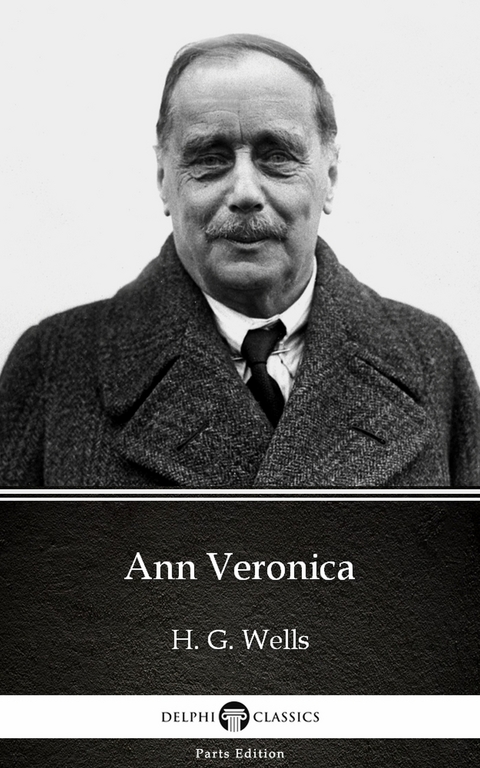
Ann Veronica by H. G. Wells (Illustrated) (eBook)
209 Seiten
Publishdrive (Verlag)
978-1-78656-574-7 (ISBN)
Having established their name as the leading publisher of classic literature and art, Delphi Classics produce publications that are individually crafted with superior formatting, while introducing many rare texts for the first time in digital print. The Delphi Classics edition of Wells includes original annotations and illustrations relating to the life and works of the author, as well as individual tables of contents, allowing you to navigate eBooks quickly and easily.
eBook features:* The complete unabridged text of 'Ann Veronica'
* Beautifully illustrated with images related to Wells's works
* Individual contents table, allowing easy navigation around the eBook
* Excellent formatting of the textPlease visit www.delphiclassics.com to learn more about our wide range of titles
This eBook features the unabridged text of 'Ann Veronica' from the bestselling edition of 'The Complete Works of H. G. Wells'. Having established their name as the leading publisher of classic literature and art, Delphi Classics produce publications that are individually crafted with superior formatting, while introducing many rare texts for the first time in digital print. The Delphi Classics edition of Wells includes original annotations and illustrations relating to the life and works of the author, as well as individual tables of contents, allowing you to navigate eBooks quickly and easily.eBook features:* The complete unabridged text of 'Ann Veronica'* Beautifully illustrated with images related to Wells's works* Individual contents table, allowing easy navigation around the eBook* Excellent formatting of the textPlease visit www.delphiclassics.com to learn more about our wide range of titles
CHAPTER THE SECOND
ANN VERONICA GATHERS POINTS OF VIEW
Part 1
“Are you coming to the Fadden Dance, Ann Veronica?” asked Constance Widgett.
Ann Veronica considered her answer. “I mean to,” she replied.
“You are making your dress?”
“Such as it is.”
They were in the elder Widgett girl’s bedroom; Hetty was laid up, she said, with a sprained ankle, and a miscellaneous party was gossiping away her tedium. It was a large, littered, self-forgetful apartment, decorated with unframed charcoal sketches by various incipient masters; and an open bookcase, surmounted by plaster casts and the half of a human skull, displayed an odd miscellany of books — Shaw and Swinburne, Tom Jones, Fabian Essays, Pope and Dumas, cheek by jowl. Constance Widgett’s abundant copper-red hair was bent down over some dimly remunerative work — stencilling in colors upon rough, white material — at a kitchen table she had dragged up-stairs for the purpose, while on her bed there was seated a slender lady of thirty or so in a dingy green dress, whom Constance had introduced with a wave of her hand as Miss Miniver. Miss Miniver looked out on the world through large emotional blue eyes that were further magnified by the glasses she wore, and her nose was pinched and pink, and her mouth was whimsically petulant. Her glasses moved quickly as her glance travelled from face to face. She seemed bursting with the desire to talk, and watching for her opportunity. On her lapel was an ivory button, bearing the words “Votes for Women.” Ann Veronica sat at the foot of the sufferer’s bed, while Teddy Widgett, being something of an athlete, occupied the only bed-room chair — a decadent piece, essentially a tripod and largely a formality — and smoked cigarettes, and tried to conceal the fact that he was looking all the time at Ann Veronica’s eyebrows. Teddy was the hatless young man who had turned Ann Veronica aside from the Avenue two days before. He was the junior of both his sisters, co-educated and much broken in to feminine society. A bowl of roses, just brought by Ann Veronica, adorned the communal dressing-table, and Ann Veronica was particularly trim in preparation for a call she was to make with her aunt later in the afternoon.
Ann Veronica decided to be more explicit. “I’ve been,” she said, “forbidden to come.”
“Hul-LO!” said Hetty, turning her head on the pillow; and Teddy remarked with profound emotion, “My God!”
“Yes,” said Ann Veronica, “and that complicates the situation.”
“Auntie?” asked Constance, who was conversant with Ann Veronica’s affairs.
“No! My father. It’s — it’s a serious prohibition.”
“Why?” asked Hetty.
“That’s the point. I asked him why, and he hadn’t a reason.”
“YOU ASKED YOUR FATHER FOR A REASON!” said Miss Miniver, with great intensity.
“Yes. I tried to have it out with him, but he wouldn’t have it out.” Ann Veronica reflected for an instant “That’s why I think I ought to come.”
“You asked your father for a reason!” Miss Miniver repeated.
“We always have things out with OUR father, poor dear!” said Hetty. “He’s got almost to like it.”
“Men,” said Miss Miniver, “NEVER have a reason. Never! And they don’t know it! They have no idea of it. It’s one of their worst traits, one of their very worst.”
“But I say, Vee,” said Constance, “if you come and you are forbidden to come there’ll be the deuce of a row.”
Ann Veronica was deciding for further confidences. Her situation was perplexing her very much, and the Widgett atmosphere was lax and sympathetic, and provocative of discussion. “It isn’t only the dance,” she said.
“There’s the classes,” said Constance, the well-informed.
“There’s the whole situation. Apparently I’m not to exist yet. I’m not to study, I’m not to grow. I’ve got to stay at home and remain in a state of suspended animation.”
“DUSTING!” said Miss Miniver, in a sepulchral voice.
“Until you marry, Vee,” said Hetty.
“Well, I don’t feel like standing it.”
“Thousands of women have married merely for freedom,” said Miss Miniver. “Thousands! Ugh! And found it a worse slavery.”
“I suppose,” said Constance, stencilling away at bright pink petals, “it’s our lot. But it’s very beastly.”
“What’s our lot?” asked her sister.
“Slavery! Downtroddenness! When I think of it I feel all over boot marks — men’s boots. We hide it bravely, but so it is. Damn! I’ve splashed.”
Miss Miniver’s manner became impressive. She addressed Ann Veronica with an air of conveying great open secrets to her. “As things are at present,” she said, “it is true. We live under man-made institutions, and that is what they amount to. Every girl in the world practically, except a few of us who teach or type-write, and then we’re underpaid and sweated — it’s dreadful to think how we are sweated!” She had lost her generalization, whatever it was. She hung for a moment, and then went on, conclusively, “Until we have the vote that is how things WILL be.”
“I’m all for the vote,” said Teddy.
“I suppose a girl MUST be underpaid and sweated,” said Ann Veronica. “I suppose there’s no way of getting a decent income — independently.”
“Women have practically NO economic freedom,” said Miss Miniver, “because they have no political freedom. Men have seen to that. The one profession, the one decent profession, I mean, for a woman — except the stage — is teaching, and there we trample on one another. Everywhere else — the law, medicine, the Stock Exchange — prejudice bars us.”
“There’s art,” said Ann Veronica, “and writing.”
“Every one hasn’t the Gift. Even there a woman never gets a fair chance. Men are against her. Whatever she does is minimized. All the best novels have been written by women, and yet see how men sneer at the lady novelist still! There’s only one way to get on for a woman, and that is to please men. That is what they think we are for!”
“We’re beasts,” said Teddy. “Beasts!”
But Miss Miniver took no notice of his admission.
“Of course,” said Miss Miniver — she went on in a regularly undulating voice— “we DO please men. We have that gift. We can see round them and behind them and through them, and most of us use that knowledge, in the silent way we have, for our great ends. Not all of us, but some of us. Too many. I wonder what men would say if we threw the mask aside — if we really told them what WE thought of them, really showed them what WE were.” A flush of excitement crept into her cheeks.
“Maternity,” she said, “has been our undoing.”
From that she opened out into a long, confused emphatic discourse on the position of women, full of wonderful statements, while Constance worked at her stencilling and Ann Veronica and Hetty listened, and Teddy contributed sympathetic noises and consumed cheap cigarettes. As she talked she made weak little gestures with her hands, and she thrust her face forward from her bent shoulders; and she peered sometimes at Ann Veronica and sometimes at a photograph of the Axenstrasse, near Fluelen, that hung upon the wall. Ann Veronica watched her face, vaguely sympathizing with her, vaguely disliking her physical insufficiency and her convulsive movements, and the fine eyebrows were knit with a faint perplexity. Essentially the talk was a mixture of fragments of sentences heard, of passages read, or arguments indicated rather than stated, and all of it was served in a sauce of strange enthusiasm, thin yet intense. Ann Veronica had had some training at the Tredgold College in disentangling threads from confused statements, and she had a curious persuasion that in all this fluent muddle there was something — something real, something that signified. But it was very hard to follow. She did not understand the note of hostility to men that ran through it all, the bitter vindictiveness that lit Miss Miniver’s cheeks and eyes, the sense of some at last insupportable wrong slowly accumulated. She had no inkling of that insupportable wrong.
“We are the species,” said Miss Miniver, “men are only incidents. They give themselves airs, but so it is. In all the species of animals the females are more important than the males; the males have to please them. Look at the cock’s feathers, look at the competition there is everywhere, except among humans. The stags and oxen and things all have to fight for us, everywhere. Only in man is the male made the most important. And that happens through our maternity; it’s our very importance that degrades us.
“While we were minding the children they stole our rights and liberties. The children made us slaves, and the men took advantage of it. It’s — Mrs. Shalford says — the accidental conquering the essential. Originally in the first animals there were...
| Erscheint lt. Verlag | 17.7.2017 |
|---|---|
| Reihe/Serie | Delphi Parts Edition (H. G. Wells) | Delphi Parts Edition (H. G. Wells) |
| Sprache | englisch |
| Themenwelt | Literatur ► Anthologien |
| Literatur ► Klassiker / Moderne Klassiker | |
| Literatur ► Romane / Erzählungen | |
| Schlagworte | complete • Island • Kipps • Polly • Science • Time • war |
| ISBN-10 | 1-78656-574-9 / 1786565749 |
| ISBN-13 | 978-1-78656-574-7 / 9781786565747 |
| Informationen gemäß Produktsicherheitsverordnung (GPSR) | |
| Haben Sie eine Frage zum Produkt? |
 EPUB (Adobe DRM)
Größe: 1,3 MB
Kopierschutz: Adobe-DRM
Adobe-DRM ist ein Kopierschutz, der das eBook vor Mißbrauch schützen soll. Dabei wird das eBook bereits beim Download auf Ihre persönliche Adobe-ID autorisiert. Lesen können Sie das eBook dann nur auf den Geräten, welche ebenfalls auf Ihre Adobe-ID registriert sind.
Details zum Adobe-DRM
Dateiformat: EPUB (Electronic Publication)
EPUB ist ein offener Standard für eBooks und eignet sich besonders zur Darstellung von Belletristik und Sachbüchern. Der Fließtext wird dynamisch an die Display- und Schriftgröße angepasst. Auch für mobile Lesegeräte ist EPUB daher gut geeignet.
Systemvoraussetzungen:
PC/Mac: Mit einem PC oder Mac können Sie dieses eBook lesen. Sie benötigen eine
eReader: Dieses eBook kann mit (fast) allen eBook-Readern gelesen werden. Mit dem amazon-Kindle ist es aber nicht kompatibel.
Smartphone/Tablet: Egal ob Apple oder Android, dieses eBook können Sie lesen. Sie benötigen eine
Geräteliste und zusätzliche Hinweise
Buying eBooks from abroad
For tax law reasons we can sell eBooks just within Germany and Switzerland. Regrettably we cannot fulfill eBook-orders from other countries.
EPUB (Ohne DRM)Digital Rights Management: ohne DRM
Dieses eBook enthält kein DRM oder Kopierschutz. Eine Weitergabe an Dritte ist jedoch rechtlich nicht zulässig, weil Sie beim Kauf nur die Rechte an der persönlichen Nutzung erwerben.
Dateiformat: EPUB (Electronic Publication)
EPUB ist ein offener Standard für eBooks und eignet sich besonders zur Darstellung von Belletristik und Sachbüchern. Der Fließtext wird dynamisch an die Display- und Schriftgröße angepasst. Auch für mobile Lesegeräte ist EPUB daher gut geeignet.
Systemvoraussetzungen:
PC/Mac: Mit einem PC oder Mac können Sie dieses eBook lesen. Sie benötigen dafür die kostenlose Software Adobe Digital Editions.
eReader: Dieses eBook kann mit (fast) allen eBook-Readern gelesen werden. Mit dem amazon-Kindle ist es aber nicht kompatibel.
Smartphone/Tablet: Egal ob Apple oder Android, dieses eBook können Sie lesen. Sie benötigen dafür eine kostenlose App.
Geräteliste und zusätzliche Hinweise
Buying eBooks from abroad
For tax law reasons we can sell eBooks just within Germany and Switzerland. Regrettably we cannot fulfill eBook-orders from other countries.
aus dem Bereich