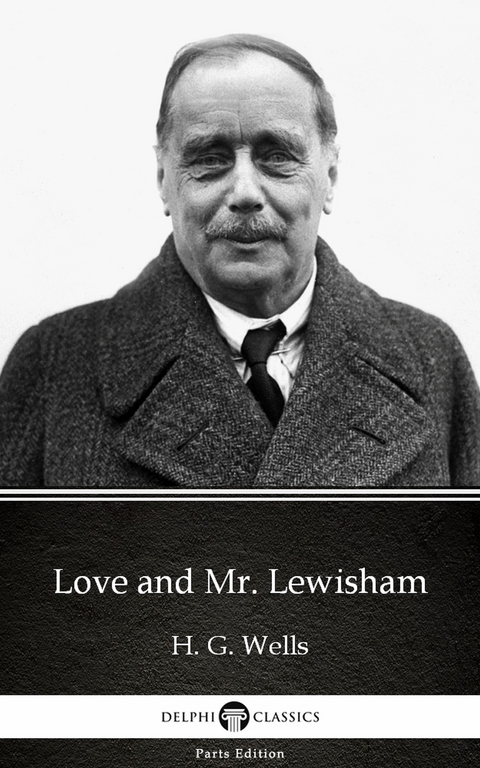
Love and Mr. Lewisham by H. G. Wells (Illustrated) (eBook)
163 Seiten
Publishdrive (Verlag)
978-1-78656-565-5 (ISBN)
Having established their name as the leading publisher of classic literature and art, Delphi Classics produce publications that are individually crafted with superior formatting, while introducing many rare texts for the first time in digital print. The Delphi Classics edition of Wells includes original annotations and illustrations relating to the life and works of the author, as well as individual tables of contents, allowing you to navigate eBooks quickly and easily.
eBook features:* The complete unabridged text of 'Love and Mr. Lewisham'
* Beautifully illustrated with images related to Wells's works
* Individual contents table, allowing easy navigation around the eBook
* Excellent formatting of the textPlease visit www.delphiclassics.com to learn more about our wide range of titles
This eBook features the unabridged text of 'Love and Mr. Lewisham' from the bestselling edition of 'The Complete Works of H. G. Wells'. Having established their name as the leading publisher of classic literature and art, Delphi Classics produce publications that are individually crafted with superior formatting, while introducing many rare texts for the first time in digital print. The Delphi Classics edition of Wells includes original annotations and illustrations relating to the life and works of the author, as well as individual tables of contents, allowing you to navigate eBooks quickly and easily.eBook features:* The complete unabridged text of 'Love and Mr. Lewisham'* Beautifully illustrated with images related to Wells's works* Individual contents table, allowing easy navigation around the eBook* Excellent formatting of the textPlease visit www.delphiclassics.com to learn more about our wide range of titles
CHAPTER I.
INTRODUCES MR. LEWISHAM.
The opening chapter does not concern itself with Love — indeed that antagonist does not certainly appear until the third — and Mr. Lewisham is seen at his studies. It was ten years ago, and in those days he was assistant master in the Whortley Proprietary School, Whortley, Sussex, and his wages were forty pounds a year, out of which he had to afford fifteen shillings a week during term time to lodge with Mrs. Munday, at the little shop in the West Street. He was called “Mr.” to distinguish him from the bigger boys, whose duty it was to learn, and it was a matter of stringent regulation that he should be addressed as “Sir.”
He wore ready-made clothes, his black jacket of rigid line was dusted about the front and sleeves with scholastic chalk, and his face was downy and his moustache incipient. He was a passable-looking youngster of eighteen, fair-haired, indifferently barbered, and with a quite unnecessary pair of glasses on his fairly prominent nose — he wore these to make himself look older, that discipline might be maintained. At the particular moment when this story begins he was in his bedroom. An attic it was, with lead-framed dormer windows, a slanting ceiling and a bulging wall, covered, as a number of torn places witnessed, with innumerable strata of florid old-fashioned paper.
To judge by the room Mr. Lewisham thought little of Love but much on Greatness. Over the head of the bed, for example, where good folks hang texts, these truths asserted themselves, written in a clear, bold, youthfully florid hand:— “Knowledge is Power,” and “What man has done man can do,” — man in the second instance referring to Mr. Lewisham. Never for a moment were these things to be forgotten. Mr. Lewisham could see them afresh every morning as his head came through his shirt. And over the yellow-painted box upon which — for lack of shelves — Mr. Lewisham’s library was arranged, was a “Schema.” (Why he should not have headed it “Scheme,” the editor of the Church Times, who calls his miscellaneous notes “Varia,” is better able to say than I.) In this scheme, 1892 was indicated as the year in which Mr. Lewisham proposed to take his B.A. degree at the London University with “hons. in all subjects,” and 1895 as the date of his “gold medal.” Subsequently there were to be “pamphlets in the Liberal interest,” and such like things duly dated. “Who would control others must first control himself,” remarked the wall over the wash-hand stand, and behind the door against the Sunday trousers was a portrait of Carlyle.
These were no mere threats against the universe; operations had begun. Jostling Shakespeare, Emerson’s Essays, and the penny Life of Confucius, there were battered and defaced school books, a number of the excellent manuals of the Universal Correspondence Association, exercise books, ink (red and black) in penny bottles, and an india-rubber stamp with Mr. Lewisham’s name. A trophy of bluish green South Kensington certificates for geometrical drawing, astronomy, physiology, physiography, and inorganic chemistry adorned his further wall. And against the Carlyle portrait was a manuscript list of French irregular verbs.
Attached by a drawing-pin to the roof over the wash-hand stand, which — the room being an attic — sloped almost dangerously, dangled a Time-Table. Mr. Lewisham was to rise at five, and that this was no vain boasting, a cheap American alarum clock by the books on the box witnessed. The lumps of mellow chocolate on the papered ledge by the bed-head indorsed that evidence. “French until eight,” said the time-table curtly. Breakfast was to be eaten in twenty minutes; then twenty-five minutes of “literature” to be precise, learning extracts (preferably pompous) from the plays of William Shakespeare — and then to school and duty. The time-table further prescribed Latin Composition for the recess and the dinner hour (“literature,” however, during the meal), and varied its injunctions for the rest of the twenty-four hours according to the day of the week. Not a moment for Satan and that “mischief still” of his. Only three-score and ten has the confidence, as well as the time, to be idle.
But just think of the admirable quality of such a scheme! Up and busy at five, with all the world about one horizontal, warm, dreamy-brained or stupidly hullish, if roused, roused only to grunt and sigh and roll over again into oblivion. By eight three hours’ clear start, three hours’ knowledge ahead of everyone. It takes, I have been told by an eminent scholar, about a thousand hours of sincere work to learn a language completely — after three or four languages much less — which gives you, even at the outset, one each a year before breakfast. The gift of tongues — picked up like mushrooms! Then that “literature” — an astonishing conception! In the afternoon mathematics and the sciences. Could anything be simpler or more magnificent? In six years Mr. Lewisham will have his five or six languages, a sound, all-round education, a habit of tremendous industry, and be still but four-and-twenty. He will already have honour in his university and ampler means. One realises that those pamphlets in the Liberal interests will be no obscure platitudes. Where Mr. Lewisham will be at thirty stirs the imagination. There will be modifications of the Schema, of course, as experience widens. But the spirit of it — the spirit of it is a devouring flame!
He was sitting facing the diamond-framed window, writing, writing fast, on a second yellow box that was turned on end and empty, and the lid was open, and his knees were conveniently stuck into the cavity. The bed was strewn with books and copygraphed sheets of instructions from his remote correspondence tutors. Pursuant to the dangling time-table he was, you would have noticed, translating Latin into English.
Imperceptibly the speed of his writing diminished. “Urit me Glycerae nitor” lay ahead and troubled him. “Urit me,” he murmured, and his eyes travelled from his book out of window to the vicar’s roof opposite and its ivied chimneys. His brows were knit at first and then relaxed. “Urit me!” He had put his pen into his mouth and glanced about for his dictionary. Urare?
Suddenly his expression changed. Movement dictionary-ward ceased. He was listening to a light tapping sound — it was a footfall — outside.
He stood up abruptly, and, stretching his neck, peered through his unnecessary glasses and the diamond panes down into the street. Looking acutely downward he could see a hat daintily trimmed with pinkish white blossom, the shoulder of a jacket, and just the tips of nose and chin. Certainly the stranger who sat under the gallery last Sunday next the Frobishers. Then, too, he had seen her only obliquely….
He watched her until she passed beyond the window frame. He strained to see impossibly round the corner….
Then he started, frowned, took his pen from his mouth. “This wandering attention!” he said. “The slightest thing! Where was I? Tcha!” He made a noise with his teeth to express his irritation, sat down, and replaced his knees in the upturned box. “Urit me,” he said, biting the end of his pen and looking for his dictionary.
It was a Wednesday half-holiday late in March, a spring day glorious in amber light, dazzling white clouds and the intensest blue, casting a powder of wonderful green hither and thither among the trees and rousing all the birds to tumultuous rejoicings, a rousing day, a clamatory insistent day, a veritable herald of summer. The stir of that anticipation was in the air, the warm earth was parting above the swelling seeds, and all the pine-woods were full of the minute crepitation of opening bud scales. And not only was the stir of Mother Nature’s awakening in the earth and the air and the trees, but also in Mr. Lewisham’s youthful blood, bidding him rouse himself to live — live in a sense quite other than that the Schema indicated.
He saw the dictionary peeping from under a paper, looked up “Urit me,” appreciated the shining “nitor” of Glycera’s shoulders, and so fell idle again to rouse himself abruptly.
“I can’t fix my attention,” said Mr. Lewisham. He took off the needless glasses, wiped them, and blinked his eyes. This confounded Horace and his stimulating epithets! A walk?
“I won’t be beat,” he said — incorrectly — replaced his glasses, brought his elbows down on either side of his box with resonant violence, and clutched the hair over his ears with both hands….
In five minutes’ time he found himself watching the swallows curving through the blue over the vicarage garden.
“Did ever man have such a bother with himself as me?” he asked vaguely but vehemently. “It’s self-indulgence does it — sitting down’s the beginning of laziness.”
So he stood up to his work, and came into permanent view of the village street. “If she has gone round the corner by the post office, she will come in sight over the palings above the allotments,” suggested the unexplored and undisciplined region of Mr. Lewisham’s mind….
She did not come into sight. Apparently she had not gone round by the post office after all. It made one wonder...
| Erscheint lt. Verlag | 17.7.2017 |
|---|---|
| Reihe/Serie | Delphi Parts Edition (H. G. Wells) | Delphi Parts Edition (H. G. Wells) |
| Sprache | englisch |
| Themenwelt | Literatur ► Anthologien |
| Literatur ► Klassiker / Moderne Klassiker | |
| Literatur ► Romane / Erzählungen | |
| Schlagworte | complete • Island • Kipps • Polly • Science • Time • war |
| ISBN-10 | 1-78656-565-X / 178656565X |
| ISBN-13 | 978-1-78656-565-5 / 9781786565655 |
| Informationen gemäß Produktsicherheitsverordnung (GPSR) | |
| Haben Sie eine Frage zum Produkt? |
 EPUB (Adobe DRM)
Größe: 1,2 MB
Kopierschutz: Adobe-DRM
Adobe-DRM ist ein Kopierschutz, der das eBook vor Mißbrauch schützen soll. Dabei wird das eBook bereits beim Download auf Ihre persönliche Adobe-ID autorisiert. Lesen können Sie das eBook dann nur auf den Geräten, welche ebenfalls auf Ihre Adobe-ID registriert sind.
Details zum Adobe-DRM
Dateiformat: EPUB (Electronic Publication)
EPUB ist ein offener Standard für eBooks und eignet sich besonders zur Darstellung von Belletristik und Sachbüchern. Der Fließtext wird dynamisch an die Display- und Schriftgröße angepasst. Auch für mobile Lesegeräte ist EPUB daher gut geeignet.
Systemvoraussetzungen:
PC/Mac: Mit einem PC oder Mac können Sie dieses eBook lesen. Sie benötigen eine
eReader: Dieses eBook kann mit (fast) allen eBook-Readern gelesen werden. Mit dem amazon-Kindle ist es aber nicht kompatibel.
Smartphone/Tablet: Egal ob Apple oder Android, dieses eBook können Sie lesen. Sie benötigen eine
Geräteliste und zusätzliche Hinweise
Buying eBooks from abroad
For tax law reasons we can sell eBooks just within Germany and Switzerland. Regrettably we cannot fulfill eBook-orders from other countries.
EPUB (Ohne DRM)Digital Rights Management: ohne DRM
Dieses eBook enthält kein DRM oder Kopierschutz. Eine Weitergabe an Dritte ist jedoch rechtlich nicht zulässig, weil Sie beim Kauf nur die Rechte an der persönlichen Nutzung erwerben.
Dateiformat: EPUB (Electronic Publication)
EPUB ist ein offener Standard für eBooks und eignet sich besonders zur Darstellung von Belletristik und Sachbüchern. Der Fließtext wird dynamisch an die Display- und Schriftgröße angepasst. Auch für mobile Lesegeräte ist EPUB daher gut geeignet.
Systemvoraussetzungen:
PC/Mac: Mit einem PC oder Mac können Sie dieses eBook lesen. Sie benötigen dafür die kostenlose Software Adobe Digital Editions.
eReader: Dieses eBook kann mit (fast) allen eBook-Readern gelesen werden. Mit dem amazon-Kindle ist es aber nicht kompatibel.
Smartphone/Tablet: Egal ob Apple oder Android, dieses eBook können Sie lesen. Sie benötigen dafür eine kostenlose App.
Geräteliste und zusätzliche Hinweise
Buying eBooks from abroad
For tax law reasons we can sell eBooks just within Germany and Switzerland. Regrettably we cannot fulfill eBook-orders from other countries.
aus dem Bereich