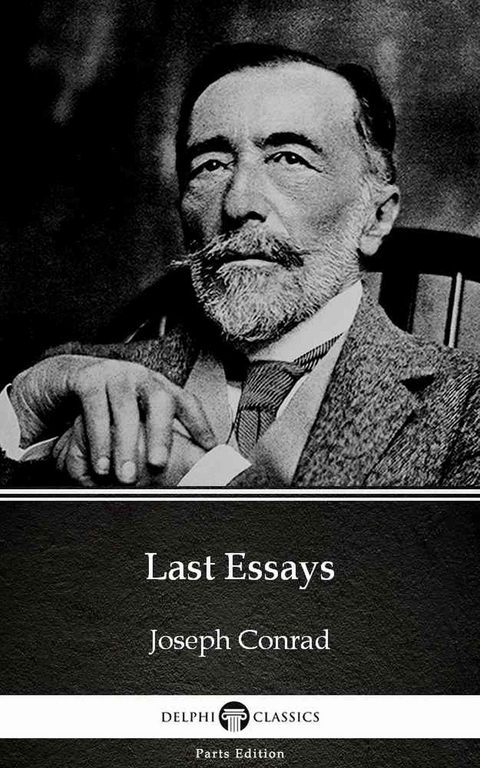
Last Essays by Joseph Conrad (Illustrated) (eBook)
121 Seiten
Publishdrive (Verlag)
978-1-78656-538-9 (ISBN)
Having established their name as the leading publisher of classic literature and art, Delphi Classics produce publications that are individually crafted with superior formatting, while introducing many rare texts for the first time in digital print. The Delphi Classics edition of Conrad includes original annotations and illustrations relating to the life and works of the author, as well as individual tables of contents, allowing you to navigate eBooks quickly and easily.
eBook features:* The complete unabridged text of 'Last Essays'
* Beautifully illustrated with images related to Conrad's works
* Individual contents table, allowing easy navigation around the eBook
* Excellent formatting of the textPlease visit www.delphiclassics.com to learn more about our wide range of titles
This eBook features the unabridged text of 'Last Essays' from the bestselling edition of 'The Complete Works of Joseph Conrad'. Having established their name as the leading publisher of classic literature and art, Delphi Classics produce publications that are individually crafted with superior formatting, while introducing many rare texts for the first time in digital print. The Delphi Classics edition of Conrad includes original annotations and illustrations relating to the life and works of the author, as well as individual tables of contents, allowing you to navigate eBooks quickly and easily.eBook features:* The complete unabridged text of 'Last Essays'* Beautifully illustrated with images related to Conrad's works* Individual contents table, allowing easy navigation around the eBook* Excellent formatting of the textPlease visit www.delphiclassics.com to learn more about our wide range of titles
GEOGRAPHY AND SOME EXPLORERS
It is safe to say that for the majority of mankind the superiority of geography over geometry lies in the appeal of its figures. It may be an effect of the incorrigible frivolity inherent in human nature, but most of us will agree that a map is more fascinating to look at than a figure in a treatise on conic sections — at any rate for the simple minds which are all the equipment of the majority of the dwellers on this earth.
No doubt a trigonometrical survey may be a romantic undertaking, striding over deserts and leaping over valleys never before trodden by the foot of civilized man; but its accurate operations can never have for us the fascination of the first hazardous steps of a venturesome, often lonely, explorer jotting down by the light of his camp fire the thoughts, the impressions, and the toil of his day.
For a long time yet a few suggestive words grappling with things seen will have the advantage over a long array of precise, no doubt interesting, and even profitable figures. The earth is a stage, and though it may be an advantage, even to the right comprehension of the play, to know its exact configuration, it is the drama of human endeavour that will be the thing, with a ruling passion expressed by outward action marching perhaps blindly to success of failure, which themselves are often undistinguishable from each other at first.
Of all the sciences, geography finds its origin in action, and what is more, in adventurous action of the kind that appeals to sedentary people who like to dream of arduous adventure in the manner of prisoners dreaming behind bars of all the hardships and hazards of liberty dear to the heart of man.
Descriptive geography, like any other kind of science, has been built on the experience of certain phenomena and on experiments prompted by that unappeasable curiosity of men which their intelligence has elevated into a quite respectable passion for acquiring knowledge. Like other sciences it has fought its way to truth through a long errors. It has suffered from the love of the marvellous, from our credulity, from rash and unwarrantable assumptions, from the play of unbridled fancy.
Geography had its phase of circumstantially extravagant speculation which had nothing to do with the pursuit of truth, but has given us a curious glimpse of the mediaeval mind playing in its ponderous childish way with the problems of our earth’s shape, its size, its character, its products, its inhabitants. Cartography was almost as pictorial then as are some modern newspapers. It crowded its map with pictures of strange pageants, strange trees, strange beasts, drawn with amazing precision in the midst of theoretically conceived continents. It delineated imaginary kingdoms of Monomotapa and of Prester John, the regions infested by lions or haunted by unicorns, inhabited by men with reversed feet, or eyes in the middle of their breasts.
All this might have been amusing if the mediaeval gravity in the absurd had not been in itself a wearisome thing. But what of that! Has not the key science of modern chemistry passed through its dishonest phase of Alchemy (a portentous development of the confidence trick), and our knowledge of the starry sky been arrived at through the superstitious idealism of Astrology looking for men’s fate in the depths of the infinite? Mere megalomania on a colossal scale. Yet, solemn fooling for solemn fooling of the scientific order, I prefer the kind that does not lay itself out to thrive on the fears and the cupidities of men.
From that point of view geography is the most blameless of sciences. Its fabulous phase never aimed at cheating simple mortals (who are a multitude) out of their peace of mind or their money. At the most it has enticed some of them away from their homes; to death may be, now and then to a little disputed glory, not seldom to contumely, never to high fortune. The greatest of them all, who has presented modern geography with a new world to work upon, was at one time loaded with chains and thrown into prison. Columbus remains a pathetic figure, not a sufferer in the cause of geography, but a victim of the imperfections of jealous human hearts, accepting his fate with resignation. Among explorers he appears lofty in his troubles and like a man of a kingly nature. His contribution to the knowledge of the earth was certainly royal. And if the discovery of America was the occasion of the greatest outburst of reckless cruelty and greed known to history we may say this at least for it, that the gold of Mexico and Peru, unlike the gold of alchemists, was really there, palpable, yet, as ever, the most elusive of the Fata Morgana that lure men away from their homes, as a moment of reflection will convince any one. For nothing it more certain than that there will never be enough gold to go round, as the Conquistadores found out by experience.
I suppose it is not very charitable of me, but I must say that to this day I feel a malicious pleasure at the many disappointments of those pertinacious searchers for El Dorado who climbed mountains, pushed through forests, swam rivers, floundered in bogs, without giving a single thought to the science of geography. Not for them the serene joys of scientific research, but infinite toil, in hunger, thirst: sickness, battle; with broken heads, unseemly squabbles, and empty pockets in the end. I cannot help thinking it served them right. It is an ugly tale, which has not much to do with the service of geography. The geographical knowledge of our day is of the kind that would have been beyond the conception of the hardy followers of Cortes and Pizaro; and of that most estimable of Conquerors who was called Cabeza de Vaca, who was high-minded and dealt humanely with the heathen nations whose territories he traversed in search of one more El Dorado. It is said they loved him greatly, but now the very memory of those nations is gone from the earth, while their territories, which they could not take with them, are being traversed many times every twenty-four hours by the trains of the Southern Pacific railroad.
The discovery of the New World marks the end of the fabulous geography, and it must be owned that the history of the Conquest contains at least one great moment — I mean a geographically great moment — when Vasco Nunez de Balboa, while crossing the Isthmus of Panama, set his eyes for the first time upon the ocean, the immensity of which he did not suspect, and which in his elation he named the Pacific. It is anything but that; but the privileged Conquistador cannot be blamed for surrendering to his first impression.
The Gulf of Panama, which is what he really saw with that first glance, is one of the calmest spots on the waters of the globe. Too calm. The old navigators dreaded it as a dangerous region where one might be caught and lie becalmed for weeks with one’s crew dying slowly of thirst under a cloudless sky. The worst of fates, this, to feel yourself die in a long and helpless agony. How much preferable a region of storms where man and ship can at least put up a fight and remain defiant almost to the last.
I must not be understood to mean that a tempest at sea is a delightful experience, but I would rather face the fiercest tempest than a gulf pacific even to deadliness, a prison-house for incautious caravels and a place of torture for their crews. But Balboa was charmed with its serene aspect. He did not know where he was. He probably thought himself within a stone’s throw, as it were, of the Indies and Cathay. Or did he perhaps, like a man touched with grace, have a moment of exalted vision, the awed feeling that what he was looking at was an abyss of waters comparable in its extent to the view of the unfathomable firmament, and sown all over with groups of islands resembling the constellations of the sky?
But whatever spiritual glimpse of the truth he might have had, Balboa could not possibly know that this great moment of his life had added suddenly thousands of miles to the circumference of the globe, had opened an immense theatre for the human drama of adventure and exploration, a field for the missionary labours of, mainly, Protestant churches, and spread an enormous canvas on which armchair geographers could paint the most fanciful variants of their pet theory of a great southern continent.
I will not quarrel with the post-Columbian cartographers for their wild but, upon the whole, interesting inventions. The provocation to let one’s self go was considerable. Geography militant, which had succeeded the geography fabulous, did not seem able to accept the idea that there was much more water than land on this globe. Nothing could satisfy their sense of the fitness of things but an enormous extent of solid earth which they placed in that region of the South where, as a matter of fact, the great white-crested seas of stormy latitudes will be free to chase each other all round the globe to the end of time. I suppose their landsmen’s temperament stood in the way of their recognition that the world of geography, so far as the apportioning of space goes, seems to have been planned mostly for the convenience of fishes.
What is surprising to me is that the seaman of the time should have really believed that the large continents to the north of the Equator demanded, as a matter of good art or else of sound science, to be balanced by corresponding masses of land in the southern hemisphere. They were simple souls. The chorus of armchair people all singing the same tune made them blind to the many plain signs of a great open sea. Every bit of coast-line discovered, every mountain-top glimpsed in the distance, had to be dragged loyally into the scheme of the Terra Australis Incognita.
Even Tasman, the best...
| Erscheint lt. Verlag | 17.7.2017 |
|---|---|
| Reihe/Serie | Delphi Parts Edition (Joseph Conrad) | Delphi Parts Edition (Joseph Conrad) |
| Sprache | englisch |
| Themenwelt | Literatur ► Anthologien |
| Literatur ► Klassiker / Moderne Klassiker | |
| Literatur ► Romane / Erzählungen | |
| ISBN-10 | 1-78656-538-2 / 1786565382 |
| ISBN-13 | 978-1-78656-538-9 / 9781786565389 |
| Informationen gemäß Produktsicherheitsverordnung (GPSR) | |
| Haben Sie eine Frage zum Produkt? |
 EPUB (Adobe DRM)
Größe: 1,0 MB
Kopierschutz: Adobe-DRM
Adobe-DRM ist ein Kopierschutz, der das eBook vor Mißbrauch schützen soll. Dabei wird das eBook bereits beim Download auf Ihre persönliche Adobe-ID autorisiert. Lesen können Sie das eBook dann nur auf den Geräten, welche ebenfalls auf Ihre Adobe-ID registriert sind.
Details zum Adobe-DRM
Dateiformat: EPUB (Electronic Publication)
EPUB ist ein offener Standard für eBooks und eignet sich besonders zur Darstellung von Belletristik und Sachbüchern. Der Fließtext wird dynamisch an die Display- und Schriftgröße angepasst. Auch für mobile Lesegeräte ist EPUB daher gut geeignet.
Systemvoraussetzungen:
PC/Mac: Mit einem PC oder Mac können Sie dieses eBook lesen. Sie benötigen eine
eReader: Dieses eBook kann mit (fast) allen eBook-Readern gelesen werden. Mit dem amazon-Kindle ist es aber nicht kompatibel.
Smartphone/Tablet: Egal ob Apple oder Android, dieses eBook können Sie lesen. Sie benötigen eine
Geräteliste und zusätzliche Hinweise
Buying eBooks from abroad
For tax law reasons we can sell eBooks just within Germany and Switzerland. Regrettably we cannot fulfill eBook-orders from other countries.
EPUB (Ohne DRM)Digital Rights Management: ohne DRM
Dieses eBook enthält kein DRM oder Kopierschutz. Eine Weitergabe an Dritte ist jedoch rechtlich nicht zulässig, weil Sie beim Kauf nur die Rechte an der persönlichen Nutzung erwerben.
Dateiformat: EPUB (Electronic Publication)
EPUB ist ein offener Standard für eBooks und eignet sich besonders zur Darstellung von Belletristik und Sachbüchern. Der Fließtext wird dynamisch an die Display- und Schriftgröße angepasst. Auch für mobile Lesegeräte ist EPUB daher gut geeignet.
Systemvoraussetzungen:
PC/Mac: Mit einem PC oder Mac können Sie dieses eBook lesen. Sie benötigen dafür die kostenlose Software Adobe Digital Editions.
eReader: Dieses eBook kann mit (fast) allen eBook-Readern gelesen werden. Mit dem amazon-Kindle ist es aber nicht kompatibel.
Smartphone/Tablet: Egal ob Apple oder Android, dieses eBook können Sie lesen. Sie benötigen dafür eine kostenlose App.
Geräteliste und zusätzliche Hinweise
Buying eBooks from abroad
For tax law reasons we can sell eBooks just within Germany and Switzerland. Regrettably we cannot fulfill eBook-orders from other countries.
aus dem Bereich