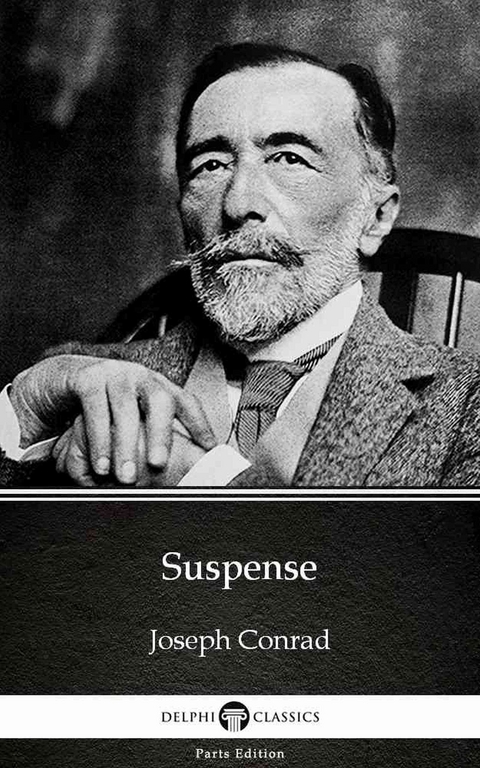
Suspense by Joseph Conrad (Illustrated) (eBook)
166 Seiten
Publishdrive (Verlag)
978-1-78656-536-5 (ISBN)
Having established their name as the leading publisher of classic literature and art, Delphi Classics produce publications that are individually crafted with superior formatting, while introducing many rare texts for the first time in digital print. The Delphi Classics edition of Conrad includes original annotations and illustrations relating to the life and works of the author, as well as individual tables of contents, allowing you to navigate eBooks quickly and easily.
eBook features:* The complete unabridged text of 'Suspense'
* Beautifully illustrated with images related to Conrad's works
* Individual contents table, allowing easy navigation around the eBook
* Excellent formatting of the textPlease visit www.delphiclassics.com to learn more about our wide range of titles
This eBook features the unabridged text of 'Suspense' from the bestselling edition of 'The Complete Works of Joseph Conrad'. Having established their name as the leading publisher of classic literature and art, Delphi Classics produce publications that are individually crafted with superior formatting, while introducing many rare texts for the first time in digital print. The Delphi Classics edition of Conrad includes original annotations and illustrations relating to the life and works of the author, as well as individual tables of contents, allowing you to navigate eBooks quickly and easily.eBook features:* The complete unabridged text of 'Suspense'* Beautifully illustrated with images related to Conrad's works* Individual contents table, allowing easy navigation around the eBook* Excellent formatting of the textPlease visit www.delphiclassics.com to learn more about our wide range of titles
II
COSMO LATHAM had an inborn faculty of orientation in strange surroundings, most invaluable in a cavalry officer, but of which he had never made much use, not even during the few months when he served as a cornet of horse in the Duke of Wellington’s army in the last year of the peninsular campaign. There had been but few occasions to make use of it for a freshly joined subaltern. It stood him in good stead that night, however, while making his way to his inn in a town in which he was a complete stranger, for it allowed him, with but little concern for the direction he took, to think of his home which he loved for itself, every stone and every tree of it — and of the two people he left there, whom he loved too, each in a different way: his father, Sir Charles, and his sister Henrietta.
Latham Hall, a large straggling building showing traces of many styles, flanked by a romantic park and commanding a vast view of the Yorkshire hills, had been the hereditary home of Lathams from the times before the Great Rebellion. That it escaped confiscation then might have been the effect of the worldly prudence of the Latham of the time. He probably took good care not to shock persons of position and influence. That, however, was not the characteristic of the later Lathams down to Sir Charles, Cosmo’s father.
Sir Charles’s unconventional individuality had never been understood by his country neighbours. Born endowed with a good intellect, a lively imagination, and a capacity for social intercourse, it had been his fate, owing to the idiosyncrasies of his own father, to spend his early youth in the depths of Yorkshire in surroundings not at all congenial to his tastes. Later he served for a time in the Guards; but he very soon left the army to make an extended tour in France and Italy. In those last days before the Revolution le chevalier Latham obtained a great social recognition in Paris and Versailles amongst the very best people, not so much by his brilliance as by the depth of his character and the largeness of his ideas. But suddenly he tore himself away from his friendships and successes and proceeded to Italy. There, amongst the members of the English colony in Florence, he met the two Aston girls and, for some reason or other, became a great favourite with their widowed mother. But at the end of some months he suddenly made up his mind to return home. During a long, sleepless night, which he spent pacing up and down in the agony of an internal struggle with himself in the magnificent rooms of his lodgings in Florence, he concluded that he would go home by sea. It was the easiest way of avoiding coming near Paris. He had heard not long before that the best friends he had made in the brilliant society he had frequented in France, the Marquis and the Marquise d’Armand, had a daughter born to them. At Leghorn on the very eve of embarking he had another struggle with himself — but he went by sea. By the time when, after a long sea passage, he put his foot on native soil he had renounced the idea of hurrying on north to shut himself up in his country home. He lingered in London, disdainful and idle, and began reluctantly to fall into the ways of a man about town, when a friend returning from Italy brought him news that Miss Aston was going to marry a Tuscan nobleman of mature years, and, as a piece of queer Florentine gossip, that if the younger sister, Miss Molly Aston, had refused two suitors in quick succession it was because she regarded herself in some way as being engaged to him, Charles Latham.
Whether stung by his conscience or urged by indignation Sir Charles started impulsively for Italy, travelling across the south of France. It was a long road. At first he had been amazed, confounded, and angry; but before he came to the end of his journey he had time to reflect upon what might have easily become an absurd and odious situation. He said to himself that a lot of bother of one sort and another would be saved by his marrying Molly Aston. He did so, to the applause of all right-minded people, and at the end of two years spent abroad came home with his wife to shut himself up in his ancestral hall commanding the view of a wide and romantic landscape, which he thought one of the finest in the world.
Molly Aston had been beautiful enough in her time to inspire several vagrant poets and at least one Italian sculptor; but as Cosmo grew older he began to understand that his mother had been a nonentity in the family life. The greatest piece of self-assertion on her part was his name. She had insisted on calling him Cosmo because the Astons counted, far back in the past, an ancestress of Florentine origin, supposed to have been a connection of the Medici family. Cosmo was fair, and the name was all about him that he had received from his mother. Henrietta was a type of dark beauty. Lady Latham died when both her children were still young. In her life she adorned Latham Hall in the same way as a statue might have adorned it. Her household power was limited to the ordering of the dinner. With habits of meticulous order and a marvellously commonplace mind she had a temperament which, if she had not fallen violently in love at the age of eighteen with the same man whom she married, would have made her fond of society, of amusement, and perhaps even of dissipation. But her only amusement and dissipation consisted of writing long letters to innumerable relations and friends all over the world, of whom after her marriage she saw but very little. She never complained. Her hidden fear of all initiative and the secret ardour of her temperament found their fulfilment in an absolute submission to Sir Charles’s will. She would never have dreamed of asking for horses for a visit in the neighbourhood, but when her husband remarked, “I think it would be advisable for you, my lady, to call at such and such a house,” her face would light up, she would answer with alacrity, “Certainly, Sir Charles,” and go off to array herself magnificently indeed (perhaps because of that drop of Medici blood), but also with great taste.
As the years went on Sir Charles aged more than he ought to have done, and even began to grow a little stout, but no one could fail to see that he had been a very handsome man in his time and that his wife’s early infatuation for him was justified in a way. In politics he was a partisan of Mr. Pitt rather than a downright Tory. He loved his country, believed in its greatness, in its superior virtue, in its irresistible power. Nothing could shake his fidelity to national prejudices of every sort. He had no great liking for grandees and mere aristocrats, despised the fashionable world, and would have nothing whatever to do with any kind of “upstart.” Without being gentle he was naturally kind and hospitable. His native generosity was so well known that no one was surprised when he offered the shelter of his Yorkshire house to a family of French refugees, the Marquis and the Marquise d’Armand and their little daughter Adèle. They had arrived in England in a state of almost complete destitution but with two servants who had shared the dangers and the miseries of their flight from the excesses of the Revolution.
The presence of all these people at Latham Hall which, considered at first as a temporary arrangement, was to last for some years, did not affect in the least Lady Latham’s beautifully dressed, idle equanimity. Had not the D’Armands been Sir Charles’s intimate friends years ago, in France? But she had no curiosity. She was vaguely impressed by the fact that the Marquise was a god-daughter of the Queen of Naples. For the rest it was only so many people more in the servants’ hall, at the dinner table, and in the drawing room where the evenings were spent.
High up on one of the walls a lamp with a shaded reflector concentrated its light on the yellow satin coat on the half-length portrait of a rubicund Latham in a white coburg, which but for the manly and sensitive mouth might have been the portrait of his own coachman. Apart from that spot of beautiful colour the vast room with its windows giving on a terrace (from which Sir Charles was in the habit of viewing sunsets) remained dim with an effect of immensity in which the occupants, and even Sir Charles himself, acquired the appearance of unsubstantial shadows uttering words that had to travel across long, almost unlighted distances.
On one side of the mantelpiece of Italian marbles (a late addition designed by Sir Charles himself) Lady Latham’s profuse jewellery sparkled about her splendid and restful person posed placidly on a sofa. Opposite her, the Marquise would be lying down on a deep couch with one of Lady Latham’s shawls spread over her feet. The D’Armands in their flight from the Terror had saved very little besides their lives, and the Marquise d’Armand’s life had by this time become a very precarious possession.
Sir Charles was perhaps more acutely aware of this than the Marquis her husband. Sir Charles remembered her gentle in her changing moods of gaiety and thought, charming, active, fascinating, and certainly the most intelligent as she was the most beautiful of the women of the French court. Her voice reaching him clear but feeble across the drawing room had a pathetic appeal; and the tone of his answers was tinged with the memory of a great sentiment and with the deference due to great misfortunes. From time to time Lady Latham would make a remark in a matter-of-fact tone which would provoke something resembling curtness in Sir Charles’s elaborately polite reply, and the thought that that woman would have made the very Lord’s Prayer sound prosaic. And then in the long pauses they would pursue their...
| Erscheint lt. Verlag | 17.7.2017 |
|---|---|
| Reihe/Serie | Delphi Parts Edition (Joseph Conrad) | Delphi Parts Edition (Joseph Conrad) |
| Sprache | englisch |
| Themenwelt | Literatur ► Anthologien |
| Literatur ► Klassiker / Moderne Klassiker | |
| Literatur ► Romane / Erzählungen | |
| ISBN-10 | 1-78656-536-6 / 1786565366 |
| ISBN-13 | 978-1-78656-536-5 / 9781786565365 |
| Informationen gemäß Produktsicherheitsverordnung (GPSR) | |
| Haben Sie eine Frage zum Produkt? |
 EPUB (Adobe DRM)
Größe: 1,4 MB
Kopierschutz: Adobe-DRM
Adobe-DRM ist ein Kopierschutz, der das eBook vor Mißbrauch schützen soll. Dabei wird das eBook bereits beim Download auf Ihre persönliche Adobe-ID autorisiert. Lesen können Sie das eBook dann nur auf den Geräten, welche ebenfalls auf Ihre Adobe-ID registriert sind.
Details zum Adobe-DRM
Dateiformat: EPUB (Electronic Publication)
EPUB ist ein offener Standard für eBooks und eignet sich besonders zur Darstellung von Belletristik und Sachbüchern. Der Fließtext wird dynamisch an die Display- und Schriftgröße angepasst. Auch für mobile Lesegeräte ist EPUB daher gut geeignet.
Systemvoraussetzungen:
PC/Mac: Mit einem PC oder Mac können Sie dieses eBook lesen. Sie benötigen eine
eReader: Dieses eBook kann mit (fast) allen eBook-Readern gelesen werden. Mit dem amazon-Kindle ist es aber nicht kompatibel.
Smartphone/Tablet: Egal ob Apple oder Android, dieses eBook können Sie lesen. Sie benötigen eine
Geräteliste und zusätzliche Hinweise
Buying eBooks from abroad
For tax law reasons we can sell eBooks just within Germany and Switzerland. Regrettably we cannot fulfill eBook-orders from other countries.
EPUB (Ohne DRM)Digital Rights Management: ohne DRM
Dieses eBook enthält kein DRM oder Kopierschutz. Eine Weitergabe an Dritte ist jedoch rechtlich nicht zulässig, weil Sie beim Kauf nur die Rechte an der persönlichen Nutzung erwerben.
Dateiformat: EPUB (Electronic Publication)
EPUB ist ein offener Standard für eBooks und eignet sich besonders zur Darstellung von Belletristik und Sachbüchern. Der Fließtext wird dynamisch an die Display- und Schriftgröße angepasst. Auch für mobile Lesegeräte ist EPUB daher gut geeignet.
Systemvoraussetzungen:
PC/Mac: Mit einem PC oder Mac können Sie dieses eBook lesen. Sie benötigen dafür die kostenlose Software Adobe Digital Editions.
eReader: Dieses eBook kann mit (fast) allen eBook-Readern gelesen werden. Mit dem amazon-Kindle ist es aber nicht kompatibel.
Smartphone/Tablet: Egal ob Apple oder Android, dieses eBook können Sie lesen. Sie benötigen dafür eine kostenlose App.
Geräteliste und zusätzliche Hinweise
Buying eBooks from abroad
For tax law reasons we can sell eBooks just within Germany and Switzerland. Regrettably we cannot fulfill eBook-orders from other countries.
aus dem Bereich