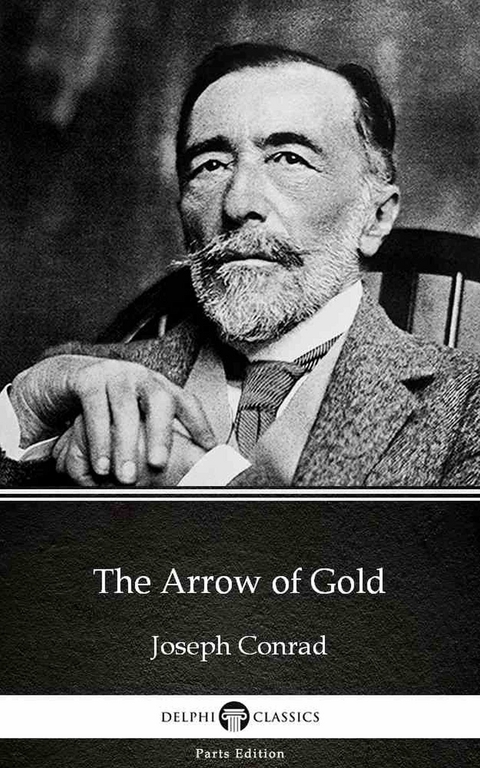
Arrow of Gold by Joseph Conrad (Illustrated) (eBook)
208 Seiten
Publishdrive (Verlag)
978-1-78656-532-7 (ISBN)

Having established their name as the leading publisher of classic literature and art, Delphi Classics produce publications that are individually crafted with superior formatting, while introducing many rare texts for the first time in digital print. The Delphi Classics edition of Conrad includes original annotations and illustrations relating to the life and works of the author, as well as individual tables of contents, allowing you to navigate eBooks quickly and easily.
eBook features:* The complete unabridged text of 'The Arrow of Gold'
* Beautifully illustrated with images related to Conrad's works
* Individual contents table, allowing easy navigation around the eBook
* Excellent formatting of the textPlease visit www.delphiclassics.com to learn more about our wide range of titles
This eBook features the unabridged text of 'The Arrow of Gold' from the bestselling edition of 'The Complete Works of Joseph Conrad'. Having established their name as the leading publisher of classic literature and art, Delphi Classics produce publications that are individually crafted with superior formatting, while introducing many rare texts for the first time in digital print. The Delphi Classics edition of Conrad includes original annotations and illustrations relating to the life and works of the author, as well as individual tables of contents, allowing you to navigate eBooks quickly and easily.eBook features:* The complete unabridged text of 'The Arrow of Gold'* Beautifully illustrated with images related to Conrad's works* Individual contents table, allowing easy navigation around the eBook* Excellent formatting of the textPlease visit www.delphiclassics.com to learn more about our wide range of titles
CHAPTER II
The street in which Mr. Blunt lived presented itself to our eyes, narrow, silent, empty, and dark, but with enough gas-lamps in it to disclose its most striking feature: a quantity of flag-poles sticking out above many of its closed portals. It was the street of Consuls and I remarked to Mr. Blunt that coming out in the morning he could survey the flags of all nations almost — except his own. (The U. S. consulate was on the other side of the town.) He mumbled through his teeth that he took good care to keep clear of his own consulate.
“Are you afraid of the consul’s dog?” I asked jocularly. The consul’s dog weighed about a pound and a half and was known to the whole town as exhibited on the consular fore-arm in all places, at all hours, but mainly at the hour of the fashionable promenade on the Prado.
But I felt my jest misplaced when Mills growled low in my ear: “They are all Yankees there.”
I murmured a confused “Of course.”
Books are nothing. I discovered that I had never been aware before that the Civil War in America was not printed matter but a fact only about ten years old. Of course. He was a South Carolinian gentleman. I was a little ashamed of my want of tact. Meantime, looking like the conventional conception of a fashionable reveller, with his opera-hat pushed off his forehead, Captain Blunt was having some slight difficulty with his latch-key; for the house before which we had stopped was not one of those many-storied houses that made up the greater part of the street. It had only one row of windows above the ground floor. Dead walls abutting on to it indicated that it had a garden. Its dark front presented no marked architectural character, and in the flickering light of a street lamp it looked a little as though it had gone down in the world. The greater then was my surprise to enter a hall paved in black and white marble and in its dimness appearing of palatial proportions. Mr. Blunt did not turn up the small solitary gas-jet, but led the way across the black and white pavement past the end of the staircase, past a door of gleaming dark wood with a heavy bronze handle. It gave access to his rooms he said; but he took us straight on to the studio at the end of the passage.
It was rather a small place tacked on in the manner of a lean-to to the garden side of the house. A large lamp was burning brightly there. The floor was of mere flag-stones but the few rugs scattered about though extremely worn were very costly. There was also there a beautiful sofa upholstered in pink figured silk, an enormous divan with many cushions, some splendid arm-chairs of various shapes (but all very shabby), a round table, and in the midst of these fine things a small common iron stove. Somebody must have been attending it lately, for the fire roared and the warmth of the place was very grateful after the bone-searching cold blasts of mistral outside.
Mills without a word flung himself on the divan and, propped on his arm, gazed thoughtfully at a distant corner where in the shadow of a monumental carved wardrobe an articulated dummy without head or hands but with beautifully shaped limbs composed in a shrinking attitude, seemed to be embarrassed by his stare.
As we sat enjoying the bivouac hospitality (the dish was really excellent and our host in a shabby grey jacket still looked the accomplished man-about-town) my eyes kept on straying towards that corner. Blunt noticed this and remarked that I seemed to be attracted by the Empress.
“It’s disagreeable,” I said. “It seems to lurk there like a shy skeleton at the feast. But why do you give the name of Empress to that dummy?”
“Because it sat for days and days in the robes of a Byzantine Empress to a painter. . . I wonder where he discovered these priceless stuffs. . . You knew him, I believe?”
Mills lowered his head slowly, then tossed down his throat some wine out of a Venetian goblet.
“This house is full of costly objects. So are all his other houses, so is his place in Paris — that mysterious Pavilion hidden away in Passy somewhere.”
Mills knew the Pavilion. The wine had, I suppose, loosened his tongue. Blunt, too, lost something of his reserve. From their talk I gathered the notion of an eccentric personality, a man of great wealth, not so much solitary as difficult of access, a collector of fine things, a painter known only to very few people and not at all to the public market. But as meantime I had been emptying my Venetian goblet with a certain regularity (the amount of heat given out by that iron stove was amazing; it parched one’s throat, and the straw-coloured wine didn’t seem much stronger than so much pleasantly flavoured water) the voices and the impressions they conveyed acquired something fantastic to my mind. Suddenly I perceived that Mills was sitting in his shirt-sleeves. I had not noticed him taking off his coat. Blunt had unbuttoned his shabby jacket, exposing a lot of starched shirt-front with the white tie under his dark shaved chin. He had a strange air of insolence — or so it seemed to me. I addressed him much louder than I intended really.
“Did you know that extraordinary man?”
“To know him personally one had to be either very distinguished or very lucky. Mr. Mills here . . .”
“Yes, I have been lucky,” Mills struck in. “It was my cousin who was distinguished. That’s how I managed to enter his house in Paris — it was called the Pavilion — twice.”
“And saw Doña Rita twice, too?” asked Blunt with an indefinite smile and a marked emphasis. Mills was also emphatic in his reply but with a serious face.
“I am not an easy enthusiast where women are concerned, but she was without doubt the most admirable find of his amongst all the priceless items he had accumulated in that house — the most admirable. . .”
“Ah! But, you see, of all the objects there she was the only one that was alive,” pointed out Blunt with the slightest possible flavour of sarcasm.
“Immensely so,” affirmed Mills. “Not because she was restless, indeed she hardly ever moved from that couch between the windows — you know.”
“No. I don’t know. I’ve never been in there,” announced Blunt with that flash of white teeth so strangely without any character of its own that it was merely disturbing.
“But she radiated life,” continued Mills. “She had plenty of it, and it had a quality. My cousin and Henry Allègre had a lot to say to each other and so I was free to talk to her. At the second visit we were like old friends, which was absurd considering that all the chances were that we would never meet again in this world or in the next. I am not meddling with theology but it seems to me that in the Elysian fields she’ll have her place in a very special company.”
All this in a sympathetic voice and in his unmoved manner. Blunt produced another disturbing white flash and muttered:
“I should say mixed.” Then louder: “As for instance . . .”
“As for instance Cleopatra,” answered Mills quietly. He added after a pause: “Who was not exactly pretty.”
“I should have thought rather a La Vallière,” Blunt dropped with an indifference of which one did not know what to make. He may have begun to be bored with the subject. But it may have been put on, for the whole personality was not clearly definable. I, however, was not indifferent. A woman is always an interesting subject and I was thoroughly awake to that interest. Mills pondered for a while with a sort of dispassionate benevolence, at last:
“Yes, Doña Rita as far as I know her is so varied in her simplicity that even that is possible,” he said. “Yes. A romantic resigned La Vallière . . . who had a big mouth.”
I felt moved to make myself heard.
“Did you know La Vallière, too?” I asked impertinently.
Mills only smiled at me. “No. I am not quite so old as that,” he said. “But it’s not very difficult to know facts of that kind about a historical personage. There were some ribald verses made at the time, and Louis XIV was congratulated on the possession — I really don’t remember how it goes — on the possession of:
“. . . de ce bec amoureux
Qui d’une oreille à l’autre va,
Tra là là.
or something of the sort. It needn’t be from ear to ear, but it’s a fact that a big mouth is often a sign of a certain generosity of mind and feeling. Young man, beware of women with small mouths. Beware of the others, too, of course; but a small mouth is a fatal sign. Well, the royalist sympathizers can’t charge Doña Rita with any lack of generosity from what I hear. Why should I judge her? I have known her for, say, six hours altogether. It was enough to feel the seduction of her native intelligence and of her splendid physique. And all that was brought home to me so quickly,” he concluded, “because she had what some Frenchman has called the ‘terrible gift of familiarity’.”
Blunt had been listening moodily. He nodded assent.
“Yes!” Mills’ thoughts were still dwelling in the past. “And when saying good-bye she could put in an instant an immense distance between herself and you. A slight stiffening of that perfect figure, a change of the physiognomy: it was like being dismissed by a person born in the purple. Even if she did offer you her hand...
| Erscheint lt. Verlag | 17.7.2017 |
|---|---|
| Reihe/Serie | Delphi Parts Edition (Joseph Conrad) | Delphi Parts Edition (Joseph Conrad) |
| Sprache | englisch |
| Themenwelt | Literatur ► Anthologien |
| Literatur ► Klassiker / Moderne Klassiker | |
| Literatur ► Romane / Erzählungen | |
| ISBN-10 | 1-78656-532-3 / 1786565323 |
| ISBN-13 | 978-1-78656-532-7 / 9781786565327 |
| Informationen gemäß Produktsicherheitsverordnung (GPSR) | |
| Haben Sie eine Frage zum Produkt? |
 EPUB (Adobe DRM)
Größe: 1,4 MB
Kopierschutz: Adobe-DRM
Adobe-DRM ist ein Kopierschutz, der das eBook vor Mißbrauch schützen soll. Dabei wird das eBook bereits beim Download auf Ihre persönliche Adobe-ID autorisiert. Lesen können Sie das eBook dann nur auf den Geräten, welche ebenfalls auf Ihre Adobe-ID registriert sind.
Details zum Adobe-DRM
Dateiformat: EPUB (Electronic Publication)
EPUB ist ein offener Standard für eBooks und eignet sich besonders zur Darstellung von Belletristik und Sachbüchern. Der Fließtext wird dynamisch an die Display- und Schriftgröße angepasst. Auch für mobile Lesegeräte ist EPUB daher gut geeignet.
Systemvoraussetzungen:
PC/Mac: Mit einem PC oder Mac können Sie dieses eBook lesen. Sie benötigen eine
eReader: Dieses eBook kann mit (fast) allen eBook-Readern gelesen werden. Mit dem amazon-Kindle ist es aber nicht kompatibel.
Smartphone/Tablet: Egal ob Apple oder Android, dieses eBook können Sie lesen. Sie benötigen eine
Geräteliste und zusätzliche Hinweise
Buying eBooks from abroad
For tax law reasons we can sell eBooks just within Germany and Switzerland. Regrettably we cannot fulfill eBook-orders from other countries.
EPUB (Ohne DRM)Digital Rights Management: ohne DRM
Dieses eBook enthält kein DRM oder Kopierschutz. Eine Weitergabe an Dritte ist jedoch rechtlich nicht zulässig, weil Sie beim Kauf nur die Rechte an der persönlichen Nutzung erwerben.
Dateiformat: EPUB (Electronic Publication)
EPUB ist ein offener Standard für eBooks und eignet sich besonders zur Darstellung von Belletristik und Sachbüchern. Der Fließtext wird dynamisch an die Display- und Schriftgröße angepasst. Auch für mobile Lesegeräte ist EPUB daher gut geeignet.
Systemvoraussetzungen:
PC/Mac: Mit einem PC oder Mac können Sie dieses eBook lesen. Sie benötigen dafür die kostenlose Software Adobe Digital Editions.
eReader: Dieses eBook kann mit (fast) allen eBook-Readern gelesen werden. Mit dem amazon-Kindle ist es aber nicht kompatibel.
Smartphone/Tablet: Egal ob Apple oder Android, dieses eBook können Sie lesen. Sie benötigen dafür eine kostenlose App.
Geräteliste und zusätzliche Hinweise
Buying eBooks from abroad
For tax law reasons we can sell eBooks just within Germany and Switzerland. Regrettably we cannot fulfill eBook-orders from other countries.
aus dem Bereich