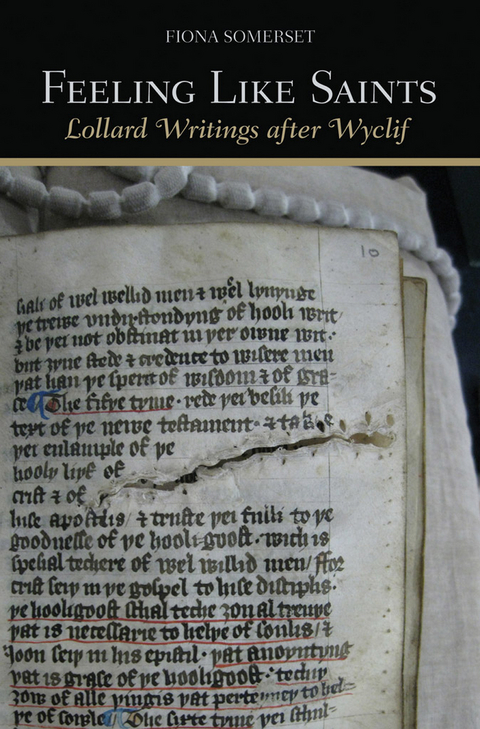
Feeling Like Saints (eBook)
336 Seiten
Cornell University Press (Verlag)
978-0-8014-7098-1 (ISBN)
Fiona Somerset examines the lollard movement by closely reading their own writings, which provide rich evidence for how lollard writers collaborated with one another and with their readers to produce a distinctive religious identity based around structures of feeling.
"Lollard" is the name given to followers of John Wyclif, the English dissident theologian who was dismissed from Oxford University in 1381 for his arguments regarding the eucharist. A forceful and influential critic of the ecclesiastical status quo in the late fourteenth century, Wyclif's thought was condemned at the Council of Constance in 1415. While lollardy has attracted much attention in recent years, much of what we think we know about this English religious movement is based on records of heresy trials and anti-lollard chroniclers. In Feeling Like Saints, Fiona Somerset demonstrates that this approach has limitations. A better basis is the five hundred or so manuscript books from the period (1375–1530) containing materials translated, composed, or adapted by lollard writers themselves.
These writings provide rich evidence for how lollard writers collaborated with one another and with their readers to produce a distinctive religious identity based around structures of feeling. Lollards wanted to feel like saints. From Wyclif they drew an extraordinarily rigorous ethic of mutual responsibility that disregarded both social status and personal risk. They recalled their commitment to this ethic by reading narratives of physical suffering and vindication, metaphorically martyring themselves by inviting scorn for their zeal, and enclosing themselves in the virtues rather than the religious cloister. Yet in many ways they were not that different from their contemporaries, especially those with similar impulses to exceptional holiness.
"Lollard" is the name given to followers of John Wyclif, the English dissident theologian who was dismissed from Oxford University in 1381 for his arguments regarding the eucharist. A forceful and influential critic of the ecclesiastical status quo in the late fourteenth century, Wyclif's thought was condemned at the Council of Constance in 1415. While lollardy has attracted much attention in recent years, much of what we think we know about this English religious movement is based on records of heresy trials and anti-lollard chroniclers. In Feeling Like Saints, Fiona Somerset demonstrates that this approach has limitations. A better basis is the five hundred or so manuscript books from the period (1375–1530) containing materials translated, composed, or adapted by lollard writers themselves.These writings provide rich evidence for how lollard writers collaborated with one another and with their readers to produce a distinctive religious identity based around structures of feeling. Lollards wanted to feel like saints. From Wyclif they drew an extraordinarily rigorous ethic of mutual responsibility that disregarded both social status and personal risk. They recalled their commitment to this ethic by reading narratives of physical suffering and vindication, metaphorically martyring themselves by inviting scorn for their zeal, and enclosing themselves in the virtues rather than the religious cloister. Yet in many ways they were not that different from their contemporaries, especially those with similar impulses to exceptional holiness.
Fiona Somerset is Professor of English at the University of Connecticut. She is the author of Clerical Discourse and Lay Audience in Late Medieval England and the coeditor of Lollards and Their Influence in Late Medieval England and The Vulgar Tongue: Medieval and Postmedieval Vernacularity.
Introduction
Part One
1. The Lollard Pastoral Program: Reform from Below
2. God's Law: Loving, Learning, and Teaching
3. Lollard Prayer: Religious Practice and Everyday Life
Part Two
4. Lollard Tales
5. Lollard Parabiblia
Part Three
6. Moral Fantasie: Normative Allegory in Lollard Writings
7. Lollard Forms of Living
Conclusion
Appendix A: Brief Descriptions of Frequently Cited Manuscripts
Appendix B: The Pastoral Syllabus of SS74 and a Detailed Summary of the Sermons
| Erscheint lt. Verlag | 8.5.2014 |
|---|---|
| Verlagsort | Ithaca |
| Sprache | englisch |
| Maße | 160 x 160 mm |
| Gewicht | 28 g |
| Themenwelt | Literatur ► Essays / Feuilleton |
| Sachbuch/Ratgeber ► Geschichte / Politik ► Mittelalter | |
| Geschichte ► Allgemeine Geschichte ► Mittelalter | |
| Geisteswissenschaften ► Geschichte ► Regional- / Ländergeschichte | |
| Geschichte ► Teilgebiete der Geschichte ► Religionsgeschichte | |
| Religion / Theologie ► Christentum ► Kirchengeschichte | |
| Geisteswissenschaften ► Sprach- / Literaturwissenschaft ► Anglistik / Amerikanistik | |
| Geisteswissenschaften ► Sprach- / Literaturwissenschaft ► Literaturwissenschaft | |
| Schlagworte | religious texts, heresy, medieval religion, medieval christianity, history of religion, english theology, ecclesiastical status quo, council of constance, lollardy |
| ISBN-10 | 0-8014-7098-6 / 0801470986 |
| ISBN-13 | 978-0-8014-7098-1 / 9780801470981 |
| Informationen gemäß Produktsicherheitsverordnung (GPSR) | |
| Haben Sie eine Frage zum Produkt? |
 EPUB (Adobe DRM)
Kopierschutz: Adobe-DRM
Adobe-DRM ist ein Kopierschutz, der das eBook vor Mißbrauch schützen soll. Dabei wird das eBook bereits beim Download auf Ihre persönliche Adobe-ID autorisiert. Lesen können Sie das eBook dann nur auf den Geräten, welche ebenfalls auf Ihre Adobe-ID registriert sind.
Details zum Adobe-DRM
Dateiformat: EPUB (Electronic Publication)
EPUB ist ein offener Standard für eBooks und eignet sich besonders zur Darstellung von Belletristik und Sachbüchern. Der Fließtext wird dynamisch an die Display- und Schriftgröße angepasst. Auch für mobile Lesegeräte ist EPUB daher gut geeignet.
Systemvoraussetzungen:
PC/Mac: Mit einem PC oder Mac können Sie dieses eBook lesen. Sie benötigen eine
eReader: Dieses eBook kann mit (fast) allen eBook-Readern gelesen werden. Mit dem amazon-Kindle ist es aber nicht kompatibel.
Smartphone/Tablet: Egal ob Apple oder Android, dieses eBook können Sie lesen. Sie benötigen eine
Geräteliste und zusätzliche Hinweise
Buying eBooks from abroad
For tax law reasons we can sell eBooks just within Germany and Switzerland. Regrettably we cannot fulfill eBook-orders from other countries.
aus dem Bereich