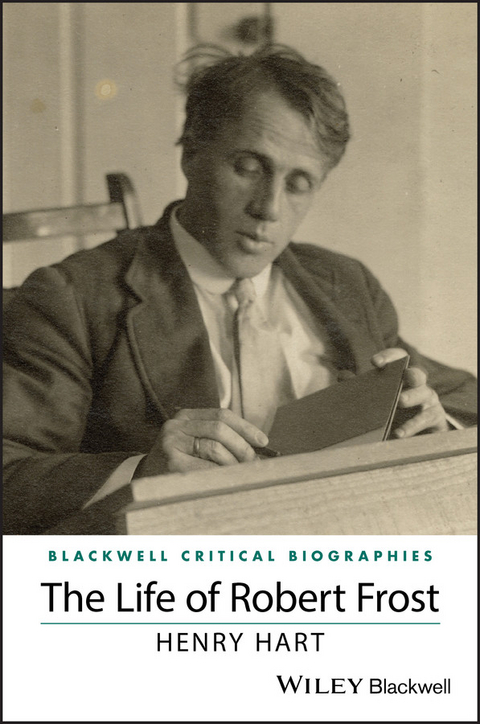
The Life of Robert Frost (eBook)
John Wiley & Sons (Verlag)
978-1-119-10365-3 (ISBN)
The Life of Robert Frost presents a unique and rich approach to the poet that includes original genealogical research concerning Frost's ancestors, and a demonstration of how mental illness plagued the Frost family and heavily influenced Frost's poetry.
- A widely revealing biography of Frost that discusses his often perplexing journey from humble roots to poetic fame, revealing new details of Frost's life
- Takes a unique approach by giving attention to Frost's genealogy and the family history of mental illness, presenting a complete picture of Frost's complexity
- Discusses the traumatic effect on Frost of his father's early death and the impact on his poetry and outlook
- Presents original information on the influence of his mother's Swedenborgian mysticism
HENRY HART is currently the Mildred and J. B. Hickman Professor of Humanities at the College of William and Mary, and Poet Laureate of Virginia. He has published several books of literary criticism about modern poets, including The Poetry of Geoffrey Hill (1986), Seamus Heaney: Poet of Contrary Progressions (1991), Robert Lowell and the Sublime (1995), and James Dickey: The World as a Lie (2000).
The Life of Robert Frost presents a unique and rich approach to the poet that includes original genealogical research concerning Frost's ancestors, and a demonstration of how mental illness plagued the Frost family and heavily influenced Frost's poetry. A widely revealing biography of Frost that discusses his often perplexing journey from humble roots to poetic fame, revealing new details of Frost's life Takes a unique approach by giving attention to Frost's genealogy and the family history of mental illness, presenting a complete picture of Frost's complexity Discusses the traumatic effect on Frost of his father's early death and the impact on his poetry and outlook Presents original information on the influence of his mother's Swedenborgian mysticism
HENRY HART is currently the Mildred and J. B. Hickman Professor of Humanities at the College of William and Mary, and Poet Laureate of Virginia. He has published several books of literary criticism about modern poets, including The Poetry of Geoffrey Hill (1986), Seamus Heaney: Poet of Contrary Progressions (1991), Robert Lowell and the Sublime (1995), and James Dickey: The World as a Lie (2000).
Acknowledgments ix
List of Abbreviations and Author's Note xi
1. The New England Frosts 1
2. Rebel Sons and Punitive Fathers 8
3. Strong Man's Food and Swedenborgian Mysticism 18
4. "A Boy's Will is the Wind's Will" 26
5. Reluctant Yankees 39
6. Monuments to After-thought 55
7. "Precipitate in Love" 64
8. Adventures in the Great Dismal Swamp 80
9. From Riffraff to Harvard 93
10. Deaths of a Son and a Hired Man 104
11. Indoor and Outdoor Schooling 121
12. Hen Man in the Academy 134
13. To the Land of The Golden Treasury 148
14. The Lively Gallows 167
15. Victory at Home 180
16. Amherst Interval 202
17. Sense and Sensibility 217
18. A Home that Never Was on Land or Sea 230
19. Something beyond Conflict 240
20. Delivering Battle 251
21. Weddings, Divorces, and Funerals 261
22. A Survivalist's Further Range 278
23. Elinor's Final Ordeal 294
24. Inferno to Vita Nuova 302
25. A Biblical Job by a Witness Tree 320
26. Mercy for the Damned 332
27. Mr Frost Goes to Washington 344
28. A Brief Shining Moment with the Kennedys 361
29. Last Act on the Global Stage 376
Notes 390
Bibliography 415
Index 423
1
The New England Frosts
Robert Frost, that quintessential New England poet, was not always a New Englander. His father had an abiding dislike for the region and had no intention of raising his children there. Growing up about 30 miles north of Boston in the industrial city of Lawrence, Massachusetts, William (or Will, as he was nicknamed) complained that the region was still in the grip of the Puritans who had founded it. His most dramatic rebellion occurred around 1862 when he ran away from home to fight for Robert E. Lee’s Army of Northern Virginia. Having recently defeated General McClellan in the Peninsular Campaign and General Pope at the Second Battle of Bull Run, General Lee was one of the most glamorous enemies of New England to whom Will could declare allegiance. While pro‐Lincoln Bostonians such as Senator Charles Sumner fulminated against the institution of slavery and Colonel Robert Shaw led an African American regiment into battle against Confederates in South Carolina, Will sided with the “Copperheads,” who were considered poisonous snakes by Boston abolitionists and other anti‐Confederate New Englanders.
Although Will’s attempt to join Lee’s army proved futile (police apprehended him in Philadelphia and sent him home to Lawrence), a decade later he put New England behind him for good, this time by traveling to San Francisco, where he worked as a newspaper reporter. For the rest of his life, Will had little contact with his family in Massachusetts, remained stubbornly committed to the principles of the antebellum South, and continued to revere Robert E. Lee. Rather than name his son after a New England military hero or Frost ancestor, which was the family custom, Will named him Robert Lee Frost in homage to his Confederate idol. As a journalist with political ambitions, he criticized New Englanders for being idealistic killjoys, and he worked tirelessly for politicians opposed to Lincoln’s Republican policies of racial integration. He kept an iconic picture of General Lee on his office desk and talked to his son about the possibility of a second civil war in which future generals like Lee might win a belated victory. With the boy looking over his shoulder, he pointed to several regions on a map of the United States that he thought could break away from the Union to form separate confederacies.
Listening to his father’s stories about the early Frosts who had made their homes in New England, Rob, as he was often called by his parents, must have thought it strange that his father was the only member of the family to sever ties with New England. For seven generations, the Frosts had lived within a 25‐mile radius of the spot north of Boston where the family patriarch, Nicholas Frost, had first settled in the seventeenth century. As a boy, Rob heard his father wax lyrical about Nicholas’s family battling Native Americans in King Philip’s War and King William’s War. (Will admired his ancestors’ military prowess while despising their Puritanism.) Rob later told a friend: “I was forever being told what a great ancestry I had come by – Indian fighters, some who had married into shavetail nobility [i.e., into the families of newly commissioned military officers] … till I found myself in distaste of them.”1 Like his father siding with New England’s Confederate enemies, Rob sided with New England’s other early enemies: the Native Americans. In one of the first stories he wrote as a boy in San Francisco, he recounted a dream that was uncannily similar to his father’s account of running away from home to fight for General Lee, only Rob dreamed of running away to join a band of Native American warriors in California’s Sierra Nevada. He idealized these renegades the way his father had idealized the Confederacy. He imagined them welcoming him as a hero, inflicting punishment on their enemies (white settlers like the Frosts) with impunity, and always returning unharmed to their utopian community in the mountains. Rob wrote in a notebook that “Civilization is the opposite of Utopia,”2 and for much of his life he sought relief from civilization in sparsely populated communities in or near mountains like the ones that protected the Native Americans in his boyhood dream.
Rob’s military‐minded father showed a keen interest in family history as a young man, and as a father he passed that interest on to Rob. Several years after failing to get admitted to West Point (General Lee’s alma mater), Will wrote a 10‐page genealogical essay for his Harvard Class Book that focused on Frost ancestors who had established a tradition of soldiering. For two centuries, he noted, Frost men had fought with distinction in most of the country’s major wars. Will’s father, William Prescott Frost Sr, had encouraged his son’s passion for all things military by giving him the name of their distant relative William Prescott, the legendary commander at the Battle of Bunker Hill who reputedly shouted to his troops as the British advanced: “Don’t fire until you see the whites of their eyes!”3 Acutely aware of the Frosts’ warrior ethos, Will tried to show he was made of the same bellicose stuff as his ancestors by regularly engaging in street fights with immigrants who worked in Lawrence’s textile mills. His father admired his feisty spirit, but eventually imposed a curfew and locked him in his room so he would refrain from fighting at night. Showing a characteristic mix of cunning and recklessness, Will climbed down a rope ladder to continue his combative ways in the city’s dimly lit streets.
After inheriting a copy of his father’s genealogical essay as an adult and receiving other accounts of ancestors from friends, Robert Frost reiterated his admiration for Native Americans and his distaste for New England precursors who fought them in “Genealogical,” a poem written in 1908. Although he told a journal editor he aimed to present an “authentic bit of family history” about Charles Frost, his “bad ancestor the Indian Killer,”4 his poem exaggerates Charles’s life, lampoons his well‐known military accomplishments, and admits to a “lifelong liking for [the] Indians” who had murdered him. Another poem written at about the same time, “The Generations of Men,” gives another caustic assessment of Frost’s New England heritage. While “Studying genealogy,” one character in the poem (a member of the Stark family who resembles Frost) declares: “What will we come to/With all this pride of ancestry, we Yankees?/I think we’re all mad.” To Frost as a young poet, his Yankee past seemed more of a burden than a blessing. Some of his forebears even seemed “stark” mad. Convinced that Frost had inherited many “eccentric” family traits, his close high school friend Carl Burell told one biographer: “To understand ROB FROST you must know his ancestors.”5 His ancestors did, indeed, provide Rob with models he tried – with various degrees of success – to emulate and resist.
The earliest records reveal that the Frosts (or “Forsts,” as the name was first spelled) were known for their military and civic activities. Some participated in the invasion of Britain by Anglo‐Saxon warriors during the fifth century, while others fought for a foothold in Britain with the Danish Vikings during the ninth century. One ancestor, Henry, named his son Robert Frost and established the Hospital of the Brothers of St John the Evangelist in 1135, which in 1509 became St John’s College, Cambridge. Once the Frosts immigrated to New England, they earned reputations as stolid Yankee farmers, merchants, soldiers, and public officials for the next two and a half centuries. The first English Frost to cross the Atlantic Ocean and settle in New England, however, was different. Court documents show that, shortly after Nicholas Frost arrived on the southern Maine coast, he was convicted of “thefte committed att Damerills Cove upon the Indeans, [and] for drunkenes and fornicacon.” His crimes on Damariscove Island (a fishing and trading site about 30 miles northeast of present‐day Portland) exacerbated the already tense relations between native and non‐native communities. For the Puritan magistrates who heard his case, drunkenness and fornication were especially heinous crimes. As punishment, he was ordered to pay a fine of £5 to the magistrates and £11 to his employers. According to historian Wilbur Spencer, the magistrates also stipulated that Nicholas be “severely whipt, & branded in the hand with a hott iron, & after banished out of this pattent.”6 His banishment from the “patent” – the land in New England granted to the colonists by King James I – was supposed to be permanent. If Nicholas returned and was caught, he would be executed.
Whether or not Nicholas obeyed the court’s order is uncertain. Spencer contends that Nicholas “went back to England in some fishing vessel” and “in June 1634 returned to New England with his family, sailing from Plymouth in the Wulfrana, which with a few passengers may have come on a fishing voyage to the Isles of Shoals [10 miles off the coast of New Hampshire].”7 By contrast, the historian Charles Libby suggests that Nicholas remained in New England, but fled the site of his crimes to avoid capture. After his 1632 appearance...
| Erscheint lt. Verlag | 8.3.2017 |
|---|---|
| Reihe/Serie | Blackwell Critical Biographies |
| Blackwell Critical Biographies | Wiley Blackwell Critical Biographies |
| Sprache | englisch |
| Themenwelt | Literatur ► Biografien / Erfahrungsberichte |
| Literatur ► Romane / Erzählungen | |
| Geisteswissenschaften ► Sprach- / Literaturwissenschaft ► Anglistik / Amerikanistik | |
| Geisteswissenschaften ► Sprach- / Literaturwissenschaft ► Literaturwissenschaft | |
| Schlagworte | 20th Century & Contemporary American Literature • A Further Range • American poetry • Amerikanische Literatur / 20. Jhd. u. zeitgenössische Werke • A Witness Tree • Edwin Arlington Robinson • Elinor White • Frost, Robert L. • Literature • Literaturwissenschaft • Modernist poetry • New England • New Hampshire • Robert Frost • Swedenborgian Church • the road not taken • The Sound of Trees • Thomas Hardy • W.B. Yeats |
| ISBN-10 | 1-119-10365-7 / 1119103657 |
| ISBN-13 | 978-1-119-10365-3 / 9781119103653 |
| Informationen gemäß Produktsicherheitsverordnung (GPSR) | |
| Haben Sie eine Frage zum Produkt? |
 EPUB (Adobe DRM)
Kopierschutz: Adobe-DRM
Adobe-DRM ist ein Kopierschutz, der das eBook vor Mißbrauch schützen soll. Dabei wird das eBook bereits beim Download auf Ihre persönliche Adobe-ID autorisiert. Lesen können Sie das eBook dann nur auf den Geräten, welche ebenfalls auf Ihre Adobe-ID registriert sind.
Details zum Adobe-DRM
Dateiformat: EPUB (Electronic Publication)
EPUB ist ein offener Standard für eBooks und eignet sich besonders zur Darstellung von Belletristik und Sachbüchern. Der Fließtext wird dynamisch an die Display- und Schriftgröße angepasst. Auch für mobile Lesegeräte ist EPUB daher gut geeignet.
Systemvoraussetzungen:
PC/Mac: Mit einem PC oder Mac können Sie dieses eBook lesen. Sie benötigen eine
eReader: Dieses eBook kann mit (fast) allen eBook-Readern gelesen werden. Mit dem amazon-Kindle ist es aber nicht kompatibel.
Smartphone/Tablet: Egal ob Apple oder Android, dieses eBook können Sie lesen. Sie benötigen eine
Geräteliste und zusätzliche Hinweise
Buying eBooks from abroad
For tax law reasons we can sell eBooks just within Germany and Switzerland. Regrettably we cannot fulfill eBook-orders from other countries.
aus dem Bereich