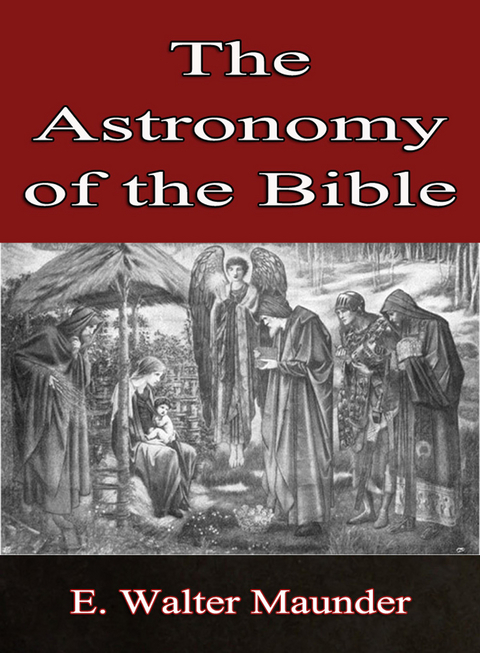
Astronomy of the Bible (eBook)
325 Seiten
Publishdrive (Verlag)
978-1-312-97518-7 (ISBN)
Modern astronomy began a little more than three centuries ago with the invention of the telescope and Galileo's application of it to the study of the heavenly bodies. This new instrument at once revealed to him the mountains on the moon, the satellites of Jupiter, and the spots on the sun, and brought the celestial bodies under observation in a way that no one had dreamed of before. In our view to-day, the planets of the solar system are worlds; we can examine their surfaces and judge wherein they resemble or differ from our earth. To the ancients they were but points of light; to us they are vast bodies that we have been able to measure and to weigh. The telescope has enabled us also to penetrate deep into outer space; we have learnt of other systems besides that of our own sun and its dependents, many of them far more complex; clusters and clouds of stars have been revealed to us, and mysterious nebulæ, which suggest by their forms that they are systems of suns in the making. More lately the invention of the spectroscope has informed us of the very elements which go to the composition of these numberless stars, and we can distinguish those which are in a similar condition to our sun from those differing from him. And photography has recorded for us objects too faint for mere sight to detect, even when aided by the most powerful telescope; too detailed and intricate for the most skilful hand to depict.
Galileo's friend and contemporary, Kepler, laid the foundations of another department of modern astronomy at about the same time. He studied the apparent movements of the planets until they yielded him their secret so far that he was able to express them in three simple laws, laws which, two generations later, Sir Isaac Newton demonstrated to be the outcome of one grand and simple law of universal range, the law of gravitation. Upon this law the marvellous mathematical conquests of astronomy have been based.
All these wonderful results have been attained by the free exercise of men's mental abilities, and it cannot be imagined that God would have intervened to hamper their growth in intellectual power by revealing to men facts and methods which it was within their own ability to discover for themselves. Men's mental powers have developed by their exercise; they would have been stunted had men been led to look to revelation rather than to diligent effort for the satisfaction of their curiosity. We therefore do not find any reference in the Bible to that which modern astronomy has taught us. Yet it may be noted that some expressions, appropriate at any time, have become much more appropriate, much more forcible, in the light of our present-day knowledge.
Modern astronomy began a little more than three centuries ago with the invention of the telescope and Galileo's application of it to the study of the heavenly bodies. This new instrument at once revealed to him the mountains on the moon, the satellites of Jupiter, and the spots on the sun, and brought the celestial bodies under observation in a way that no one had dreamed of before. In our view to-day, the planets of the solar system are worlds; we can examine their surfaces and judge wherein they resemble or differ from our earth. To the ancients they were but points of light; to us they are vast bodies that we have been able to measure and to weigh. The telescope has enabled us also to penetrate deep into outer space; we have learnt of other systems besides that of our own sun and its dependents, many of them far more complex; clusters and clouds of stars have been revealed to us, and mysterious nebulae, which suggest by their forms that they are systems of suns in the making. More lately the invention of the spectroscope has informed us of the very elements which go to the composition of these numberless stars, and we can distinguish those which are in a similar condition to our sun from those differing from him. And photography has recorded for us objects too faint for mere sight to detect, even when aided by the most powerful telescope; too detailed and intricate for the most skilful hand to depict.Galileo's friend and contemporary, Kepler, laid the foundations of another department of modern astronomy at about the same time. He studied the apparent movements of the planets until they yielded him their secret so far that he was able to express them in three simple laws, laws which, two generations later, Sir Isaac Newton demonstrated to be the outcome of one grand and simple law of universal range, the law of gravitation. Upon this law the marvellous mathematical conquests of astronomy have been based.All these wonderful results have been attained by the free exercise of men's mental abilities, and it cannot be imagined that God would have intervened to hamper their growth in intellectual power by revealing to men facts and methods which it was within their own ability to discover for themselves. Men's mental powers have developed by their exercise; they would have been stunted had men been led to look to revelation rather than to diligent effort for the satisfaction of their curiosity. We therefore do not find any reference in the Bible to that which modern astronomy has taught us. Yet it may be noted that some expressions, appropriate at any time, have become much more appropriate, much more forcible, in the light of our present-day knowledge.
| Erscheint lt. Verlag | 27.12.2016 |
|---|---|
| Sprache | englisch |
| Themenwelt | Literatur ► Fantasy / Science Fiction ► Science Fiction |
| Naturwissenschaften ► Physik / Astronomie ► Astronomie / Astrophysik | |
| Schlagworte | astronomy bible • Hinduism • Religious • Spirituality |
| ISBN-10 | 1-312-97518-0 / 1312975180 |
| ISBN-13 | 978-1-312-97518-7 / 9781312975187 |
| Informationen gemäß Produktsicherheitsverordnung (GPSR) | |
| Haben Sie eine Frage zum Produkt? |
 EPUB (Ohne DRM)
Digital Rights Management: ohne DRM
Dieses eBook enthält kein DRM oder Kopierschutz. Eine Weitergabe an Dritte ist jedoch rechtlich nicht zulässig, weil Sie beim Kauf nur die Rechte an der persönlichen Nutzung erwerben.
Dateiformat: EPUB (Electronic Publication)
EPUB ist ein offener Standard für eBooks und eignet sich besonders zur Darstellung von Belletristik und Sachbüchern. Der Fließtext wird dynamisch an die Display- und Schriftgröße angepasst. Auch für mobile Lesegeräte ist EPUB daher gut geeignet.
Systemvoraussetzungen:
PC/Mac: Mit einem PC oder Mac können Sie dieses eBook lesen. Sie benötigen dafür die kostenlose Software Adobe Digital Editions.
eReader: Dieses eBook kann mit (fast) allen eBook-Readern gelesen werden. Mit dem amazon-Kindle ist es aber nicht kompatibel.
Smartphone/Tablet: Egal ob Apple oder Android, dieses eBook können Sie lesen. Sie benötigen dafür eine kostenlose App.
Geräteliste und zusätzliche Hinweise
Buying eBooks from abroad
For tax law reasons we can sell eBooks just within Germany and Switzerland. Regrettably we cannot fulfill eBook-orders from other countries.
aus dem Bereich