


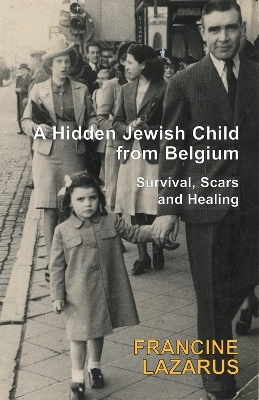
A Hidden Jewish Child from Belgium
Survival, Scars and Healing
Seiten
2017
Vallentine Mitchell & Co Ltd (Verlag)
978-1-910383-28-5 (ISBN)
Vallentine Mitchell & Co Ltd (Verlag)
978-1-910383-28-5 (ISBN)
Francine Lazarus survived WWII in Belgium hidden with strangers, isolated from her family, and moved from place to place. However, this testimony is much more than a chronicle of Francine's life. Plagued by secrecy, guilt, and shame, she explains how silence affected her life, and the events that prompted her to share her story.
Francine Lazarus survived WWII in Belgium hidden with strangers, isolated from her family, and moved from place to place. She witnessed murder and was often injured herself. With her father murdered in Auschwitz, her story continues post-war with the young Francine, neglected and abused by her family, being sent into foster care, and only commencing schooling aged eight. At 13 she was sent to work and forced to abandon education. Like most child Survivors, she was told to forget about her war experiences. After involuntary migration to Australia her life began to improve. She created a loving family and, in middle age, earned bachelor's and master's degrees.
However, this testimony is much more than a chronicle of Francine's life. Plagued by secrecy, guilt, and shame, she explains how silence affected her life, and the events that prompted her to share her story.
The book is particularly valuable because Francine relates her memories, emotions and introspection to the existing literature on Hidden Children. The research on her life, family and their history (including books, papers, archives, and museum documents) is interspersed throughout the book, offering a detailed portrayal of her situation, and this description by a Survivor of her reconstruction and self-healing process is rare in existing literature. Furthermore, her immigration, part of the recovery process, is a fascinating and under-researched topic, which allows for a unique insight into post-war expatriation.
The issue of reconstruction is what makes this book a considerable addition to current literature. It fills the gap between the intimacy of individual memoirs and the past ten years' academic research conducted on elderly hidden Jewish children by historians, psychologists, and other professionals.
Francine Lazarus survived WWII in Belgium hidden with strangers, isolated from her family, and moved from place to place. She witnessed murder and was often injured herself. With her father murdered in Auschwitz, her story continues post-war with the young Francine, neglected and abused by her family, being sent into foster care, and only commencing schooling aged eight. At 13 she was sent to work and forced to abandon education. Like most child Survivors, she was told to forget about her war experiences. After involuntary migration to Australia her life began to improve. She created a loving family and, in middle age, earned bachelor's and master's degrees.
However, this testimony is much more than a chronicle of Francine's life. Plagued by secrecy, guilt, and shame, she explains how silence affected her life, and the events that prompted her to share her story.
The book is particularly valuable because Francine relates her memories, emotions and introspection to the existing literature on Hidden Children. The research on her life, family and their history (including books, papers, archives, and museum documents) is interspersed throughout the book, offering a detailed portrayal of her situation, and this description by a Survivor of her reconstruction and self-healing process is rare in existing literature. Furthermore, her immigration, part of the recovery process, is a fascinating and under-researched topic, which allows for a unique insight into post-war expatriation.
The issue of reconstruction is what makes this book a considerable addition to current literature. It fills the gap between the intimacy of individual memoirs and the past ten years' academic research conducted on elderly hidden Jewish children by historians, psychologists, and other professionals.
Francine Lazarus survived the Nazi takeover of Belgium but lost her father in Auschwitz. After the war her family abused her, however involuntary migration to Australia enabled her to experience happiness and to create her own loving family. In her forties she resumed her education, earning two degrees.
| Erscheinungsdatum | 26.05.2017 |
|---|---|
| Verlagsort | Ilford |
| Sprache | englisch |
| Maße | 152 x 229 mm |
| Themenwelt | Literatur ► Biografien / Erfahrungsberichte |
| Geschichte ► Allgemeine Geschichte ► 1918 bis 1945 | |
| Geisteswissenschaften ► Psychologie | |
| Geisteswissenschaften ► Religion / Theologie ► Judentum | |
| Sozialwissenschaften ► Soziologie | |
| ISBN-10 | 1-910383-28-7 / 1910383287 |
| ISBN-13 | 978-1-910383-28-5 / 9781910383285 |
| Zustand | Neuware |
| Informationen gemäß Produktsicherheitsverordnung (GPSR) | |
| Haben Sie eine Frage zum Produkt? |
Mehr entdecken
aus dem Bereich

aus dem Bereich
Deutschland 1933 bis 1945
Buch | Hardcover (2025)
S. Fischer (Verlag)
CHF 47,60
ein Psychologe erlebt das Konzentrationslager
Buch | Hardcover (2024)
Kösel (Verlag)
CHF 30,80
Helfer und Vollstrecker: Das Dritte Reich in 24 Porträts
Buch | Hardcover (2025)
DVA (Verlag)
CHF 55,95


