Moses Mendelssohn
Oxford University Press (Verlag)
978-0-19-710015-8 (ISBN)
- Titel ist leider vergriffen;
keine Neuauflage - Artikel merken
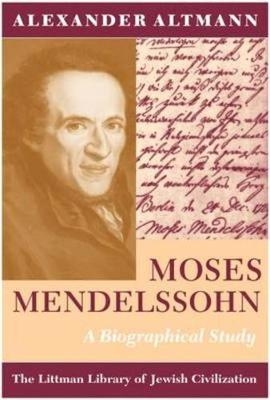
Alexander Altmann’s acclaimed, wide-ranging biography of Moses Mendelssohn (1729–96) was first published in 1973, but its stature as the definitive biography remains unquestioned. In fact, there has been no subsequent attempt at an intellectual biography of this towering and unusual figure: no other Jew so deeply rooted in the Jewish tradition was at the same time so much a part of the intellectual life of the German Enlightenment in the second half of the eighteenth century. As such, Moses Mendelssohn came to be recognized as the inaugurator of a new phase in Jewish history; all modern Jews today are in his debt.
Altmann presents Moses Mendelssohn in strictly biographical terms. He does not attempt to assess his significance with the hindsight of historical perspective nor to trace his image in subsequent generations, but rather to observe his life from the period within which it was set. Altmann has written an absorbing and compelling narrative that makes a whole epoch come alive with great drama, for Mendelssohn’s life was a kaleidoscope of the European intellectual scene, Jewish and non-Jewish. As both a prominent philosopher and a believing Jew, Mendelssohn became a spokesman for the Jews and Judaism; he was one of the rare figures who become the symbol of an era. Through Altmann’s skilful use of hitherto unpublished archival material, the reader is introduced to the vast array of people—men of letters, artists, politicians, scientists, philosophers, and theologians—with whom Mendelssohn was in contact, and sometimes in conflict.
What was Mendelssohn’s Judaism like? To what extent did the disparate worlds of Judaism and modern Enlightenment jostle each other in his mind and to what degree could he harmonize them? These questions are not easily answered, and it is only in the aggregate of a multitude of accounts of experiences, reaction, and statements on his part that the answer is to be found. Alexander Altmann’s analysis of this wealth of material is extraordinary in its discernment, subtlety, and clarity of expression.
This masterly work will be of interest not only to those who are concerned with Jewish intellectual history but also to those interested in eighteenth-century cultural and social history, philosophy and theology, literary criticism, aesthetics, and the other areas of intellectual activity in ferment at that time. The general reader will also find much of contemporary relevance in Mendelssohn’s life, not only because of his exemplary devotion to reason and tolerance, but also because of his lifelong struggle with the basic dilemma of the Jew in the modern world: the attraction of assimilation versus the singularity of Jewish life, and the preservation of Jewish identity versus integration in the wider society.
Alexander Altmann (1906–87) was born in Hungary and educated at the Rabbinical Seminary, Berlin, and at the University of Berlin. In 1938 he left Germany for Manchester, England, where he was appointed communal rabbi. While in Manchester he founded the Institute of Jewish Studies that later moved to University College, London. In 1959 he was appointed Professor of Jewish Philosophy at Brandeis University, Massachusetts, and Director of its Lown Institute of Advanced Judaic Studies. A Fellow of the American Academy of Arts and Sciences, his numerous publications in English, Hebrew, and German range over such diverse fields as classical rabbinic literature, medieval Judaeo-Arabic philosophy, Jewish mysticism, eighteenth-century Enlightenment, and modern Jewish thought. Among his significant contributions to the history of Jewish thought are 'Saadya Gaon: The Book of Doctrines and Beliefs' (1946), 'Studies in Religions, Philosophy and Mysticism' (1969), and 'Studies in Jewish Intellectual History' (1981). In later years, much of Professor Altmann’s scholarly work focused on Moses Mendelssohn and the period of the German Enlightenment, and he took over the editorship of Mendelssohn’s 'Gesammelte Schriften' (collected works). In 1979, the 250th anniversary of Mendelssohn’s birth, he delivered the key lecture in Berlin on ‘Enlightenment and Culture’ at the ceremony marking the city's celebration of Mendelssohn's life.
Preface
1 Years of Growth
Childhood in Dessau
Early Years in Berlin
The Budding Philosopher
Lessing
The Metaphysician
The Bel Esprit
A Learned Society
Kohelet Mussar
2 Maturity and Fame
Marriage and Family Life
Thomas Abbt
The Prize-Essay
The Correspondence about the Vocation of Man
The Phaedon
Questions and Answers
Cognate Hebrew Writings
3 Turning Point: The Lavater
Affair 'Juif de Berlin'
The Prehistory of the Lavater Affair
Lavater's Challenge and Mendelssohn's Reply
First Reactions and Behind-the-Scene Activities; Lavater's Reply and Mendelssohn's Epilogue
Reverberations of the Conflict
Literary Concerns and Another Lavater Episode
4 Changes in the Pattern of Life
The Strange Illness
Ups and Downs; A Chronicle of Events
Hebraica and Judaica
The Chronicle Continued
Some Philosophical Preoccupations
Friends in Unexpected Quarters
5 The Teacher
The Avant-Garde of Haskala
The German Translation of the Pentateuch
Obstacles on the Road
Completing the Work
6 Political Reformer
Spokesman of his People
Co-operation with Dohm
A Momentous Event and a New Tract for the Times
The Issue of Educational Reform
The Summer of 1782
Jerusalem
7 Strains and Stresses
Friendship with Lessing: The Last Phase
A Projected Essay on Lessing's Character
Jacobi's Attitude toward Mendelssohn: Antecedents of their Conflict
An Uneasy Correspondence
8 Guardian of the Enlightenment
The Contest
Literary Activity, 1783-1785
Morning Hours
In Combat
The Social and Domestic Scene
The End
Epilogue
Notes
Index of Subjects and Names
| Erscheint lt. Verlag | 1.3.1984 |
|---|---|
| Reihe/Serie | The Littman Library of Jewish Civilization |
| Zusatzinfo | Fr. |
| Sprache | englisch |
| Maße | 150 x 230 mm |
| Gewicht | 1470 g |
| Themenwelt | Literatur ► Biografien / Erfahrungsberichte |
| Geschichte ► Allgemeine Geschichte ► Neuzeit (bis 1918) | |
| Geisteswissenschaften ► Geschichte ► Regional- / Ländergeschichte | |
| Geisteswissenschaften ► Philosophie ► Geschichte der Philosophie | |
| Sozialwissenschaften ► Soziologie | |
| ISBN-10 | 0-19-710015-5 / 0197100155 |
| ISBN-13 | 978-0-19-710015-8 / 9780197100158 |
| Zustand | Neuware |
| Informationen gemäß Produktsicherheitsverordnung (GPSR) | |
| Haben Sie eine Frage zum Produkt? |
aus dem Bereich