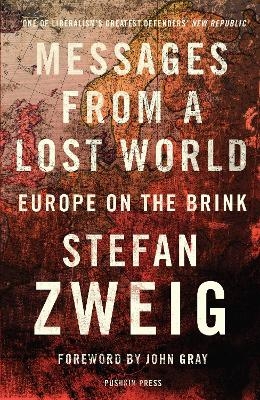
Messages from a Lost World
Pushkin Press (Verlag)
978-1-78227-229-8 (ISBN)
- Titel z.Zt. nicht lieferbar
- Portofrei ab CHF 40
- Auch auf Rechnung
- Artikel merken
As Europe faced its darkest days, Stefan Zweig was a passionate voice for tolerance, peace and a world without borders. In these moving, ardent essays, speeches and articles, composed before and during the Second World War, one of the twentieth century's greatest writers mounts a defence of European unity against terror and brutality.
These haunting lost messages, all appearing in English for the first time and some newly discovered, distil Zweig's courage, belief and richness of learning to give the essence of a writer; a spiritual will and testament to stand alongside his memoir, The World of Yesterday. Brief and yet intense, they are a tragic reminder of a world lost to the 'bloody vortex of history', but also a powerful statement of one man's belief in the creative imagination and the potential of humanity, with a resounding relevance today.
"At a time of monetary crisis and political disorder, of mounting border controls and barbed-wire fences... Zweig's celebration of the brotherhood of peoples reminds us that there is another way" The Nation
"One of liberalism's greatest defenders" New Republic
"Zweig's impassioned pursuit of personal freedom seems more relevant than ever" Newsweek
"These essays, few in number but rich in content, reveal the essence of Zweig's thought... Messages from a Lost World is ably translated from German into English for an American readership by Will Stone, making it an extraordinary and highly recommended addition to community and academic library collections" Midwest Book Review
"In pieces from the 1920s and early 30s, Zweig takes it as a moral imperative to champion the cause of peace by reminding his readers and listeners that humanity could no longer afford the sort of belligerent nationalism that had led them into the Great War" Inside Higher Ed
"While it is disheartening to read these pieces today, knowing how Zweig's life ended, it is inspiring to see that they have been published. However defeated Zweig might appear to contemporary readers, however aloof or naive, his idea of the European soul is still worth defending" Northwest Review of Books
Stefan Zweig was born in 1881 in Vienna, a member of a wealthy Austrian-Jewish family. He studied in Berlin and Vienna and was first known as a translator and later as a biographer. Zweig travelled widely, living in Salzburg between the wars, and enjoying literary fame. His stories and novellas were collected in 1934. In the same year, with the rise of Nazism, he briefly moved to London, taking British citizenship. After a short period in New York, he settled in Brazil. It was here that he completed his acclaimed memoir The World of Yesterday, a lament for the golden age of a Europe destroyed by two world wars. The articles and speeches in Messages from a Lost World were written as Zweig, a pacifist and internationalist, witnessed this destruction and warned of the threat to his beloved Europe. On 23 February 1942, Zweig and his second wife Lotte were found dead, following an apparent double suicide. Much of his work is available from Pushkin Press.
Stefan Zweig was one of the most popular and widely translated writers of the early twentieth century. Born into an Austrian-Jewish family in 1881, he became a leading figure in Vienna's cosmopolitan cultural world and was famed for his gripping novellas and vivid psychological biographies. In 1934, following the Nazis' rise to power, Zweig fled Austria, first for England, where he wrote his famous novel Beware of Pity, then the United States and finally Brazil. It was here that he completed his acclaimed autobiography The World of Yesterday, a lament for the golden age of a Europe destroyed by two world wars. The articles and speeches in Messages from a Lost World were written as Zweig, a pacifist and internationalist, witnessed this destruction and warned of the threat to his beloved Europe. On 23 February 1942, Zweig and his second wife Lotte were found dead, following an apparent double suicide.
Contents
Foreword by John Gray 9
Translator’s Introduction 15
The Sleepless World—1914 39
The Tower of Babel—1916 51
History as Poetess—1931 61
European Thought in Its Historical Development—1932 85
The Unification of Europe—1934 113
1914 and Today—1936 125
The Secret of Artistic Creation—1938 135
The Historiography of Tomorrow—1939 159
The Vienna of Yesterday—1940 183
In This Dark Hour—1941 207
Details of First Publication 213
| Erscheinungsdatum | 02.03.2017 |
|---|---|
| Einführung | John Gray |
| Übersetzer | Will Stone |
| Verlagsort | London |
| Sprache | englisch |
| Maße | 129 x 198 mm |
| Themenwelt | Literatur ► Essays / Feuilleton |
| Geschichte ► Allgemeine Geschichte ► 1918 bis 1945 | |
| Geisteswissenschaften ► Geschichte ► Regional- / Ländergeschichte | |
| Geschichte ► Teilgebiete der Geschichte ► Militärgeschichte | |
| ISBN-10 | 1-78227-229-1 / 1782272291 |
| ISBN-13 | 978-1-78227-229-8 / 9781782272298 |
| Zustand | Neuware |
| Informationen gemäß Produktsicherheitsverordnung (GPSR) | |
| Haben Sie eine Frage zum Produkt? |
aus dem Bereich