


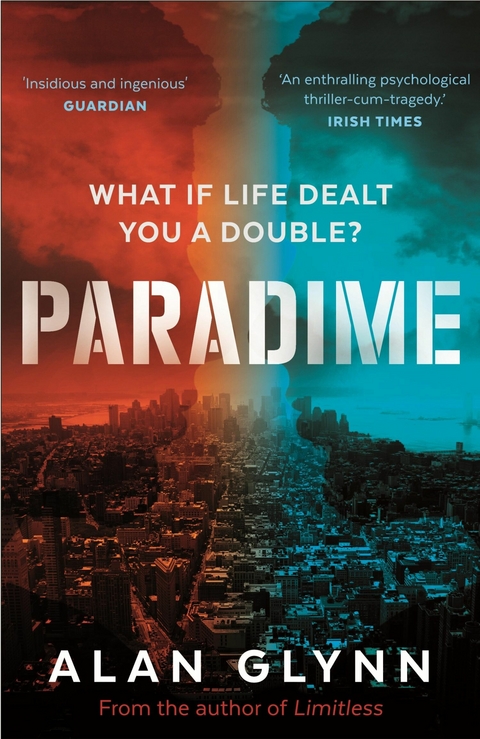
Paradime (eBook)
300 Seiten
Faber & Faber (Verlag)
978-0-571-31624-3 (ISBN)
Alan Glynn is a graduate of Trinity College Dublin, where he studied English Literature, and has worked in magazine publishing in New York and as an EFL teacher in Italy. His debut novel, The Dark Fields, was released in 2011 as the hit movie Limitless, which went to #1 on both sides of the Atlantic, and became a hit CBS network show. His other novels include Bloodland, the Irish Crime Fiction Book of the Year in 2011, also nominated for an Edgar, and Paradime, described in the Guardian as a 'wheels-within-wheels conspiracy novel both insidious and ingenious'. He is married with two children and lives in Dublin.
After a stint as a private contractor in Afghanistan, Danny Lynch is back in New York. But nothing's easy. Work is hard to find and his girlfriend owes more than $30,000 in student loans. Danny is also haunted by something he witnessed at the base - a fact that could ultimately destroy him. Then he spots Teddy Trager, tech visionary and billionaire. These two men couldn't be more different - except for one thing: in appearance, they're identical. Danny becomes obsessed with Trager, and before long this member of the ninety-nine per cent is passing undetected into the gilded realm of the one per cent. But what does Danny find there? Who does he become? And is there a route home?From the prize winning author of Limitless, Paradime is a novel for fans of the great '70s conspiracy thrillers, rebooted for today's ever-globalising world.
An enthralling psychological thriller-cum-tragedy ... All told, it's a pulsating tale from one of the most inventive practitioners working in contemporary crime fiction, a novel that pounds to the rhythms of the conventional thriller but employs its tropes to divert its protagonist, and the reader, down some very unusual dark alleyways.
No one spins 21st Century facts into high-tech fantasies like Glynn.
Bristling with paranoia, this wheels-within-wheels conspiracy novel is both insidious and ingenious.
There’s no app for this.
Though I seem to have one for nearly everything else. I can track my movements over the course of a day, every footstep, every heartbeat. I can monitor my stress levels, boost productivity, enhance cognition.
But relieve anxiety? Eliminate dread? Not a chance.
As the R train rattles towards 59th Street, I look down at my phone and swipe to the right.
Start your free seven-day trial now . . .
I’ll never use any of these. I put my phone away.
The green I-beam columns and ceramic wall tiles of the station flicker into view. I get up and wait by the car door. It’s 11:30 a.m., the platform not particularly crowded – a lull between surges, the secret hour for tourists, junkies, and unemployed people.
Up on 59th Street, it’s bright and sunny, the sky almost aggressively blue. Just ahead, vast and constipated as always, looms the Plaza Hotel. At the kerb, waiting to cross, I gaze for a moment down Fifth at the flow of traffic and buildings – parallel lines that trail towards a meeting point at the blistering horizon. I turn and look the other way, over at the huddled expanse of Central Park, and then, a little further to the right, at the deck of sidewalk awnings fanning north – the ones fronting the granite and marble mansions that line this side of Fifth, what used to be called, quaintly, Millionaire’s Row.
This morning, up here, the specific anxiety, the specific dread, is easy to identify. It’s simply that I don’t belong. I’m not a tourist en route to Tiffany’s, or an addled junkie wandering lost through the canyons of Midtown. I belong to that third group, the unemployed, and consequently have no real business being here. Every person I see reinforces this – every silk-suited alpha dog barking into his cellphone, every skinny society hostess dripping in jewellery and laden down with designer shopping bags, every map-consulting European family of four, immaculate in their ironed jeans and matching Oxford-blue windbreakers.
But I have to go somewhere, right? I can’t be nowhere. And that’s the problem. No matter where I end up, there’ll be a local supply of reasons to feel shitty and out of place. If I go into the park, for example, all those bright, determined people in Lycra running towards a better future . . . well, they’ll crush any semblance of hope I might have. If I go too far west, Tenth Avenue and beyond, the gradual disintegration I’ll see all around me there won’t do my mood any good.
If I go back to the apartment . . .
Can’t really do that though, not until late afternoon, not until Kate has put in however many hours she needs to put in. And even then . . .
If I leave New York?
If I go back to Asheville?
It doesn’t matter. When it comes to anxiety and dread, there’ll always be location-specific reasons. But it’s when they run out that the existential shit really hits the fan – because even if I found the perfect location, where conditions were ideal, guess what . . . I’d still be there.
How do you escape that?
I cross Fifth, walk past the Plaza and on towards Sixth, where I turn left.
The Avenue of the Americas.
I could walk down to Greenwich Village from here, block after block, passing through several Americas in the process and certainly ending up in one that’s different from the one I’m in right now. But what then? Another cappuccino in some dingy café? Another hour or two in the Strand? How long will it be before I start shouting at people – from a park bench, say, or in the street, or on a subway platform?
Hey, you!
Hey, buddy!
Hey, gorgeous!
The prospects aren’t good. I need something to occupy my time. I need something to occupy my mind. I need a job. And I need one fast.
*
Three weeks ago I was a civilian contractor in Afghanistan.
Working in a chow hall.
All my life, on and off, I’ve worked in kitchens. My old man had a restaurant – restaurant, it was a steakhouse – and I spent a lot of time there, first as a kid running around the place, then as a teenager washing pots, bringing out the garbage, even doing some basic prep, but always, as I remember – and no disrespect to the old man here – always dreaming of what it’d be like to work in a proper kitchen. By this I think I probably meant the kitchen of some place like the Four Seasons on 52nd Street, which I’d once seen an article about in a trade magazine. But with visions of pristine chef whites and brushed-steel surfaces etched in my mind, sustaining me, I never thought I’d end up working in a place that served food you’d be embarrassed to feed to a dog – food that was tasteless, highly processed and basically inedible. The stuff still had to be cooked though, and the job of doing that, it turns out, was an actual job, and a well-paying one – something that at the time I really needed.
The chow hall was at Forward Operating Base Sharista in Nangarhar Province and was one of countless food-service facilities privately operated by Gideon Logistics. That meant production-line industrial food shipped in frozen, then cooked (for lack of a better word) and served up to exhausted, bored, jangly-nerved, hot, and above all hungry servicemen. Described as a ‘global provider of integrated supply-chain solutions’, Gideon was in Afghanistan as part of the LOGCAP IV programme and had a hand in pretty much everything over there. Security, transportation, freight management, food and laundry services, sanitation – you name it, they were doing it, squeezing every last dollar out of the war before the fucking thing ground to a halt.
I’d only been there for four months, shipped over myself like a box of frozen burger patties after I answered an ad and signed up for what promised to be a lucrative two-year contract with above-average benefits and good rotation cycles. They were looking for food-service managers, chefs, line cooks, whatever, to help run their various overseas facilities, most of which were located in environments ranging, the ad said, from ‘potentially hostile’ to ‘extremely dangerous’. In short, the work would be ‘demanding, but rewarding’. Kate was dead set against it, of course, why would you put yourself in that position when you didn’t have to, but all I could see were the numbers. I’d already been in Iraq – done two tours there – so I wasn’t intimidated by the war-zone thing, and I had sufficient food-industry experience to qualify for the job. The math was simple. Two short years over there and I could earn what it would take me five or six to earn here. Which, given our financial circumstances at the time, made it a no-brainer.
It’s just that, I suppose, go figure, things didn’t exactly work out as planned.
*
Every few blocks or so, stopped at the lights, I almost resolve to quit this charade and head back to the apartment. It’s Kate’s, a one-bedroom sublet in a rent-stabilised walk-up on 10th Street, so it’s small and cramped – but still, I could lie quietly on the bed, laid out like a corpse waiting to be embalmed, and she wouldn’t even have to know I was there. How different would that be from what I’m doing now, which is, supposedly – and at Kate’s gentle insistence – out looking for a job?
Or meeting people, at the very least.
Networking.
Her word.
Sometimes I wonder if Kate has met me.
To be fair, though, she’s doing her best. Equipped with a BA in political science from Atherton College, Kate moved to Manhattan five years ago with high hopes of . . . I don’t know, going to law school, eventually getting into public service, something, whatever, but after only a few months it became obvious that her chief asset, the one thing she had going for her, was this rent-stabilised sublet, because without it, bottom line, she wouldn’t be living in Manhattan, probably not even in Brooklyn. More than likely, in fact, with today’s rents, she’d be back living with her parents in Baltimore. She got the sublet through a connection of her old man’s, an ex-colleague who’d also promised to show her the ropes, even pave the way to a possible job, something decent, but unfortunately this same guy got sick, lost his job, and had to skip town, leaving Kate with the just about affordable apartment and the dawning realisation that she had little or no prospect of getting into law school, little or no prospect of getting anything like a ‘decent’ job, and little or no prospect of paying back her student-loan debts, which amounted to more than thirty-three thousand dollars and were probably now set to become the defining fact of her life.
And then – let there be no doubt – she met me.
*
I resolve once more to quit this charade and head back to the apartment, but again don’t quite manage it.
It’s like each day now is its own little tour of duty, and in that context there’s no scenario where you can just say Fuck it, let’s return to base. Think I’ll de-enlist. Don’t want to do this any more.
I come to the lights at 42nd, stop, and look around. The big difference here is that I’m on my own. There’s no command structure, no one barking orders, no exit strategy either, or even talk of one. My four months in Afghanistan might be only just behind me, but I find that my memory, if left on auto-pilot, drifts more readily to Iraq. Those impressions are bigger, louder, stickier. But that’s just what they are, impressions, because I can’t pinpoint specific incidents, I don’t have recurring nightmares, there are no...
| Erscheint lt. Verlag | 26.5.2016 |
|---|---|
| Verlagsort | London |
| Sprache | englisch |
| Maße | 150 x 150 mm |
| Themenwelt | Literatur ► Krimi / Thriller / Horror ► Krimi / Thriller |
| Schlagworte | Bestseller • conspiracy thriller • doppelganger • limitless • Val McDermid |
| ISBN-10 | 0-571-31624-7 / 0571316247 |
| ISBN-13 | 978-0-571-31624-3 / 9780571316243 |
| Informationen gemäß Produktsicherheitsverordnung (GPSR) | |
| Haben Sie eine Frage zum Produkt? |
 EPUB (Adobe DRM)
Kopierschutz: Adobe-DRM
Adobe-DRM ist ein Kopierschutz, der das eBook vor Mißbrauch schützen soll. Dabei wird das eBook bereits beim Download auf Ihre persönliche Adobe-ID autorisiert. Lesen können Sie das eBook dann nur auf den Geräten, welche ebenfalls auf Ihre Adobe-ID registriert sind.
Details zum Adobe-DRM
Dateiformat: EPUB (Electronic Publication)
EPUB ist ein offener Standard für eBooks und eignet sich besonders zur Darstellung von Belletristik und Sachbüchern. Der Fließtext wird dynamisch an die Display- und Schriftgröße angepasst. Auch für mobile Lesegeräte ist EPUB daher gut geeignet.
Systemvoraussetzungen:
PC/Mac: Mit einem PC oder Mac können Sie dieses eBook lesen. Sie benötigen eine
eReader: Dieses eBook kann mit (fast) allen eBook-Readern gelesen werden. Mit dem amazon-Kindle ist es aber nicht kompatibel.
Smartphone/Tablet: Egal ob Apple oder Android, dieses eBook können Sie lesen. Sie benötigen eine
Geräteliste und zusätzliche Hinweise
Buying eBooks from abroad
For tax law reasons we can sell eBooks just within Germany and Switzerland. Regrettably we cannot fulfill eBook-orders from other countries.
aus dem Bereich


