


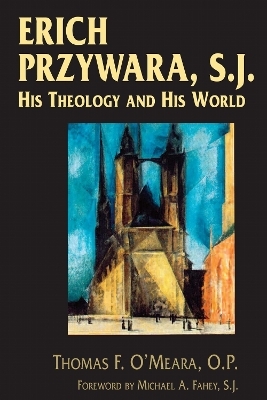
Erich Przywara, S.J.
His Theology and His World
Seiten
2002
University of Notre Dame Press (Verlag)
978-0-268-02763-6 (ISBN)
University of Notre Dame Press (Verlag)
978-0-268-02763-6 (ISBN)
Erich Przywara, S.J. (1889-1972) is one of the important Catholic intellectuals of the twentieth century. Yet, in the English-speaking world Przywara remains largely unknown. In this engaging new book, Thomas O'Meara offers a comprehensive study of the German Jesuit and his philosophical theology.
Erich Przywara, S.J. (1889–1972), is one of the important Catholic intellectuals of the twentieth century. Yet, in the English-speaking world Przywara remains largely unknown. Few of his sixty books or six hundred articles have been translated. In this engaging new book, Thomas O'Meara offers a comprehensive study of the German Jesuit Erich Przywara and his philosophical theology.
Przywara's scholarly contributions were remarkable. He was one of three theologians who introduced the writings of John Henry Cardinal Newman into Germany. From his position at the Jesuit journal in Munich, Stimmen der Zeit, he offered an open and broad Catholic perspective on the cultural, philosophical, and theological currents of his time. As one of the first Catholic intellectuals to employ the phenomenologies of Edmund Husserl and Max Scheler, he was also responsible for giving an influential, more theological interpretation of the Spiritual Exercises of Ignatius Loyola.
Przywara was also deeply engaged in the ideas and authors of his times. He was the first Catholic dialogue partner of Karl Barth and Paul Tillich. Edmund Husserl was counted among Przywara's friends, and Edith Stein was a close personal and intellectual friend. Through his interactions with important figures of his age and his writings, ranging from speculative systems to liturgical hymns, Przywara was of marked importance in furthering a varied dialogue between German Catholicism and modern culture.
Following a foreword by Michael A. Fahey, S.J., O'Meara presents a chapter on Pryzwara's life and a chronology of his writings. O'Meara then discusses Pryzwara's philosophical theology, his lecture-courses at German universities on Augustine and Aquinas, his philosophy of religion, and his influence on important intellectual contemporaries. O'Meara concludes with an in-depth analysis of Pryzwara's theology—focusing particularly on his Catholic views on person, liturgy, and church.
Erich Przywara, S.J. (1889–1972), is one of the important Catholic intellectuals of the twentieth century. Yet, in the English-speaking world Przywara remains largely unknown. Few of his sixty books or six hundred articles have been translated. In this engaging new book, Thomas O'Meara offers a comprehensive study of the German Jesuit Erich Przywara and his philosophical theology.
Przywara's scholarly contributions were remarkable. He was one of three theologians who introduced the writings of John Henry Cardinal Newman into Germany. From his position at the Jesuit journal in Munich, Stimmen der Zeit, he offered an open and broad Catholic perspective on the cultural, philosophical, and theological currents of his time. As one of the first Catholic intellectuals to employ the phenomenologies of Edmund Husserl and Max Scheler, he was also responsible for giving an influential, more theological interpretation of the Spiritual Exercises of Ignatius Loyola.
Przywara was also deeply engaged in the ideas and authors of his times. He was the first Catholic dialogue partner of Karl Barth and Paul Tillich. Edmund Husserl was counted among Przywara's friends, and Edith Stein was a close personal and intellectual friend. Through his interactions with important figures of his age and his writings, ranging from speculative systems to liturgical hymns, Przywara was of marked importance in furthering a varied dialogue between German Catholicism and modern culture.
Following a foreword by Michael A. Fahey, S.J., O'Meara presents a chapter on Pryzwara's life and a chronology of his writings. O'Meara then discusses Pryzwara's philosophical theology, his lecture-courses at German universities on Augustine and Aquinas, his philosophy of religion, and his influence on important intellectual contemporaries. O'Meara concludes with an in-depth analysis of Pryzwara's theology—focusing particularly on his Catholic views on person, liturgy, and church.
Thomas F. O'Meara is William K. Warren Professor Emeritus of Theology at the University of Notre Dame. He is the author of several books, including Thomas Aquinas, Theologian (University of Notre Dame Press, 1997). Rev. Michael A. Fahey, S.J., was the Emmett Doerr Professor of Catholic Systematic Theology at Marquette University.
| Erscheint lt. Verlag | 22.4.2002 |
|---|---|
| Vorwort | Michael A. Fahey |
| Verlagsort | Notre Dame IN |
| Sprache | englisch |
| Maße | 152 x 229 mm |
| Themenwelt | Literatur ► Biografien / Erfahrungsberichte |
| Religion / Theologie ► Christentum ► Kirchengeschichte | |
| ISBN-10 | 0-268-02763-3 / 0268027633 |
| ISBN-13 | 978-0-268-02763-6 / 9780268027636 |
| Zustand | Neuware |
| Informationen gemäß Produktsicherheitsverordnung (GPSR) | |
| Haben Sie eine Frage zum Produkt? |
Mehr entdecken
aus dem Bereich

aus dem Bereich
eine andere Geschichte der Papststadt
Buch | Softcover (2024)
C.H.Beck (Verlag)
CHF 25,20
die Macht des Dunklen in unserer Zeit und wie wir ihr entgegentreten
Buch | Hardcover (2025)
Verlag Herder
CHF 27,90


