


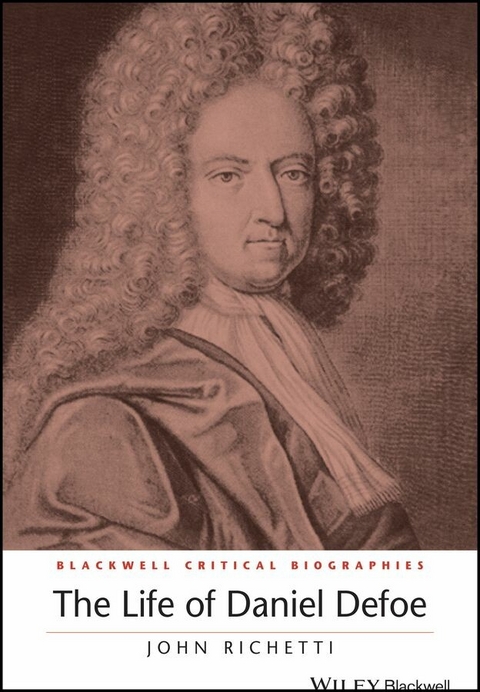
The Life of Daniel Defoe (eBook)
John Wiley & Sons (Verlag)
978-1-119-11800-8 (ISBN)
The Life of Daniel Defoe examines the entire range of Defoe’s writing in the context of what is known about his life and opinions.
- Features extended and detailed commentaries on Defoe’s political, religious, moral, and economic journalism, as well as on all of his narrative fictions, including Robinson Crusoe
- Places emphasis on Defoe’s distinctive style and rhetoric
- Situates his work within the precise historical circumstances of the eighteenth-century in which Defoe was an important and active participant
- Now available in paperback
John Richetti is A.M. Rosenthal Professor of English at the University of Pennsylvania. He has written extensively on the eighteenth-century English novel and eighteenth-century philosophical prose, including The English Novel in History: 1700-1780 (1999), Philosophical Writing: Locke, Berkeley, Hume (1983), Defoe's Narratives (1975), and Popular Fiction Before Richardson: Narrative Patterns 1700-1739 (1969). He has edited Robinson Crusoe (2003), among other titles.
The Life of Daniel Defoe examines the entire range of Defoe s writing in the context of what is known about his life and opinions. Features extended and detailed commentaries on Defoe s political, religious, moral, and economic journalism, as well as on all of his narrative fictions, including Robinson Crusoe Places emphasis on Defoe s distinctive style and rhetoric Situates his work within the precise historical circumstances of the eighteenth-century in which Defoe was an important and active participant Now available in paperback
John Richetti is A.M. Rosenthal Professor of English at the University of Pennsylvania. He has written extensively on the eighteenth-century English novel and eighteenth-century philosophical prose, including The English Novel in History: 1700-1780 (1999), Philosophical Writing: Locke, Berkeley, Hume (1983), Defoe's Narratives (1975), and Popular Fiction Before Richardson: Narrative Patterns 1700-1739 (1969). He has edited Robinson Crusoe (2003), among other titles.
Preface vi
Acknowledgments x
1 Dissenter, Merchant, Speculator,Writer 1
2 Early Writings 1697-1703: Projects, Dissent, Poems 31
3 Political Journalism: 1697-1710 70
4 Political Agent and Journalist: Queen Anne to the Hanoverians 113
5 Moral, Social, and Economic Writings 1714-31 143
6 Robinson Crusoe 174
7 Travel, Politics, and Adventure 213
8 Crime and Narrative 234
9 Roxana: A Novel of Crime and Punishment 268
10 History, Facts, and Literature 301
11 Political Journalist and Moral Censor: 1715-31 337
Notes 362
Bibliography 390
Index 395
"Richetti conscientiously explains the political controversies that possessed Defoe ... When he reaches his chapters on Defoe's novels you get the eloquent condensation of his expertise." London Review of Books
"Richetti reminds us why so many of Defoe's works are still worth reading ... [The Life of Daniel Defoe] is a welcome addition to the family of biographies trying to render three-dimensional the man behind so many voices." Studies In English Literature 1500-1900
"[Richetti] brings us closer than any previous biographer to the personality that 'must have been lurking somewhere behind the various voices that he projected' over forty years of writing. This is an urbane, well informed, and interesting account, not only of Defoe but of the entire Defoe enterprise." Scriblerian
"Richetti does a remarkable job." 18th-Century Studies
"Richetti's contributions to the study of 18th century fiction have established him among the foremost critics ... he has been brilliant in his treatment of Defoe." 1650-1850 Ideas, Aesthetics, and Inquiries in the Early Modern Era
Preface
… a great, a truly great liar, perhaps the greatest that ever lived.
William Minto, Daniel Defoe
Paula R. Backscheider begins her biography of Defoe by saying that “few men seem to be better subjects for a biography than Daniel Defoe.”1 She means that Defoe’s life is a heroic story of constant struggle to survive, a string of personal and financial disasters, a life that spanned a tumultuous era (1660–1731) of crucial political and historical events that changed the face of Europe, and witnessed the emergence of nothing less than the modern world order, with Britain in his life-time gradually becoming the dominant European imperial power. Defoe has since the late eighteenth century attracted many biographers, including most recently a rival to Backscheider’s life by Maximillian E. Novak.2 Much is known about Defoe. There is an extensive factual record of many personal events as well as financial, political, and literary circumstances in his life, some of which do him little honor and mark him as a flawed human being, at times even distinctly unattractive. But in the final analysis, whether one likes this Daniel Defoe is irrelevant, since almost nothing is known or certain about his inner life except what he chose to reveal about himself in his writing and in his surviving letters. That correspondence consists mostly of letters to the powerful early eighteenth-century politician, Robert Harley, Earl of Oxford, whom he served from 1704 until 1714 as a secret agent, political operative and advisor. The figure revealed in that correspondence and clandestine relationship is as his biographers have noted preeminently a master of disguise and deception, a plotter and dissimulator. In his public writing as well as in his private correspondence, Defoe is manifestly self-serving and self-dramatizing, or at times as in his most elaborate public apologia, An Appeal to Honour and Justice, tho it be of his Worst Enemies (1714–15), deeply evasive and even mendacious.
We need, therefore, to modify Backscheider’s recommendation of Defoe as the perfect biographical subject: he is immensely (or even fatally) attractive to biographers because he lived in exceedingly interesting times, because his voluminous writings allow us to speculate about the personality that must have been lurking somewhere behind the various voices that he projected in that endlessly flowing river of writing that he produced over a long career of over forty years.3 Moreover, there is a clear line to his intellectual development; his wide-ranging and often enough quirky and original mind is very much on display in his writing, and his forcefully-expressed ideas and attitudes are there for those who care to trace them. However, the question of just what Defoe actually wrote is still an open one. W.R. Owens and P.N. Furbank, his most recent editors and bibliographers, have mounted a largely convincing attack on the canon of Defoe’s writing compiled by scholars since the early nineteenth century that had steadily expanded over the years until in J.R. Moore’s Checklist of the Writings of Daniel Defoe (1960) it numbered over 570 separate titles. Owens and Furbank have argued for a skeptical reformation of the expanded canon propounded by several generations of Defoe scholars, who tended to attribute to Defoe any pamphlet from the early eighteenth century that featured what they saw as their hero’s characteristic energy and style. Owens’s and Furbank’s new canon of Daniel Defoe’s writings is a rational, Protestant reformation of the implicit faith in their own judgments of earlier Defoe scholar-enthusiasts. I follow Owens’s and Furbank’s de-attribution of some 252 items from the Defoe canon in this book, with one or two exceptions, as will appear. 4 But even Furbank and Owens cannot resolve the uncertainty surrounding some of what we think is Defoe’s massive output, and in their Critical Bibliography of Daniel Defoe they list works that are “probably” by Defoe, and in their ongoing collected edition of large numbers of Defoe’s works they and their colleagues in that enterprise reprint and annotate some of those pieces that they mark as merely probable in their Critical Bibliography.5
Robinson Crusoe continued to be read through the eighteenth century and in some quarters was highly regarded. Boswell records that Dr. Johnson, for one, admired it greatly and commended Defoe, “allowing a considerable share of merit to a man, who, bred a tradesman, had written so variously and so well,” and Mrs. Thrale remembered him saying that along with Don Quixote and The Pilgrim’s Progress it was one of only three books that its readers “wished longer.”6 Otherwise, Defoe seems to have been little read or remembered in the years after his death. The revival of systematic interest in his life and works dates from George Chalmers (1742–1825), an antiquarian who published a Life of Defoe in 1785 in which he called him “one of the ablest and most useful writers of our island.” Chalmers concentrated on Defoe’s achievements as a “commercial writer … fairly entitled to stand in the foremost ranks among his contemporaries” and as a “historian who … had few equals in the English language.” 7 Despite several centuries of literary and bibliographical criticism since Chalmers, and of repeated biographical investigation, however, the inner man, the personality, the actual Defoe, remains an elusive and even a mysterious figure. As Furbank and Owens put it, “much of the trouble in understanding Defoe and consequently in fixing the canon of his writings, stems from the fact that the personality he presents to us in his writings is completely a construction, allowing us to guess only dimly at the ‘real’ Defoe.”They may be stretching things, since Defoe did not construct his public personae out of whole cloth, and there is always some relationship between these public poses and what must have been his own attitudes and ideas, and we should remember that a persona is an aspect of the actual personality most of the time and not an outright disguise. Still, Furbank and Owens observe that Defoe is thus an impalpable and essentially a textual presence who “courts exposure and yet hides his personality, so that we get no such feeling of him as a person as we do with Swift or Pope.”8
This study will, by choice and by necessity, dwell on the ultimate mystery surrounding Defoe the person, on that gap between Defoe’s writing (in so far as it can be identified as his beyond a reasonable doubt) and the motives and feelings that must have propelled or at least shaped much of it. I will not attempt, however, to construct a coherent interior life or confident psychological profile of Daniel Defoe, nor will biographical speculation accompany my treatment of Defoe’s writings in any exact way that might claim simple relationships between life events and writing, although doubtless they existed and are worth reaching for. That biographer’s hunger for knowledge of the whole man has led in the past to a good deal of fanciful speculation, usually framed as a question that slides from the interrogative to the assertive: “What must Defoe have thought?” becomes “Surely Defoe was thinking.” It seems to me that our lack of information about Defoe’s inner life combined with a literary output that even if defined conservatively is staggering in its extent marks him more than other eighteenth-century authors as a man whose life consists of his own words. Of Defoe one might say with Vladimir Nabokov that “the best part of a writer’s biography is not the record of his adventures but the story of his style.”9 Given Defoe’s penchant for stylistic mimicry, from The Shortest Way with the Dissenters to the voices he assumes so convincingly in his longer fictions, that is in his case quite an adventure. To be sure, Defoe’s writing has rich local contexts and particular occasions; it is always involved in religious, political, economic, and moral controversies of the day, and we do know enough about his life to call it an adventure, a picaresque tale, almost, of strife and struggle in the commercial, political, and literary arena of his time. Most of his writing is polemical journalism about a wide variety of subjects, directly and practically provoked by contemporary developments and involving Defoe in urgent speculation about his country’s uncertain and perilous future. However obscure his personal and private life, in his writing Defoe has a clear and specific intellectual profile and public persona in the early decades of the English eighteenth century, and there isn’t a contemporary issue from those years that he didn’t write about. He was certainly one of the best-known and also one of the most reviled writers of his day, attracting what Furbank and Owens in a nice phrase have called “a quite exceptional torrent of vituperation.”10
Much of the book that follows will like many others before it seek to trace Defoe’s views as they are expressed in his voluminous writings and to evaluate their force and resonance for him and his contemporaries, many of whom were his antagonists in the paper wars and bitter political-religious controversy of the early years of the century, especially the tumultuous reigns of William III and...
| Erscheint lt. Verlag | 29.7.2015 |
|---|---|
| Reihe/Serie | Blackwell Critical Biographies |
| Blackwell Critical Biographies | Wiley Blackwell Critical Biographies |
| Sprache | englisch |
| Themenwelt | Literatur ► Biografien / Erfahrungsberichte |
| Literatur ► Romane / Erzählungen | |
| Geisteswissenschaften ► Sprach- / Literaturwissenschaft ► Anglistik / Amerikanistik | |
| Geisteswissenschaften ► Sprach- / Literaturwissenschaft ► Literaturwissenschaft | |
| Schlagworte | 18th Century English Literature • Daniel Defoe • Defoe and journalism • Defoe and satire • Defoe economic journalism • Englische Literatur / 18. Jhd. • English literary history • English novel • Journal of the Plague Year • Literarische Biographien • Literary Biography • Literary Criticism & History • Literature • Literaturkritik u. -geschichte • Literaturwissenschaft • Moll Flanders • political pamphlets • Robinson Crusoe • Roxana • travel writing genre |
| ISBN-10 | 1-119-11800-X / 111911800X |
| ISBN-13 | 978-1-119-11800-8 / 9781119118008 |
| Informationen gemäß Produktsicherheitsverordnung (GPSR) | |
| Haben Sie eine Frage zum Produkt? |
 EPUB (Adobe DRM)
Kopierschutz: Adobe-DRM
Adobe-DRM ist ein Kopierschutz, der das eBook vor Mißbrauch schützen soll. Dabei wird das eBook bereits beim Download auf Ihre persönliche Adobe-ID autorisiert. Lesen können Sie das eBook dann nur auf den Geräten, welche ebenfalls auf Ihre Adobe-ID registriert sind.
Details zum Adobe-DRM
Dateiformat: EPUB (Electronic Publication)
EPUB ist ein offener Standard für eBooks und eignet sich besonders zur Darstellung von Belletristik und Sachbüchern. Der Fließtext wird dynamisch an die Display- und Schriftgröße angepasst. Auch für mobile Lesegeräte ist EPUB daher gut geeignet.
Systemvoraussetzungen:
PC/Mac: Mit einem PC oder Mac können Sie dieses eBook lesen. Sie benötigen eine
eReader: Dieses eBook kann mit (fast) allen eBook-Readern gelesen werden. Mit dem amazon-Kindle ist es aber nicht kompatibel.
Smartphone/Tablet: Egal ob Apple oder Android, dieses eBook können Sie lesen. Sie benötigen eine
Geräteliste und zusätzliche Hinweise
Buying eBooks from abroad
For tax law reasons we can sell eBooks just within Germany and Switzerland. Regrettably we cannot fulfill eBook-orders from other countries.
aus dem Bereich


