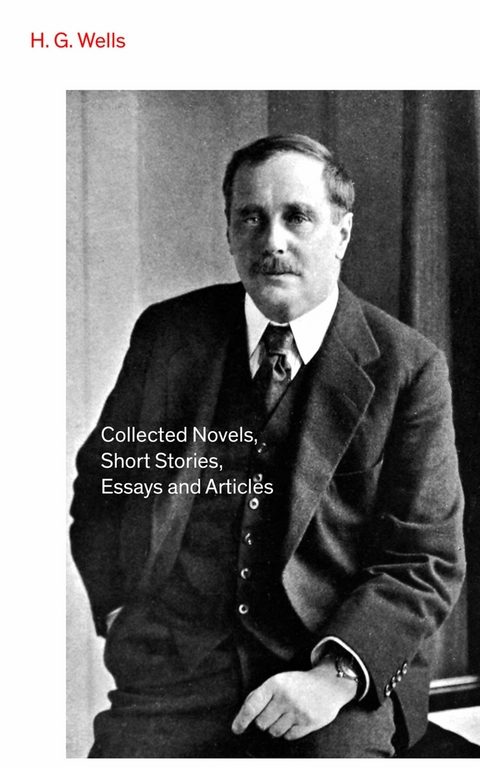
Collected Novels, Short Stories, Essays and Articles (eBook)
9632 Seiten
e-artnow (Verlag)
978-80-268-3990-3 (ISBN)
III
THE NOVELS
I am willing to maintain that H.G. Wells is second to none as a writer of romances of the type I have just examined. I am less certain of his position as a novelist. He brings to his fiction the open-eyed recognition of realities, the fine analysis of modern conditions, the lucid consequent thought and the clean, graphic style that mark the qualities of his other method; he has that “poetic gift, the gift of the creative and illuminating phrase,” which, he has said, “alone justifies writing”; but he has not the power of creating characters that stand for some essential type of humanity. On the one hand he is inclined to idealise the engineer and the scientific researcher, on the other to satirise and, in effect, to group into one sloppy-thinking mass every other kind of Englishman, not excepting philosophers, politicians and social reformers. This broad generalisation omits any consideration of the merely uneducated, such as Hoopdriver or Kipps, and the many women he has drawn. But the former, however sympathetically treated, are certainly not idealised; and among the latter, the only real creation, in my opinion, is Susan Ponderevo in Tono-Bungay; although there is a possible composite of various women in the later books that may represent the general insurgent character of recent young womanhood. But now that I have made this too definite statement I want to go back over it, touch it up and smooth it out. For if I have found Mr Wells’ character types too few and too specialised; and as if, with regard to his more or less idealised males — such as Capes, George Ponderevo, Remington, Trafford, Stafford — he had modelled and re-modelled them in the effort to build up one finally estimable figure of masculine ability; there still remains an enormous gallery of subsidiary portraits, for the most part faintly caricatured, of men and women who do stand for something in modern life; portraits that are valuable, interesting and memorable. Nevertheless, I submit that Mr Wells’ novels will not live by reason of their characterisation.
The desire to write essays in this class of fiction does not seem to have overcome Wells until the last few years. Before 1909, he had written all his sociology and all his romances, with the exception of The World Set Free, but only three novels — namely, The Wheels of Chance, Love and Mr Lewisham and Kipps; and none of them gives any indication of the characteristic method of the later work.
The first of the three, published in 1896, is in one respect a splendid answer to the objection against what has been called the episodical novel. The story deals only with ten glorious days in the life of Hoopdriver, a callow assistant in a draper’s “emporium” at Putney. He learnt to ride a bicycle, set out to tour the south coast for his short summer holiday and rode into romance. One section of the book is a trifle too hilarious, coming perilously near to farce, but underlying the steady humour of it all is a perfectly consistent, even saddening, criticism of the Hoopdriver type. He has imagination without ability; life is made bearable for him chiefly by the means of his poor little dreams and poses; he sees himself momentarily in the part of a detective, a journalist, a South African millionaire, any assumption to disguise the horrible reality of the draper’s assistant; and yet there is fine stuff in him. (Perhaps the suggested antithesis is hardly justified!) We leave him at the door of the Putney shop full of resolution to read, to undertake his own education, in some way, no doubt, to better himself, as he might have phrased it. But we doubt the quality of his determination and of the lasting influence of the “more wonderful desires and ambitions replacing those discrepant dreams.” We have only followed Hoopdriver through a ten-day episode, but all his story has been told.
We are in quite a different position with regard to Lewisham. The history of his encounter with love and the world, published in 1900, covers a period of four or five years, but while we leave him down-at-heel, with a wife and a motherin-law dependent upon him, and the prospect of fatherhood adding to his responsibilities, we are uncertain whither his career will take him. Lewisham is the first sketch for the type that was to be elaborated in five subsequent books. The allurements of his love for Ethel Henderson spoilt his chances at the science school, but he has the quality that is so conspicuously lacking in the Hoopdriver-Kipps-Polly succession. Lewisham had some resolution, undoubted energy, and the beginnings of that larger vision which was the gift of the later protagonists. But he is not idealised; he comes nearer to the average of humanity than the later pictures of his like; although they share with him that tendency to sudden irascibility, to outbursts of a somewhat petty temper against the obvious limitations of life — a common tendency observable in nearly all Mr Wells’ dominant male characters. Those few years of Lewisham’s life were so well done, so consistently developed, that I have regretted the absence of a sequel. Indeed, I still regret it, although I realise very well that Mr Wells’ steady progress in the conception of his own purpose as a writer has absolutely precluded any return to an older method. Lewisham was not quite strong enough to portray the further development of the dominant idea, not a sufficiently tempered tool for the dissection of the modern world.
I have said little about the story of this fragment of Lewisham’s career; I have not even mentioned that deliciously plausible and able rogue, Chaffery, the fraudulent medium; but in this essay I am more concerned to trace the meaning of Mr Wells’ books than to criticise or praise the detail. With regard to the latter, the reader may always feel so perfectly safe. He need have no doubt that description of action, of mood, or of place will be vivid and convincing, true to life and essential to the story. I do not pass this detail by because I have found it better done in other contemporary writers; I have not; but because I find a pregnancy and a growing force behind these minutiæ that is strangely lacking from any other works of fiction in which I can find any comparison.
There are, however, still two more novels to be disposed of before I can examine the full expression of Mr Wells’ purpose as I find it in his later books. One of these novels, Kipps (1905), is the next in chronological order; the other, The History of Mr Polly, was published in 1910, interpolated between Ann Veronica and The New Machiavelli. Both Kipps and Polly began active life in a draper’s shop. The former is explicitly labelled “a simple soul.” He is at once sillier and sharper than Hoopdriver, but, like that “dear fool” (the phrase is Mr Wells’), Kipps has some very sterling qualities. He had the good fortune to come into money — I cannot but count it good fortune in his case — and was just wise enough to avoid a marriage with Helen Walshingham — “County family. Related to the Earl of Beauprés” — and if he shirked that match rather from sheer funk than from any clear realisation of the futility of what he was avoiding, he did, at least, run away with and marry that very charming little housemaid, Ann Pornick, whom he had loved in his early boyhood. After his marriage he lost the greater part of his money, and later recovered it again; but all these shocks of fortune left him the same simple soul, untroubled by any urgent problems outside the range of his personal experience. His brief contact with the dreamer, Masterman, and his friendship with the capable young engineer-socialist, Sid Pornick, Ann’s brother, only roused Kipps to a momentary wonder, and his final enunciation of the great question was representative. “I was thinking just what a Rum Go everything is,” he says. That question, to quote Mr Wells, “never reached the surface of his mind, it never took to itself substance or form; it looked up merely as the phantom of a face might look, out of deep waters, and sank again into nothingness.”
Mr Polly is a third variant of the Hoopdriver-Kipps genus. He had more initiative, although he still presents a problem in inertia, and he is the only one of the three who had a feeling for literature, and read persistently, if vagariously. And Mr Polly did at last take his fate into his own hands, commit arson, desert his wife and wander off, an “exploratious adventurer,” as he might have put it, to discover some joy and poetry in life after a heroic battle that he funked most horribly and might have avoided. This may sound rather a criminal record, and even so I have taken no account of his fraud on the Life Assurance Company, but no one could ever condemn Mr Polly — or wish him a happier employment than that he finally achieved partly by luck and partly by his own effort. He was the sport of the forces that break out so ungovernably in this haphazard world. As the “highbrowed gentleman living at Highbury” explains: “Nothing can better demonstrate the collective dullness of our community, the crying need for a strenuous, intellectual renewal, than the consideration of that vast mass of useless, uncomfortable, undereducated, under-trained, and altogether pitiable people we contemplate when we use that inaccurate and misleading term, the...
| Erscheint lt. Verlag | 31.7.2017 |
|---|---|
| Verlagsort | Prague |
| Sprache | englisch |
| Themenwelt | Literatur ► Anthologien |
| Literatur ► Fantasy / Science Fiction ► Science Fiction | |
| Literatur ► Klassiker / Moderne Klassiker | |
| Literatur ► Romane / Erzählungen | |
| Schlagworte | A Game of Thrones • British author collection • classic literary works • Divergent • Future dystopian societies • Historical fantasy stories • Intellectual satire essays • Jonathan Swift • Jules Verne • Philosophical speculative fiction • scientific exploration tales • Social commentary novels • The Atlantis World • The Hunger Games • The Martian • the mysterious island • The War of the Worlds • time travel adventures • Victorian science fiction • Voyager |
| ISBN-10 | 80-268-3990-0 / 8026839900 |
| ISBN-13 | 978-80-268-3990-3 / 9788026839903 |
| Informationen gemäß Produktsicherheitsverordnung (GPSR) | |
| Haben Sie eine Frage zum Produkt? |
 EPUB (Wasserzeichen)
DRM: Digitales Wasserzeichen
Dieses eBook enthält ein digitales Wasserzeichen und ist damit für Sie personalisiert. Bei einer missbräuchlichen Weitergabe des eBooks an Dritte ist eine Rückverfolgung an die Quelle möglich.
Dateiformat: EPUB (Electronic Publication)
EPUB ist ein offener Standard für eBooks und eignet sich besonders zur Darstellung von Belletristik und Sachbüchern. Der Fließtext wird dynamisch an die Display- und Schriftgröße angepasst. Auch für mobile Lesegeräte ist EPUB daher gut geeignet.
Systemvoraussetzungen:
PC/Mac: Mit einem PC oder Mac können Sie dieses eBook lesen. Sie benötigen dafür die kostenlose Software Adobe Digital Editions.
eReader: Dieses eBook kann mit (fast) allen eBook-Readern gelesen werden. Mit dem amazon-Kindle ist es aber nicht kompatibel.
Smartphone/Tablet: Egal ob Apple oder Android, dieses eBook können Sie lesen. Sie benötigen dafür eine kostenlose App.
Geräteliste und zusätzliche Hinweise
Buying eBooks from abroad
For tax law reasons we can sell eBooks just within Germany and Switzerland. Regrettably we cannot fulfill eBook-orders from other countries.
aus dem Bereich