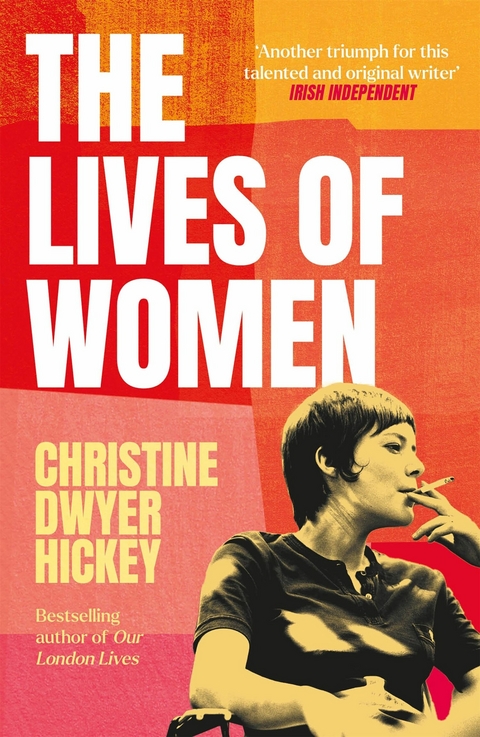
Lives of Women (eBook)
288 Seiten
Atlantic Books (Verlag)
978-1-78239-006-0 (ISBN)
Christine Dwyer Hickey is an award winning novelist and short story writer. Her novel The Cold Eye of Heavenwon the Irish Novel of the Year of the Year 2012, was shortlisted for the Irish Book Awards 2011 and nominated for the IMPAC 2013 award. Last Train from Liguria was shortlisted for the Prix L'Européen de Littérature andTatty was chosen as one of the 50 Irish Books of the Decade as well as being nominated for The Orange Prize and shortlisted for the Irish Book Awards novel of the year 2004. Her first novel The Dancer was shortlisted for Irish Novel of the Year. She has won several short story awards and her first collection The House on Parkgate Street and other Dublin stories was published in 2013. Her first play, Snow Angels premiered at the Project Theatre Dublin in 2014 and the text of same is published in March 2015 (New Island Books). The Lives of Women is her seventh novel. She is a member of Aosdana.
The stunning new novel from Christine Dwyer Hickey, bestselling author of Last Train from Liguria. 'One of Ireland's most lauded modern writers, Christine Dwyer Hickey teases out the strands of her story... It leaves the reader with the aftertaste of regret for their own what might have been...' - Daily MailFollowing a long absence spent in New York, Elaine Nichols returns to her childhood home to live with her invalid father and his geriatric Alsatian dog. The house backing on to theirs is sold and as she watches the old furniture stack up on the lawn, Elaine is brought back to a summer in the 1970s. She is almost sixteen again and this small out-of-town estate is an enclave for women and children while the men are mysterious shadows who leave every day for the outside world. The women are isolated but keep their loneliness and frustrations hidden behind a veneer of suburban respectability. When an American divorcee and her daughter move into the estate, the veneer begins to crack. The women learn how to socialise, how to drink martinis in the afternoon, how to care less about their wifely and maternal duties. While the women are distracted, Elaine and her friends find their own entry into the adult world and the result is a tragic event that will mark the rest of Elaine's life and be the cause of her long and guilt-ridden exile. Insightful and full of suspense, this is an uncompromising portrayal of the suburbs and the cruelties brought about by the demands of respectability.
Christine Dwyer Hickey is an award-winning novelist and short-story writer. Twice winner of the Listowel Writers' Week short story competition, she was also a prize-winner in the prestigious Observer/Penguin short story competition. Her bestselling novel Tatty was chosen as one of the 50 Irish Books of the Decade, longlisted for the Orange Prize and shortlisted for the Hughes & Hughes Irish Novel of the Year Award, for which her novel The Dancer was also shortlisted. Last Train from Liguria, was nominated for the Prix L'Européen de Littérature. Her latest novel The Cold Eye of Heaven won Irish Novel of the Year 2012 and was nominated for the IMPAC 2013 award. She lives in Dublin.
2
Summer Past
May
HER NAME IS ELAINE. She writes it on top of a page in one of the journals she keeps under her bed. My name is Elaine Nichols.
It physically hurts her to write these few words, but seeing them crawl out from under her twisted fingers – that brings her pleasure too.
The doctor has said writing will help her hands come back to full use, and so her father brought up to the hospital a block of unused legal journals, parcelled in smooth brown paper.
Each morning, as soon as she wakes, she reaches for the rubber ball on her bedside locker. Her hands will have clawed overnight and be stubborn as steel; the ball will help coax them back to life.
The first words of the day are always the toughest. As the day moves on and her hands start to loosen, the words will become easier to release, less measured. No matter which journal she happens to be on, no matter how many pages she uses in one day, she always starts with the same thing. My name is Elaine Nichols.
Whatever else she may forget in her life, she knows it won’t be that name.
She has been sick for months. At the end of January she went down with a virus and now it is almost summer. One Saturday morning she’d felt a bit off. By afternoon, she’d had to cancel a babysitting job for the Jacksons – something she hated to do, knowing full well that Junie Caudwell would be in like a light, making the Jackson twins love her more with her bag of sweeties, her big blonde curls and crolly-dolly eyes. For a while she had tortured herself with images of Junie up in the bathroom sniffing Mr Jackson’s after-shave, or twirling around in his big leather chair, or even kissing the photograph of him on the mantelpiece with his tanned face and rolled up shirtsleeves, taken in some far away place like Saudi Arabia.
By Sunday morning she’d forgotten all about the Jacksons and June Caudwell. By Sunday morning she’d hardly known her own name. She’d woken to find a three-headed version of her mother at the end of the bed, asking if she fancied scrambled eggs for breakfast.
It seemed only a few seconds later when she’d opened her eyes to a different light. Thick grey dust at the window, a globe of red from the silk lightshade above, and her mother, back to the one-headed version, standing by the bed holding a plate, in a voice, slightly hurt, asking why – why had she eaten nothing all day?
‘Even the eggs, you haven’t touched. And just how? How do you expect to get well if you won’t even make the smallest of efforts?’
And then her mother, scooping cold eggs onto cold toast, had begun eating them herself.
At some stage an ambulance was called. Later she would remember being wheeled out to it; night sky above and the voices of strangers.
She would remember, too, Doctor Townsend coming from across the road and climbing into the ambulance ahead of her, a hem of pyjama leg showing under the end of his trousers along with a hard knob of ankle. After that she had gone down a hole and disappeared into a delirium.
She was gone for a long time. She crossed a desert and was almost drowned in a crimson sandstorm. It filled her eyes, nose and throat.
A man pulled her out of the storm. He wore a large scarlet turban and had a big silver moustache. When he spoke, it was through a hole in his neck. When he smiled, there was an arc of gold-speckled teeth instead of an Adam’s apple.
There were goats on the journey. Sometimes in a herd, but mostly alone. She hated the goats. The way they shot out of nowhere, nudged her nightdress back with a cold, damp snout, gave a few bleats, before biting down on her buttock and disappearing again. She liked the man, though, and his safe brown arms with their mane of fine silver hair.
The man whispered words into her ear – right down into it. The words were small, warm shapes made of air. She could feel them entering her head, winding their way around and nesting in her brain. She knew they would always live there, that they would grow strong and never leave. They would become part of her. She also knew she would never quite hear them, never mind understand their meaning.
When she came through to the other side, there wasn’t much flesh left under her skin, her hands were crippled and her legs were two hockey sticks that showed no interest in walking. She was in quarantine, in a small square room with a glass wall on either side. There had been a baby in the room to her right. Beyond it, similar rooms that seemed to go on forever: layers of glass and the movement of nurses. Hers was the second-last room on the row. On her left, in the last room, was a man in paisley-print pyjamas.
Three months later the doctor said she was in recovery.
She had wanted to ask what that meant exactly, but the doctor’s back was turned to her, and he hadn’t been speaking to her anyway, he’d been speaking to her mother. Over his shoulder she could see her mother nodding away, touching her hair and looking up at him sideways as if she’d been expecting him to ask her to dance.
In his opinion the girl was greatly improved but by no means completely recovered. Nonetheless he would consider discharging her, depending on the results of a few last minute tests.
‘Well, of course, Doctor,’ her mother was saying. ‘If you think that best, of course…’
For a young girl to be stuck so long on her own… The loneliness – you see? It gets to them. ‘She is what now?’ he asked then, reaching for the chart at the end of the bed.
‘Seventeen in December,’ her mother said.
He lifted the chart and squinted into it. ‘Sixteen,’ he corrected, ‘and a young sixteen at that – would I be right?’
‘Well, yes, Doctor, indeed. Like myself, she’s an only child and, well, we are inclined to be a bit reserved.’
The previous few months had been the loneliest of her life. Days had gone by without a single visitor and only the baby seemed to make sense to her – the two of them lying on their sides and gazing at each other through the glass wall. Different sized nurses had passed through her illness, night into day and back again, but there’d been no conversation beyond a few generalities that only seemed to concern the weather or her bowels. There had been little or no interest shown in her at all, except by the man in the paisley pyjamas who had made her skin crawl, the way he sometimes stared in at her.
For all that she had grown used to the hospital. She liked being on her own. She liked, too, not having to put up with her mother’s habit of asking endless questions about everything and anything that happened to wander into her head. Or being nagged into constantly eating just to keep her company. She liked the small portions they served here. The little silver bowl of jelly and ice-cream for dessert every day, and the way she was given her own little pot of tea. She liked that she didn’t have to share. She had her radio and her two pillars of books – one short, the other tall – and knew she could rely on Mrs Hanley to keep them coming.
Her mother, for all her suffocating ways, had only come to see her twice a week: once when her father drove her after church on Sunday, and for an hour or so every Wednesday afternoon when she came by herself. For the week-day visit she took a taxi and it had been clear from her jigging about that she couldn’t wait to get back to her housework. On Sundays, she put in more of an effort, bringing a bag of homemade buns along with a compendium of games. Elaine always looked forward to these visits, but no sooner had they started when she wished they were over. Her father in the corner of the little room, plucking cake flesh out of the buns and reading the Sunday newspapers. Elaine and her mother by the bed, half-heartedly rattling dice in a plastic cup and pushing coloured buttons up ladders and down snakes.
The doctor brought the good news in person. Her tests had come back. She was to be discharged this very afternoon.
She’d been reading one of Mrs Hanley’s novels at the time and her heart had been thumping on some faraway beach in the South of France.
His sudden appearance gave her a fright. For some reason, she felt ashamed of the book, turning it over and covering it with her hand. She’d had trouble understanding him or even why he should be addressing her in the first place. She kept looking around, expecting her mother to be standing there behind her in the doorway.
The doctor sat side-saddle on the end of the bed and called her ‘young lady’. He tapped his thigh as he spoke. There would be certain conditions, of course: a weekly check-up in the outpatient department. Bed rest and quarantine for a further two weeks. After that, afternoon naps and early to bed to allow her immune system to build itself up. ‘In short, young lady, you will be a hot-house plant, but at least you’ll be a hot-house plant in the loving comfort of your own home where your own people can take good care of you.’
Then he wished her good luck and sauntered off down the corridor, leaving her bereft.
She had thought about getting up and shouting down the corridor after him. She thought of all the things she might say: ‘But I don’t feel better,...
| Erscheint lt. Verlag | 2.4.2015 |
|---|---|
| Verlagsort | London |
| Sprache | englisch |
| Themenwelt | Literatur ► Historische Romane |
| Literatur ► Romane / Erzählungen | |
| Schlagworte | 1970s • American dream • Cold Eye of Heaven • Coming of Age • Contemporary Women • efg short story award • historical fiction • Irish • irish writer • Last Train to Liguria • literary fiction • New York • Suburbia • Sunday Times short story • wives |
| ISBN-10 | 1-78239-006-5 / 1782390065 |
| ISBN-13 | 978-1-78239-006-0 / 9781782390060 |
| Informationen gemäß Produktsicherheitsverordnung (GPSR) | |
| Haben Sie eine Frage zum Produkt? |
 EPUB (Wasserzeichen)
DRM: Digitales Wasserzeichen
Dieses eBook enthält ein digitales Wasserzeichen und ist damit für Sie personalisiert. Bei einer missbräuchlichen Weitergabe des eBooks an Dritte ist eine Rückverfolgung an die Quelle möglich.
Dateiformat: EPUB (Electronic Publication)
EPUB ist ein offener Standard für eBooks und eignet sich besonders zur Darstellung von Belletristik und Sachbüchern. Der Fließtext wird dynamisch an die Display- und Schriftgröße angepasst. Auch für mobile Lesegeräte ist EPUB daher gut geeignet.
Systemvoraussetzungen:
PC/Mac: Mit einem PC oder Mac können Sie dieses eBook lesen. Sie benötigen dafür die kostenlose Software Adobe Digital Editions.
eReader: Dieses eBook kann mit (fast) allen eBook-Readern gelesen werden. Mit dem amazon-Kindle ist es aber nicht kompatibel.
Smartphone/Tablet: Egal ob Apple oder Android, dieses eBook können Sie lesen. Sie benötigen dafür eine kostenlose App.
Geräteliste und zusätzliche Hinweise
Buying eBooks from abroad
For tax law reasons we can sell eBooks just within Germany and Switzerland. Regrettably we cannot fulfill eBook-orders from other countries.
aus dem Bereich