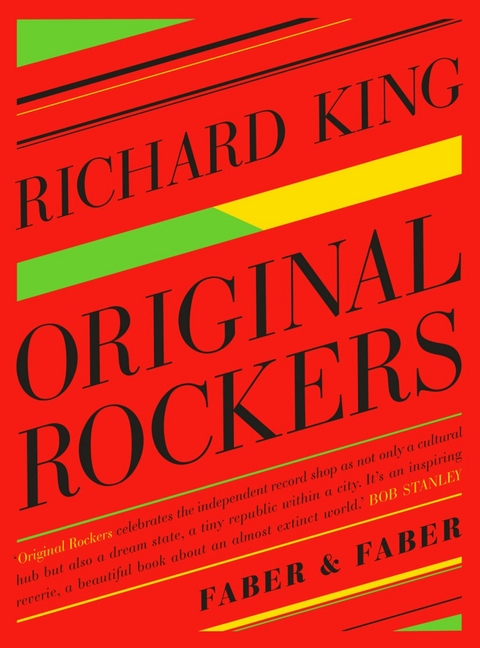
Original Rockers (eBook)
356 Seiten
Faber & Faber (Verlag)
978-0-571-31181-1 (ISBN)
RICHARD KING is the author of Original Rockers (shortlisted for the Gordon Burn Prize and a Rough Trade, Times and Uncut Book of the Year), How Soon Is Now? (a Sunday Times Music Book of the Year), The Lark Ascending (a Rough Trade, MOJO and Evening Standard Book of the Year, shortlisted for the Penderyn Prize), Brittle with Relics and, most recently, Travels Over Feeling: Arthur Russell, A Life, all published by Faber & Faber. His recent appointments have included Visiting Simon Industrial and Professional Fellow, University of Manchester and Royal Literary Fund Fellow, School of Journalism, Media and Culture, Cardiff University. He is currently writing a history of the art school. richardhywelking.com
Richard King's account of the several years he spent working in a Bristol independent record shop in the early 90s is destined to become a classic of music writing. We live in an age when the most beautiful of recording formats, vinyl, is back in vogue and thriving. In the early 90s, with the march of the cd and record company disinterest oin the format, vinyl was looking like an anachronism. And with its demise came the gradual erosion of a once beautiful and unique landscape known as the independent record shop. Richard King, author of How Soon is Now, blends memoir and elegiac music writing on the likes of Captain Beefheart, CAN and Julian Cope, to create a book that recalls the debauched glory days of the independent record shop. Chaotic, amateurish and extravagantly dysfunctional, this is a book full of rare personalities and rum stories. It is a book about landscape, place and the personal; the first piece of writing to treat the environment of the record shop as a natural resource with its own peculiar rhythms and anecdotal histories.
Richard King was born in Newport, Gwent. He has worked at the heart of the independent music industry for nearly twenty years. He is the co-editor of Loops, an occasional journal of long-form music writing published jointly by Faber and Domino Records. He has contributed to the Guardian, the Observer and many other publications. He lives with his family in Powys.
One morning I walked into the back room of Revolver and immediately tripped over a bicycle, my fall broken by a pile of discarded record boxes and cracked PVC covers. The bike was usually stored against a shelf of vinyl hidden in a recess. It belonged to Roger, Revolver’s proprietor, who had moved the bike from its customary place in order to improvise a temporary signwriting studio. Around his feet were old coffee pots full of stubs of pastel-coloured and white chalk. In his hand was a blue J-cloth he had just dampened in the sink which he was now slowly running across the surface of a sturdy five-foot-high A-board.
In the breathless manner with which he had built the display boxes, counter and shelves and wired and fastened every fitting in the shop, Roger had constructed and painted the A-board with a confidence that combined childhood enthusiasm with dexterity. I had first encountered then befriended Roger, as one of the many customers whose primary reason for visiting the shop was to hold prolonged conversations at the counter. These exchanges began as slightly competitive discussions about obscure records before growing into a form of theatrical, absurdist exchange on which the shop’s reputation thrived.
Roger was one of the most remarkable people I have ever met. His supple and well-built frame was evidence of his love of cycling and of moonlighting from the shop as a handyman and builder, an interest that ensured he spent regular periods of time away from Revolver, fitting roofs or hanging doors within the informal Bristol economy to which the shop, via the exchange of records for other miscellaneous goods and services, often contributed. Unlike many record-shop proprietors, Roger was in rude health and took care over his appearance. He had a thick head of dark silver-flecked hair that, along with his aura of briskness and his tendency to be boisterous and ready to engage anyone who visited the shop, meant his age was difficult to determine. I never established how old Roger was, but when I started working in the shop I assumed he was in his forties.
Roger had taken over Revolver from the shop’s founders, who had left to concentrate on running a record distribution company of the same name. He had arrived in Bristol from Cheltenham, where he had known and played in a band with the musicians who became Pigbag. At times his manner could appear evangelical, almost crazed, to the point where customers felt intimidated and vowed never to return. His willingness to give his opinion about enquiries for records he considered second-rate occasionally had consequences. I once saw a visitor distribute the contents of a divider bin across the shop floor and shout, ‘Take this lot to the tip then!’ in response to Roger’s assertion that the record the visitor was searching for was more likely to be found in a skip than in Revolver. A few months later a colleague informed me that such retaliations were not without precedent.
In a city as lackadaisical as Bristol, a natural extrovert such as Roger was occasionally considered volatile or opinionated; but his opinions were invariably worth hearing. His knowledge of every genre and style of music, especially jazz, was unparalleled and had begun at an early age. He told me stories of wandering into Marine Ices in Chalk Farm in need of sugar after nights spent in the Roundhouse as a stoned teenager; later he ran a record stall in Portobello Road where Brian Eno had been a regular customer, for albums by Fela Kuti in particular.
As Revolver had no store front Roger had made the A-board to help summon interest. It was positioned every morning alongside the shop’s entrance where the careful design used in its decoration was at the mercy of Bristol’s weather patterns. On the near side of the board was written that week’s releases and details of any new stock and consignments that might be of interest to our customers. The reverse side was taken up with what had become known as the Revolver alphabet, an A to Z of bands and artists that represented the ethos and taste of the shop but whose releases, given our cash flow, were far from guaranteed to be in stock. The contents of this inventory were usually discussed by committee, one whose decisions were disregarded by whoever had decided to write up the board and who instead substituted the agreed list of names with one derived from their prejudices and imagination. A typical board might start with ‘Ayers’ and ‘Buckley’, which gave the impression of the morning register at a provincial boys school.
The alphabet gradually grew detached from such orthodoxies and began to bear the hallmarks of a more conceptual approach. Roger might create an imaginary band name or, as he occasionally did, satirise some of the shop’s clientele. As a customer I had once walked passed the board and was compelled to stop and attempt to decipher a word placed in between ‘Momus’ for M and ‘Ornette’ for O (in keeping with its vernacular, jazz musicians were referred to by their first name). Along nearly the entire length of a line in the alphabet was written ‘Neoohhhvarhhhniahhl’. Inside the shop I had waited for a quiet moment before asking Roger the meaning of this linguistic composition. ‘Nirvana,’ he replied, evidently surprised at my confusion. ‘Spoken in a thick Bristolian accent.’
Although the names written on the board were notionally interchangeable, the repeated inclusion of a few artists was assured. This was no more so the case than with Can.
When I began working at the shop, Can were revered, but the band’s music retained an air of mystery and secrecy, one that was shared among acolytes but had little resonance other than being an influence. In part this was due to the difficulty of finding their releases. Although the Can catalogue had been reissued on CD, the band had yet to receive any critical reassessment or undergo the careful remastering that accompanies canonical status. Instead their albums were available in rather piecemeal editions with thin facsimile sleeves that lacked the resonance of the originals.
The sound quality of the CDs was equally insubstantial, as if the sound engineer had digitally remastered a low-resolution cassette from a vinyl copy of each album rather than returning to the original master tapes.
The albums Can released in the 1970s had been housed in thick, cardboard gatefold sleeves with dramatic, gnostic artwork and which had long been prized by record collectors. Although I prided myself on enjoying older records far more than anything written about in the contemporary music press or in the charts, I was unfamiliar with Can’s recordings. I had first heard their name as I witnessed Roger selling ‘Fools Gold’, a 12" by the Stone Roses, to an undergraduate. As he completed the transaction he debated with a regular customer to what extent the Stone Roses had committed larceny by plagiarising Can for their latest release and whether the German band might be in a position to sue.
‘Straight rip-off,’ said Roger, but, ‘This lot …’ he nodded towards the student who had just completed what was likely to be his final Revolver purchase, ‘straight over their heads.’
In a corner behind the counter, hidden from sight, was piled a large assortment of bootleg CDs and other recordings whose provenance was never fully explained.
Two separate copies of live Can performances from their mid-decade eminence were included in this hoard of illicitly produced music. Their titles, as was common with bootlegs, demonstrated a fan’s stoned fanaticism. The first CD was titled Unopened, in a rather laboured play on words on the official 1976 Can compilation, Opener. The second bootleg was named Horror Trip in the Paperhouse for the song ‘Paperhouse’ on Tago Mago, an album, one of several, that were frequently described in Revolver as ‘the greatest record ever made’.
Towards the end of an uneventful day I loaded Horror Trip in the Paperhouse into the CD player. The recording was of a largely improvised free concert the band gave in the Sporthalle, Cologne, in 1972. An hour later I realised there had been no visitors to the shop and outside the light had grown dark. I had been oblivious to my surroundings for the duration of Horror Trip in the Paperhouse.
Until advances in digital recording, concert bootlegs were taped on to cassette either by a member of the audience via a microphone and recorder concealed within a coat pocket, or directly from the signal at the mixing board positioned in the middle of the concert hall. Once these recordings were duplicated, the sound quality depreciated and gained the subaqueous echoing quality that could be heard on Horror Trip in the Paperhouse and that suited the music of Can. The performance essentially consisted of a single, long jam that occasionally fell into a structure recognisable as one of their songs.
Can’s bass player Holger Czukay had been a student of Stockhausen, as had the keyboard player Irmin Schmidt, and Jaki Liebezeit, the band’s drummer, had once played in the Manfred Schoof quintet, one of West Germany’s few and respected free-jazz ensembles. Czukay and Liebezeit synthesised the economy of James Brown’s rhythm section with the theories and transcendental qualities of minimalism. On Horror Trip in the Paperhouse there was a devotional intensity to Can’s music that was overwhelming and had consumed me as I sat listening in the empty shop.
In the back room of Revolver was a set of floor-to-ceiling shelves, each four feet in length and overfilled with records arranged in loose alphabetic order. The artist names corresponded with...
| Erscheint lt. Verlag | 31.3.2015 |
|---|---|
| Verlagsort | London |
| Sprache | englisch |
| Themenwelt | Literatur ► Biografien / Erfahrungsberichte |
| Kunst / Musik / Theater ► Musik ► Pop / Rock | |
| Schlagworte | Bristol • Domino Records • Massive Attack • record collecting • Tim Book Two • Vinyl • W. G. Sebald |
| ISBN-10 | 0-571-31181-4 / 0571311814 |
| ISBN-13 | 978-0-571-31181-1 / 9780571311811 |
| Informationen gemäß Produktsicherheitsverordnung (GPSR) | |
| Haben Sie eine Frage zum Produkt? |
 EPUB (Adobe DRM)
Kopierschutz: Adobe-DRM
Adobe-DRM ist ein Kopierschutz, der das eBook vor Mißbrauch schützen soll. Dabei wird das eBook bereits beim Download auf Ihre persönliche Adobe-ID autorisiert. Lesen können Sie das eBook dann nur auf den Geräten, welche ebenfalls auf Ihre Adobe-ID registriert sind.
Details zum Adobe-DRM
Dateiformat: EPUB (Electronic Publication)
EPUB ist ein offener Standard für eBooks und eignet sich besonders zur Darstellung von Belletristik und Sachbüchern. Der Fließtext wird dynamisch an die Display- und Schriftgröße angepasst. Auch für mobile Lesegeräte ist EPUB daher gut geeignet.
Systemvoraussetzungen:
PC/Mac: Mit einem PC oder Mac können Sie dieses eBook lesen. Sie benötigen eine
eReader: Dieses eBook kann mit (fast) allen eBook-Readern gelesen werden. Mit dem amazon-Kindle ist es aber nicht kompatibel.
Smartphone/Tablet: Egal ob Apple oder Android, dieses eBook können Sie lesen. Sie benötigen eine
Geräteliste und zusätzliche Hinweise
Buying eBooks from abroad
For tax law reasons we can sell eBooks just within Germany and Switzerland. Regrettably we cannot fulfill eBook-orders from other countries.
aus dem Bereich