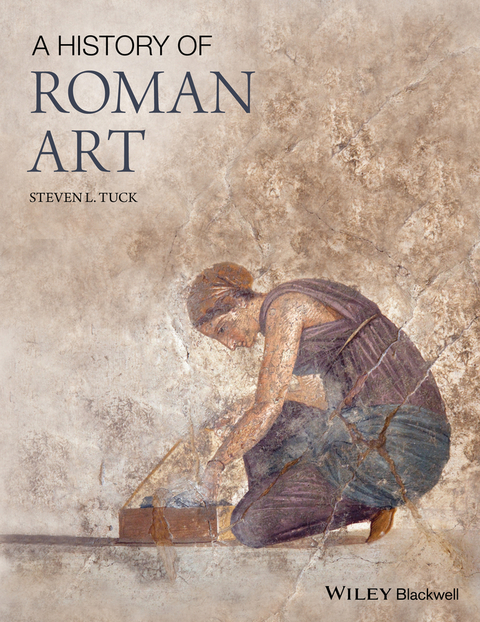
A History of Roman Art provides a wide-ranging survey of the subject from the founding of Rome to the rule of Rome?s first Christian emperor, Constantine. Incorporating the most up-to-date information available on the topic, this new textbook explores the creation, use, and meaning of art in the Roman world.
- Extensively illustrated with 375 color photographs and line drawings
- Broadly defines Roman art to include the various cultures that contributed to the Roman system
- Focuses throughout on the overarching themes of Rome?s cultural inclusiveness and art?s important role in promoting Roman values
- Discusses a wide range of Roman painting, mosaic, sculpture, and decorative arts, as well as architecture and associated sculptures within the cultural contexts they were created and developed
- Offers helpful and instructive pedagogical features for students, such as timelines; key terms defined in margins; a glossary; sidebars with key lessons and explanatory material on artistic technique, stories, and ancient authors; textboxes on art and literature, art from the provinces, and important scholarly perspectives; and primary sources in translation
- Upon publication, a book companion website will be available with the following resources: PowerPoint slides, glossary, and timeline
Steven Tuck is the 2014 receipient of the American Archaeological Association's Excellence in Undergarduate Teaching Award.
Steven L. Tuck is Professor and Chair of Classics at Miami University. In 2012, he received the E. Phillips Knox award, Miami University's highest honor for innovative and effective undergraduate teaching. He is the author of Latin Inscriptions in the Kelsey Museum: The Dennison and De Criscio Collections (2006).
A History of Roman Art provides a wide-ranging survey of the subject from the founding of Rome to the rule of Rome's first Christian emperor, Constantine. Incorporating the most up-to-date information available on the topic, this new textbook explores the creation, use, and meaning of art in the Roman world. Extensively illustrated with 375 color photographs and line drawings Broadly defines Roman art to include the various cultures that contributed to the Roman system Focuses throughout on the overarching themes of Rome's cultural inclusiveness and art's important role in promoting Roman values Discusses a wide range of Roman painting, mosaic, sculpture, and decorative arts, as well as architecture and associated sculptures within the cultural contexts they were created and developed Offers helpful and instructive pedagogical features for students, such as timelines; key terms defined in margins; a glossary; sidebars with key lessons and explanatory material on artistic technique, stories, and ancient authors; textboxes on art and literature, art from the provinces, and important scholarly perspectives; and primary sources in translation A book companion website is available at www.wiley.com/go/romanart with the following resources: PowerPoint slides, glossary, and timeline Steven Tuck is the 2014 recipient of the American Archaeological Association's Excellence in Undergraduate Teaching Award.
Steven L. Tuck is Professor and Chair of Classics at Miami University. In 2012, he received the E. Phillips Knox award, Miami University's highest honor for innovative and effective undergraduate teaching. He is the author of Latin Inscriptions in the Kelsey Museum: The Dennison and De Criscio Collections (2006).
Dedication
Acknowledgments
Preface
Note to Students
1 Introduction
2 Regal Period, 753 BC-509 BC: The Etruscans and the Question of Etruscan Dominance
3 The Early Republic, 509 BC-211 BC: The Spread of Roman Power and Forms
4 The Later Republic, 211 BC-31 BC: The Origins of a Hellenistic Roman Culture
5 The Age of Augustus, 31 BC-AD 14: The Art of Empire
6 The Julio-Claudians, AD 14-68: The Rise of Roman Dynastic Art
7 The Flavians, AD 69-96: Civil War, Disaster and Response
8 Trajan and Hadrian, AD 98-138: Emperors from the Provinces
9 Antonine Emperors, AD 138-192: From an Empire of Gold to one of Rust
10 Civil War and Severan Dynasty, AD 193-235: Calm before the Storm
11 The Third Century and the Tetrarchy, AD 235-306: Crisis and Renewal
12 Constantine, AD 306-337: Christian Empire and the Decline of the West
Glossary
Guide to Further Reading
"In his engagingly conversational, often humorous, and
lavishly illustrated text, Tuck approaches the multifaceted role of
Roman art as visual communication that was essential to governing a
vast and diverse empire. Contextually-oriented and informed by
current scholarly debates, the book encourages students to
appreciate not only Roman visual culture but also how we write its
history." -Elaine Gazda, University of
Michigan
"Gloriously illustrated, this book excels for its emphasis
on Roman viewers, its conversational style (fitting from the winner
of a national teaching award!), and its deft anticipation of modern
assumptions." -Lea Stirling, University of
Manitoba
"This book provides an accessible overview of Roman art,
drawing on the most recent developments in Roman archaeology and
art history. Elegantly written and exquisitely illustrated, it also
tackles questions of modern reception, collection and ownership of
the Roman artistic heritage. This is both an invaluable
introduction for students and a go-to reference work for
scholars." -J.C.N. Coulston, University of St.
Andrews
"Steven L. Tuck's book offers a fresh, fast-paced
and abundantly illustrated narrative of Roman art, from its
Etruscan beginnings to the emergence of early Christian art.
Tuck's survey is a great starting point for students and all
those making first contact with the art and architecture of ancient
Rome." -Björn C. Ewald, University of
Toronto
"Tuck gives an excellent introduction to Roman art.
Accessible and engaging, this book covers key monuments and
objects, while also providing useful discussions of historical
context, scholarly debate and contemporary response. I recommend
it." -Zahra Newby, University of Warwick
Illustrations
| 0.1 | Map of full extent of Roman Empire under Trajan, c. 115 CE |
| 1.1 | Julio-Claudian man, portrait |
| 1.2 | Capitoline She-wolf statue, 5th cent. BCE or 13th cent. CE |
| 1.3 | Statue of Roman man with busts of ancestors, “Barbarini Togatus,” 1st cent. CE and 16th cent. CE |
| 1.4 | Cloaca Maxima (Great Drain) outlet to the Tiber, Rome, c. 510 BCE |
| 1.5a,b | Greek Temple of Hera, Paestum, c. 450 BCE compared with Roman Temple of Portunus, Rome, c. 150 BCE |
| 1.6 | Victorious general from Tivoli, Italy, c. 75–50 BCE |
| 1.7 | Emperor Lucius Verus as victorious athlete, Rome, c. 169 CE |
| 1.8 | Trebonianus Gallus bronze portrait, 251–253 CE |
| 1.9a,b | Small Herculaneum Woman Statue and Large Herculaneum Woman Statue, 1st cent. CE |
| 1.10 | Still life paintings, Praedia of Julia Felix, Pompeii, c. 70 CE |
| 1.11 | Gladiator fresco, Tomb of Vestorius Priscus, Pompeii, 75/76 CE |
| 1.12 | Silver service fresco, Tomb of Vestorius Priscus, Pompeii, 75/76 CE |
| 1.13a,b | Cutaway and plan of Roman atrium house |
| 1.14 | Facade photo of Roman house, Pompeii |
| 2.1 | Map of Etruria, including Etruscan, Latin, and Greek communities in early Italy |
| 2.2a,b | Plan of the Etruscan Banditaccia necropolis, Cerveteri and photo of tumulus |
| 2.3 | Tomb of the Shields and Chairs plan, Banditaccia necropolis, Cerveteri, c. 550 BCE |
| 2.4 | Gold fibula from the Regolini-Galassi tomb, Cerveteri |
| 2.5 | Ivory pyxis, Pania burial, Chiusi, 650–600 BCE |
| 2.6 | Terracotta “canopic” urn, Chiusi, 625–600 BCE |
| 2.7 | Couple sarcophagus from Cerveteri, c. 525 BCE |
| 2.8 | Apollo of Portonaccio Sanctuary, Veii, 510 BCE |
| 2.9 | Minerva Tritonia from Lavinium, Latium, 5th cent. BCE |
| 2.10 | Bronze Italic disk, one of three from a breast plate, 7th cent. BCE |
| 2.11 | Rome, plan of Palatine and early Rome with cemeteries, Forum Romanum (including Regia) and Boarium marked |
| 2.12 | House urn, Forum Romanum, Rome, 7th cent. BCE |
| 2.13 | Cross section drawing of cremation burial tomb from the Forum necropolis, Via Sacra, Rome |
| 2.14 | Temple of Fortuna acroterion of Hercules and Athena, Sant’Omobono Sanctuary, Rome, 570–540 BCE |
| 2.15 | Temple of Jupiter Optimus Maximus, plan |
| 2.16 | Temple of Jupiter Optimus Maximus, model |
| 2.17 | Silver denarius of Petillius Capitolinus. Reverse, Temple of Jupiter Optimus Maximus, c. 43 BCE |
| 2.18 | Murlo (Poggio Civitate) plan of Orientalizing phase buildings, c. 675–600 BCE |
| 2.19 | Murlo (Poggio Civitate) reconstruction illustration of Archaic phase buildings, c. 600–590 BCE |
| 2.20 | Murlo (Poggio Civitate) terracotta plaque of horse race; artist’s reconstruction of fragmentary plaques, c. 580–575 BCE |
| 2.21 | Murlo (Poggio Civitate) terracotta plaque of banquet scene; artist’s reconstruction of fragmentary plaques, c. 580–575 BCE |
| 2.22 | Murlo (Poggio Civitate) terracotta plaque of assembly scene; artist’s reconstruction of fragmentary plaques, c. 580–575 BCE |
| 2.23 | Wall painting of Achilles and Troilus, main wall of the antechamber, Tomb of the Bulls, Tarquinia, 560 BCE |
| 2.24 | Wall painting of events from funeral games, Tomb of the Augurs, Tarquinia, 530 BCE |
| 2.25 | Elite dining and outdoor scenes, wall painting from back wall of the burial chamber, Tomb of Hunting and Fishing, Tarquinia, 530 BCE |
| 2.26 | Remains of the Doric temple in the Triangular Forum, Pompeii, 600–550 BCE |
| 3.1 | Symposium scene, wall painting in the Tomb of the Diver, Paestum, c. 480 BCE |
| 3.2 | Diver scene from the roof slab, wall painting in the Tomb of the Diver, Paestum, c. 480 BCE |
| 3.3 | Banquet scene, wall painting in the Tomb of the Leopards, Tarquinia, 470 BCE |
| 3.4 | Dancers, wall painting from the Tomb of the Triclinium, Tarquinia, 470 BCE |
| 3.5 | Pediment relief sculpture from Temple A, Pyrgi, 460 BCE |
| 3.6 | Funerary games of boxers and gladiators, wall painting from Tomb 90a, Paestum, 370 BCE |
| 3.7 | Funerary games of charioteers, wall painting from Tomb X, Paestum. Museo Archeologico Nazionale di Paestum, 350 BCE |
| 3.8 | Scenes of woman’s funeral and travel into the underworld, wall painting from Tomb 47, Paestum, 360 BCE |
| 3.9 | Historical battle, tomb painting from Tomb 114, Paestum, 320 BCE |
| 3.10 | Carved and painted reliefs, Tomb of the Reliefs, Cerveteri, 4th cent. BCE |
| 3.11 | Portrait of Velia, tomb painting, Tomb of Orcus, Tarquinia, 330 BCE |
| 3.12 | Banqueting couple, wall painting from the Tomb of the Shields, Tarquinia, 325 BCE |
| 3.13 | Processional scene, Tomb of the Typhon, Tarquinia, late 3rd cent. BCE |
| 3.14 | Tomb of Q. Fabius, wall painting from a tomb on the Esquiline Hill, Rome, c. 300–250 BCE |
| 3.15 | Statue of Mars from Todi, c. 400 BCE |
| 3.16 | Bronze statuette of Hercules, probably from Cerveteri, c. 400–350 BCE |
| 3.17 | Ficoroni Cista, Praeneste, 350–330 BCE |
| 3.18 | Bronze chimera from Arezzo, 4th cent. BCE |
| 3.19 | Bronze bust of a man “Brutus,” c. 300 BCE |
| 3.20 | “Servian Wall,” Rome, c. 386 BCE |
| 3.21 | Limestone relief of sulcus primigenius for a Roman colony, 2nd cent. BCE? |
| 3.22 | Ostia, plan of Roman colony centered on forum, 338 BCE |
| 3.23 | Paestum, plan of Roman colony, 273 BCE |
| 3.24 | Cosa, plan of Roman colony, 273 BCE |
| 3.25 | Cosa, reconstruction drawing of arx dominated by their Capitolium, 273 BCE |
| 4.1 | Sarcophagus of Scipio Barbatus, Rome, c. 200 BCE |
| 4.2 | Temple of Portunus, Rome, c. 150 BCE |
| 4.3 | Temple of Hercules Victor, Rome, c. 150 BCE |
| 4.4 | Republican Temples, Tivoli, c. 100 BCE |
| 4.5 | Basilica plan, Pompeii, c. 150 BCE |
| 4.6a,b | Basilica interior, Pompeii, c. 150 BCE |
| 4.7 | Plan, city of Pergamon, c. 133... |
| Erscheint lt. Verlag |
16.12.2014
|
| Sprache |
englisch |
| Themenwelt
|
Literatur |
| Kunst / Musik / Theater ► Kunstgeschichte / Kunststile |
| Geschichte ► Allgemeine Geschichte ► Altertum / Antike |
| Geisteswissenschaften ► Sprach- / Literaturwissenschaft ► Anglistik / Amerikanistik |
| Geisteswissenschaften ► Sprach- / Literaturwissenschaft ► Literaturwissenschaft |
| Schlagworte |
Art & Applied Arts • Art History & Criticism • Classical Studies • Humanistische Studien • Kultur der römischen Antike • Kultur der römischen Antike • Kunstgeschichte • Kunstgeschichte u. -kritik • Kunst u. Angewandte Kunst • Roman art, painting, mosaic, sculpture, decorative arts, architecture, Rome, Constantine, Regal Period, Republic, Principate, Roman Empire, Etruscan art, Greek art, Plebian art, Roman dynastic art, early republic, later republic, age of Augustus, Julio-Claudians, the Flavians, Trajan, Hadrian, Antonine Emperors, Severan dynasty, Tetrarchy, Roman values • Roman Culture • Rom /Kultur, Künste • Rom /Kultur, Künste |
| ISBN-10 |
1-118-88543-0 / 1118885430 |
| ISBN-13 |
978-1-118-88543-7 / 9781118885437 |
 EPUB (Adobe DRM)
Kopierschutz: Adobe-DRM
Adobe-DRM ist ein Kopierschutz, der das eBook vor Mißbrauch schützen soll. Dabei wird das eBook bereits beim Download auf Ihre persönliche Adobe-ID autorisiert. Lesen können Sie das eBook dann nur auf den Geräten, welche ebenfalls auf Ihre Adobe-ID registriert sind.
Details zum Adobe-DRM
Dateiformat: EPUB (Electronic Publication)
EPUB ist ein offener Standard für eBooks und eignet sich besonders zur Darstellung von Belletristik und Sachbüchern. Der Fließtext wird dynamisch an die Display- und Schriftgröße angepasst. Auch für mobile Lesegeräte ist EPUB daher gut geeignet.
Systemvoraussetzungen:
PC/Mac: Mit einem PC oder Mac können Sie dieses eBook lesen. Sie benötigen eine Adobe-ID und die Software Adobe Digital Editions (kostenlos). Von der Benutzung der OverDrive Media Console raten wir Ihnen ab. Erfahrungsgemäß treten hier gehäuft Probleme mit dem Adobe DRM auf.
eReader: Dieses eBook kann mit (fast) allen eBook-Readern gelesen werden. Mit dem amazon-Kindle ist es aber nicht kompatibel.
Smartphone/Tablet: Egal ob Apple oder Android, dieses eBook können Sie lesen. Sie benötigen eine Adobe-ID sowie eine kostenlose App.
Geräteliste und zusätzliche Hinweise
Buying eBooks from abroad
For tax law reasons we can sell eBooks just within Germany and Switzerland. Regrettably we cannot fulfill eBook-orders from other countries.