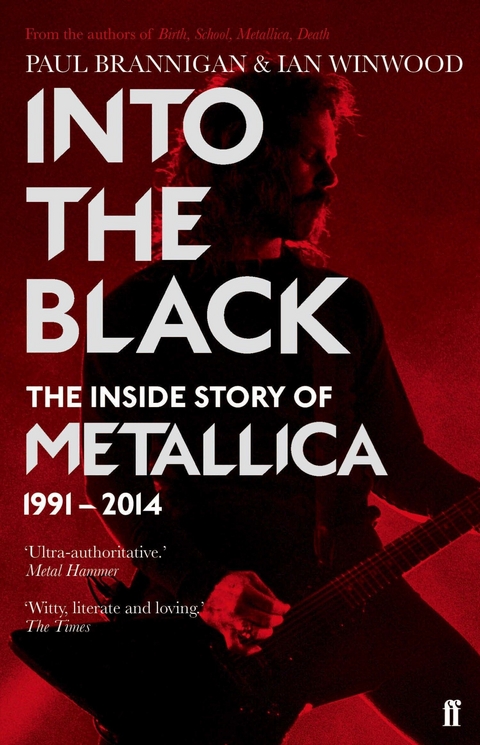
Into the Black (eBook)
400 Seiten
Faber & Faber (Verlag)
978-0-571-29577-7 (ISBN)
Ian Winwood is a music journalist whose work has appeared in the Daily Telegraph, the Guardian, Kerrang!, Rolling Stone, Mojo, NME, Q and the BBC. His most recent book, Smash!, was published in 2019. @IanWinwood1
As they embark upon the fourth decade of the career, Metallica's legacy is as unique as it is remarkable: having sold over 100 million albums their status as the biggest Metal band of all time is indisputable. Following the acclaimed first volume, which chronicled the band's rise to international stardom, the authors now explore the challenges and tensions that ensued for the band. From the phenomenal, breakthrough, success of 1991's 'Black' album to the band's reinvention with the 'Load/Reload' albums; bassist Jason Newsted's shock exit in 2001 and the group's subsequent meltdown, as laid bare in the unvarnished fly-on-the-wall documentary Some Kind Of Monster, to the divisive 'St. Anger' and 'Lulu' sets (recorded with Rick Rubin and in collaboration with Lou Reed respectively), they brilliantly capture this unique bands epic, louder than life saga.
Paul Brannigan and Ian Winwood are two of the UK's foremost music writers. A former editor of Kerrang! - the world's biggest weekly music magazine - Brannigan is the author of the Sunday Times Bestseller This Is A Call: The Life And Times Of Dave Grohl while Winwood has written for Rolling Stone, the Guardian, Mojo, Kerrang!, NME and the BBC. The first volume of Birth, School, Metallica, Death was published to huge acclaim in Autumn 2013.
Standing outside Le Dome brasserie, Lars Ulrich and Axl Rose watched a cavalcade of sports cars, SUVs and limousines nudge headlight-to-bumper along Sunset Boulevard, West Hollywood’s vena cava. Eddie Kerkhof’s restaurant, located at 8720 Sunset, a plectrum flick away from Tinseltown’s most notorious rock ’n’ roll haunts, was a popular meeting place for the entertainment industry’s power players, and as Rose sucked on a Marlboro Red by the doorway, his live-wire companion offered a sarcastic running commentary on the beautiful people gliding by, all of whom were oblivious to the duo’s presence.
‘You know, people are going to be so surprised by this,’ Ulrich told Rose. ‘Everyone is going to be saying “I can’t believe it, it’ll never happen.”’
As the pair returned to join James Hetfield and Slash at their patio table, their respective managers – Q Prime’s Peter Mensch and Cliff Burnstein, and Guns N’ Roses handler Doug Goldstein – could be found deep in conversation, their food untouched. With due respect to Le Dome’s lauded haute cuisine, dinner could wait, for this elevated summit had been convened with one simple, if audacious, purpose in mind: to iron out the logistics involved in putting the world’s biggest hard rock band and the world’s biggest metal band on tour together.
*
Though the impetus to propel the Metallica/Guns N’ Roses US touring juggernaut on to America’s highways originated with the Guns N’ Roses camp, the original concept belonged, inevitably, to Ulrich. The little Dane had long harboured dreams of the two groups uniting to deliver a historic touring package akin to a Rolling Stones/The Who bill in the Sixties. Introduced by a mutual business associate, music industry lawyer Peter Paterno, the Californian bands had first met in 1987 and subsequently bonded over lines of white powder and fingers of hard liquor during Metallica’s five-month residency in Los Angeles recording the … And Justice for All album, with the San Franciscans gamely keeping pace with the younger band’s well-documented appetite for self-destruction. In his self-titled 2007 autobiography, Slash recalled James Hetfield requesting the use of his bedroom for a romantic dalliance with a young lady at one typically rambunctious party at his apartment on Hollywood and Franklin. ‘I had to get in there to get something, so I crept in quietly and saw James head-fucking her,’ the guitarist remembered. ‘He was standing on the bed, ramming her head against the wall, moaning in that thunderous voice of his … “That’ll be fine! That’ll be fine! Yes! That’ll be fine!”’
The evening during which the two bands shared a stage for the first time was an equally unrefined affair. The Los Angeles-based heavy metal magazine RIP had hired the Hollywood Palladium to host its fourth anniversary party celebrations on November 9, 1990, hand-picking LA cock-rockers Bang Tango, sepia-toned oddballs Masters of Reality, San Francisco’s Faith No More, Dave Mustaine’s Megadeth and Ulrich’s long-time heroes Motörhead to deliver a state of the hard rock nation address. Unbeknown to the crowd gathered inside the beautiful 4,000-capacity art deco building, the magazine’s king-maker editor Lonn Friend had not only persuaded Ozzy Osbourne to make an unbilled guest appearance with Faith No More on their cover of Black Sabbath’s ‘War Pigs’, but had also cajoled members of Guns N’ Roses, Skid Row and Metallica into uniting to form a one-off super-group for the occasion.
The longer arms of the clocks in the venue’s dressing rooms had ticked thirty minutes into November 10, when a visibly ‘refreshed’ Ulrich, Slash and Duff McKagan stumbled behind Skid Row vocalist Sebastian Bach on to the Palladium stage. Taking the opportunity to introduce four men who needed no introduction to the partisan crowd, Friend revealed that the quartet wished to be known as Gak – Hollywood slang for cocaine – a little in-joke which presumably seemed significantly more amusing when coined in a bathroom cubicle earlier that same evening. In truth, had the four men onstage spent rather more time with instruments in their hands instead of $20 bills up their noses in the days leading up to the show, the twenty-five-minute set which followed might have been marginally less shambolic. As it was, Gak’s debut bow bore all the grace and artistry of a three-legged terrier attempting to write out its home address in excrement on a Hollywood sidewalk.
The quartet fumbled through an out-of-tune, out-of-key version of Guns N’ Roses’ ‘You’re Crazy’ before committing assault and battery on Metallica’s ‘For Whom the Bell Tolls’. Axl Rose then took over on vocals for a stab at Skid Row’s ‘Piece of Me’ before Bach re-joined the stramash to trade vocals with Rose on a version of Nazareth’s ‘Hair of the Dog’.
The set’s closing minutes bore witness to the most telling performance of the night. Ulrich beckoned James Hetfield from the bar to play rhythm guitar on ‘Whiplash’, an invitation he would come to regret as he watched his friend’s face register first bemusement then embarrassment and then granite-faced anger, Hetfield’s eyes narrowing to slits as it became abundantly clear that vocalist Bach’s familiarity with the Metallica standard extended only to screaming its title. Hetfield’s mood was in no way improved when, as the song ground to an ignominious conclusion in squalls of feedback, a laughing Axl Rose approached the mic, and addressed the crowd saying, ‘We tried to tell him that nobody knew the song!’
‘He’s into being a lumberjack tonight’, Rose laughed, teasing the Metallica man over his decision to show up to the party in a blue plaid shirt.
‘I’m a lumberjack and I don’t give a shit,’ Hetfield sang in response, his bristling demeanour completely contradicting his words.
‘Whiplash’ might not have been the most sophisticated song in Metallica’s armoury, but, as an unabashed love letter to the San Francisco metal community which had first clasped his band to its bosom eight years earlier, its lyric still had a profound resonance for Hetfield. Seeing it transformed into lumpen pub rock cabaret stung the proud Bay Area émigré. Kirk Hammett was duly summoned to the stage to strap on his Flying V as Hetfield told the crowd, ‘I’m going to sing it this time. The other guy fucked it all up.’ Two choruses in, with the song now taking flight, Axl Rose stage-dived into the crowd and a smile was restored on the face of Metallica’s redoubtable front man.
But it was close. Things could have gone either way.
Fifteen months on, seated around a table laden with gourmet French cuisine, Metallica felt they could afford to be magnanimous towards their LA brethren. Scores of shows deep into the Wherever We May Roam tour, the Metallica machine was operating at full hypnotising power, racking up multiple nights in North America’s most capacious sports arenas – three nights at the 18,000-capacity Nassau Coliseum, five nights at the 17,500-capacity LA Forum – as sales of ‘The Black Album’ sailed north of four million copies in the US alone. Performing nightly on a special diamond-shaped stage, its ‘snake pit’ centre hollowed out so that a hundred fans might stand close enough to the epicentre to feel James Hetfield’s beer-breath on their faces, the quartet understood instinctively that they had acquired an irresistible, unstoppable momentum. The idea that Guns N’ Roses should close out each night of their proposed stadium tour was fine with Hetfield and Ulrich. And if Axl Rose insisted upon aping the organisers of 1991’s inaugural Lollapalooza festival by granting organisations permission to erect booths promoting liberal causes in the parking lot at every stop on the tour, that, too, was okay with Hetfield, as long as everyone understood that he personally wouldn’t be endorsing these causes. Provided that the bands were allocated equal time onstage and gate receipts were split evenly (and projected ticket sales suggested a gross of between one and 1.8 million dollars per night), as far as Metallica were concerned Guns N’ Roses could do what they damn well pleased.
For Mensch, Burnstein, Goldstein and Bill Graham Promotions, the logistical headaches started here. The unusual nature of the tour presented unique problems. Since both bands were intent upon performing sets stretching to two and a half hours onstage, the event – making allowance for set changeover times and a forty-five-minute slot for an opening band – could potentially run to almost eight hours each day: furthermore, the fact that Metallica desired to take the stage after sundown each evening would mean that the concert could conceivably run two hours past midnight. For stadium managers and local law enforcement agencies this would create significant issues regarding crowd control, transport and noise regulations. Chicago, Cleveland, Philadelphia and Atlanta were among the cities who instantly rejected the opportunity to host shows: stadium managers in other key markets informed Bill Graham’s people that a non-negotiable $4,000 per minute fine would be levied for shows exceeding curfew.
As if all this were not sufficiently daunting, above and beyond such work-a-day concerns, Axl Rose’s mercurial reputation cast its own dark shadows on the venture.
On July 2, 1991, a riot had erupted at a Guns N’ Roses show at the Riverport Performing Arts Center in St Louis, Missouri, when Rose walked offstage ninety minutes into the band’s set, irked by confrontations with...
| Erscheint lt. Verlag | 4.11.2014 |
|---|---|
| Verlagsort | London |
| Sprache | englisch |
| Themenwelt | Literatur ► Biografien / Erfahrungsberichte |
| Kunst / Musik / Theater ► Musik ► Pop / Rock | |
| Schlagworte | Enter Sandman • James Hetfield • Lars Ulrich • Master of Puppets • Megadeth • Some Kind of Monster • The Black Album |
| ISBN-10 | 0-571-29577-0 / 0571295770 |
| ISBN-13 | 978-0-571-29577-7 / 9780571295777 |
| Informationen gemäß Produktsicherheitsverordnung (GPSR) | |
| Haben Sie eine Frage zum Produkt? |
 EPUB (Adobe DRM)
Kopierschutz: Adobe-DRM
Adobe-DRM ist ein Kopierschutz, der das eBook vor Mißbrauch schützen soll. Dabei wird das eBook bereits beim Download auf Ihre persönliche Adobe-ID autorisiert. Lesen können Sie das eBook dann nur auf den Geräten, welche ebenfalls auf Ihre Adobe-ID registriert sind.
Details zum Adobe-DRM
Dateiformat: EPUB (Electronic Publication)
EPUB ist ein offener Standard für eBooks und eignet sich besonders zur Darstellung von Belletristik und Sachbüchern. Der Fließtext wird dynamisch an die Display- und Schriftgröße angepasst. Auch für mobile Lesegeräte ist EPUB daher gut geeignet.
Systemvoraussetzungen:
PC/Mac: Mit einem PC oder Mac können Sie dieses eBook lesen. Sie benötigen eine
eReader: Dieses eBook kann mit (fast) allen eBook-Readern gelesen werden. Mit dem amazon-Kindle ist es aber nicht kompatibel.
Smartphone/Tablet: Egal ob Apple oder Android, dieses eBook können Sie lesen. Sie benötigen eine
Geräteliste und zusätzliche Hinweise
Buying eBooks from abroad
For tax law reasons we can sell eBooks just within Germany and Switzerland. Regrettably we cannot fulfill eBook-orders from other countries.
aus dem Bereich