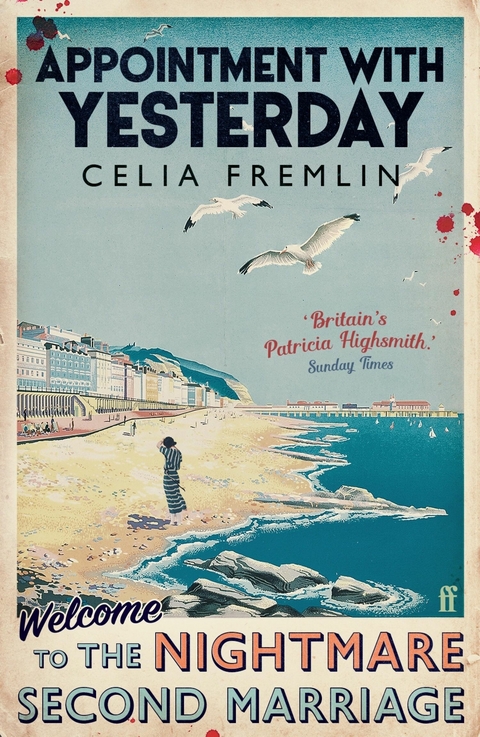
Appointment with Yesterday (eBook)
198 Seiten
Faber & Faber (Verlag)
978-0-571-31265-8 (ISBN)
Celia Fremlin (1914-2009) was born in Kent and spent her childhood in Hertfordshire, before studying at Oxford (whilst working as a charwoman). During World War Two, she served as an air-raid warden before becoming involved with the Mass Observation Project, collaborating on a study of women workers, War Factory. In 1942 she married Elia Goller, moved to Hampstead and had three children. In 1968, their youngest daughter committed suicide aged 19; a month later, her husband also killed himself. In the wake of these tragedies, Fremlin briefly relocated to Geneva. In 1985, she married Leslie Minchin, with whom she lived until his death in 1999. Over four decades, Fremlin wrote sixteen celebrated novels - including the classic summer holiday seaside mystery Uncle Paul (1959) - one book of poetry and three story collections. Her debut The Hours Before Dawnwon the Edgar Award in 1960.
A classic seaside psychological thriller from author of Waterstones Thriller of the Month, Uncle Paul: 'Britain's Patricia Highsmith' and the 'grandmother of psycho-domestic noir' (Sunday Times)'Brilliant ... So witty and clever.' Elly Griffiths'Fremlin packs a punch.' Ian Rankin'Splendid ... Got me hooked.' Ruth Rendell'A master of suspense.' Janice HallettFOUND IN FLAT was all she could see of the headline, but it was enough: enough to freeze her hovering hand ... Milly Barnes has just arrived in the seaside town of Seacliffe. Between windswept walks on the beach, she settles into lodgings and finds work as a Daily Help. Except this isn't her real name - 'Milly' is on the run from her past life, escaping a nightmare marriage. Abandoned by her first husband for another woman, she took revenge by marrying Gilbert: but this proved a terrible mistake. Trapped in a London basement flat, she became a victim of his increasingly paranoid delusions. But what really happened in that underground dungeon? And is somebody on her trail, the hunter in a game of cat-and-mouse ...?
MILLY, SHE FELT, would be a good name. Quiet, undistinguished, and as different from her real name as it was possible to be.
Real? Who needed to be real, travelling on the Inner Circle at four o’clock on a Monday afternoon? Staring past the blank, middle-aged faces opposite, she caught sight of her own blank, middle-aged face reflected in the scurrying blackness of the window beyond. She almost laughed at the likeness between the whole lot of them, and at the feeling of safety it gave her. It’s because of London Passenger Transport, she mused, dreamy and almost light-headed by now from lack of food and sleep: we’re just the Passenger part of London Passenger Transport. How marvellous to be just a swaying statistic, gently nodding, staring into space! Statistical space. Nobody, she reflected, ever brings their real selves with them on to a tube train. None of us have. We have all left our identities behind in some vast spiritual Left Luggage office: and no one could guess—no one, possibly, could ever guess, just by looking—that there is one among all these glazed faces that has left its identity behind not just for the duration of the tube journey, but for ever.
The train was slowing down now, the cold, underground light of Euston Square platform was wiping her reflection off the window opposite: and the fear—familiar now, and as regular as labour pains, coming at three minute intervals throughout the day—nagged at her once again as the train sighed to a halt, and the doors slipped open. Suppose someone should get on who knew her! Suppose one or other of the station men were beginning to recognise her, as she travelled round and round the same circuit of stations, ever since seven o’clock this morning!
Oh, she varied herself for them, as best she could! Sometimes she took her hat off, and sat with wispy hair dangling: sometimes she put it on again: and sometimes she clutched it in her lap, and tied round her head a red silk square. Lucky, really, that this red silk square had happened to be in the bag that she snatched up as she fled out of the house before dawn this morning. Lucky, too, that there had been some money in the bag: a couple of pounds, anyway, and some odd silver: for she had thought of nothing—not of money nor anything else—as she tore up the basement stairs, her breath grating in her lungs with terror at what she had done. How she had wrenched and wrestled at the warped, obstinate front door, with its peeling paint and ancient, rusty bolts! Beyond that door was freedom—she seemed still to be tasting that first rush of icy air into her throat as the door lurched open. After that, all she could remember was the running. Running, running, running, the winter air searing into her lungs like gulps of fire, and her startled heart clamouring for mercy as it fought to keep pace with her terror, her instinctive, primitive certainty of being hunted down.
But she wasn’t being hunted down, of course. Who goes hunting along the South London streets at six o’clock on a January morning? And especially along a street like this, with not a light glimmering anywhere, in all those serried rows of windows. For this was not a street of bright, brisk, busy people, the sort who might get up at six to light the fire, to start the kids’ breakfast, to get to the factory in time for the early shift. No, this was a street where people lie in bed till noon: till two, or three, or four in the afternoon: where milk bottles stand unwashed and uncollected on steps and landings, and where the names printed under the tiers of bells are yellow with age, and evoke no glimmer of recognition in the red-rimmed eyes of whichever current incumbent might drag himself to the door when you ring. Un-names. Just like hers. How appropriate, then, that she, an inhabitant of that street, should be finishing her life on the Inner Circle, going round, and round, and round, the one place in all the world where you will never need a name again.
*
She roused herself with a start. Now, Milly, she admonished herself—for it was imperative that she should get used to the name, herself, before she had to try it out on other people—now, Milly, pull yourself together! You mustn’t keep dozing off like this, or people really will start noticing you! Some kind gentleman will come along and say, “Now, Lady, where d’you want to get off …?” and then you’ll have to say the name of some station, and actually get off there! You can’t say to him, can you, that you’re not going to get off anywhere, that you’ve come here to live, you’ve moved in, and you’re going round and round the Inner Circle, on a ten pence ticket, for ever?
So come, now, Milly, what are you going to do? You have spent ten pence of the two pounds thirty-five that you had in your bag. You have the clothes you stand up in, including, luckily, your outdoor coat. You are forty-two years old. You have no skills, qualifications, references. Until these last terrible months, you led a life so protected, so narrow, so luxurious, that you are soft as pulp, through and through. You probably can’t work at anything. You have no friends to turn to, no relatives, because you are Milly now, and nobody, nobody in all the wide world—must ever have the faintest inkling that you have any connection with that woman who ran all but screaming into a London street in the early hours of Monday, January the tenth.
*
It couldn’t be in the papers yet. Not possibly. All the same, Milly felt her heart thumping horribly every time a new passenger got on the train, sat down opposite her, and unfolded before her eyes yet another copy of the back page of the evening paper.
Not that it would be on the back page. It would be on the front page, certainly, once it got into the papers at all; and so each time Milly waited, in growing trepidation, while the owner of the paper turned it this way and that, folding and refolding it as he read, until at last, with any luck, the front headline would swoop into view, often upside down.
*
Yes, it was still all right. PETROL PRICE SHOCK still occupied the place of honour. No one, yet, would be surreptitiously studying her features round the edge of their paper. So far, so good.
But what would be the headlines tomorrow morning …? and now, at last, into her slow mind, still numbed with shock, there seeped the idea that there was need for haste. What had she been thinking of, wasting the precious daylight hours crouched in a corner of the tube train like an abandoned kitten? She should have been hastening to find herself a job, lodgings, an employment card … a whole new identity. She should have done all this instantly, today, before her blurred picture began staring up at every strap-hanging commuter in London: before every employer, every landlady was on the alert, peering under the brim of her hat, wondering who it was she reminded them of …?
In stumbling haste, she sprang from her seat as the train slowed down, and hobbled on stiff legs towards the sliding doors. Which station it was, she neither knew nor cared: she only knew that she must get out—get moving—do something! The long day’s paralysis of will was succeeded now by an obsession for hurry. Hurry to anywhere, to do anything—it didn’t matter, for the obsession was just as irrational as the paralysis had been, just another symptom of shock, not a real decision at all.
*
The Outside struck her full in the face, like a breaking wave. The cold, the speed, the people, and above all the bedlam of sounds, pounding against ears that had registered nothing all the live-long day except the endless soothing rumble of the Underground. She, Milly, new-born and newly christened, had been thrust forth from the safe womb of the Inner Circle, and must start living her new life.
Here. Now. In the Edgware Road. In the middle of the rush-hour, with darkness falling, and with two pounds twenty-five remaining in her bag.
Gradually, as she stood there, she realised that there wasn’t anything she dared do. Not anything at all. Even if she had had the money for a hotel, she knew that she would never dare to push open any swing-door or walk up to any receptionist’s desk. Imagine standing there, mouth open, while a polished, glittering girl insolently took it all in, from wispy, uncombed hair to lack of suitcase in grimy, un-gloved hand!
*
And a job—even worse! Imagine an interview right now … “Yes, Miss—er?” (Goodness, she hadn’t even decided what her surname was to be yet, and whether she was to be Mrs or Miss!) “Yes, Miss K, and what was your last employment? What are your typing speeds? … Are you familiar with the use of a Something-ator? … Have you had experience on the sales side …?”
As she ambled, almost in a trance, amid the pushing, scurrying crowds, Milly suddenly caught sight in a shop window of someone walking just as slowly as she was herself: an old woman with hair sticking out like straws from under her battered hat. For almost a second she didn’t recognise her: and when she did, she stopped, her heart pounding. So that is what you looked like, after a single day on the run …! She must buy a comb … a lipstick …! Wildly she looked round for a Woolworths—a chemist—a supermarket.
But everywhere the shops were closing. London’s day was over: night, and lights, and swarming people swept over the city as over a battlefield when the carnage is finished: and, more...
| Erscheint lt. Verlag | 20.2.2014 |
|---|---|
| Verlagsort | London |
| Sprache | englisch |
| Themenwelt | Literatur ► Klassiker / Moderne Klassiker |
| Literatur ► Krimi / Thriller / Horror | |
| Literatur ► Romane / Erzählungen | |
| ISBN-10 | 0-571-31265-9 / 0571312659 |
| ISBN-13 | 978-0-571-31265-8 / 9780571312658 |
| Informationen gemäß Produktsicherheitsverordnung (GPSR) | |
| Haben Sie eine Frage zum Produkt? |
 EPUB (Adobe DRM)
Kopierschutz: Adobe-DRM
Adobe-DRM ist ein Kopierschutz, der das eBook vor Mißbrauch schützen soll. Dabei wird das eBook bereits beim Download auf Ihre persönliche Adobe-ID autorisiert. Lesen können Sie das eBook dann nur auf den Geräten, welche ebenfalls auf Ihre Adobe-ID registriert sind.
Details zum Adobe-DRM
Dateiformat: EPUB (Electronic Publication)
EPUB ist ein offener Standard für eBooks und eignet sich besonders zur Darstellung von Belletristik und Sachbüchern. Der Fließtext wird dynamisch an die Display- und Schriftgröße angepasst. Auch für mobile Lesegeräte ist EPUB daher gut geeignet.
Systemvoraussetzungen:
PC/Mac: Mit einem PC oder Mac können Sie dieses eBook lesen. Sie benötigen eine
eReader: Dieses eBook kann mit (fast) allen eBook-Readern gelesen werden. Mit dem amazon-Kindle ist es aber nicht kompatibel.
Smartphone/Tablet: Egal ob Apple oder Android, dieses eBook können Sie lesen. Sie benötigen eine
Geräteliste und zusätzliche Hinweise
Buying eBooks from abroad
For tax law reasons we can sell eBooks just within Germany and Switzerland. Regrettably we cannot fulfill eBook-orders from other countries.
aus dem Bereich