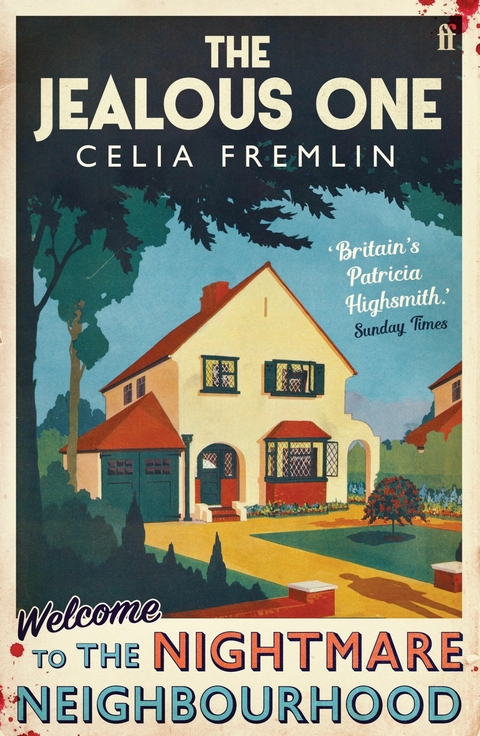
Jealous One (eBook)
196 Seiten
Faber & Faber (Verlag)
978-0-571-31276-4 (ISBN)
Celia Fremlin (1914-2009) was born in Kent and spent her childhood in Hertfordshire, before studying at Oxford (whilst working as a charwoman). During World War Two, she served as an air-raid warden before becoming involved with the Mass Observation Project, collaborating on a study of women workers, War Factory. In 1942 she married Elia Goller, moved to Hampstead and had three children. In 1968, their youngest daughter committed suicide aged 19; a month later, her husband also killed himself. In the wake of these tragedies, Fremlin briefly relocated to Geneva. In 1985, she married Leslie Minchin, with whom she lived until his death in 1999. Over four decades, Fremlin wrote sixteen celebrated novels - including the classic summer holiday seaside mystery Uncle Paul (1959) - one book of poetry and three story collections. Her debut The Hours Before Dawnwon the Edgar Award in 1960.
A classic psychological thriller from author of Waterstones Thriller of the Month, Uncle Paul: 'Britain's Patricia Highsmith' and the 'grandmother of psycho-domestic noir' (Sunday Times)'Brilliant ... So witty and clever.' Elly Griffiths'Fremlin packs a punch.' Ian Rankin'Irresistible.' Val McDermid'Splendid ... Got me hooked.' Ruth Rendell'A master of suspense.' Janice HallettRosamund wakes up from her mid-morning nap to find, to her delight, that she is running a temperature. Surely that explains her blinding headache, and the weird, delirious dream in which she had murdered her overly seductive neighbour in a vengeful act of jealousy? A great relief, then, to find this was merely the nightmarish work of a fevered imagination. Until her husband exclaims, 'Rosamund! Have you any idea what's happened to Lindy? She's disappeared!.'
In actual fact, of course, Lindy never had been beautiful. When Rosamund had first seen her, flushed and untidy, leaning into the back of the removal van to explain something to the men rootling about inside, she had summed her up as a rather dumpy, fussy little woman. ‘Woman’ mark you, not ‘girl’, was the word that had sprung to her mind at that first glimpse, when she and Geoffrey had been peeping, guiltily, like two naughty children, at the arrival of their new neighbour. It was only later that Lindy had begun to seem so young, as well as so beautiful. It was only later, too, that her house had begun to seem so beautifully and so tastefully furnished. On the day of the move, her furniture had looked absolutely dreadful, bumping its way sordidly across the pavement, every stain, every worn patch of upholstery, cruelly exposed to the blaze of a July afternoon.
‘School teacher’, Geoffrey had surmised cheerfully, his arm thrown lightly across Rosamund’s shoulder as they both peered with companionable, ill-bred curiosity round the edge of the bedroom curtain. ‘School teacher, full of earnest, progressive theories about the potentialities of the young. The sort that loses her illusions late—good, sturdy, well nourished illusions, built to last. I wonder how long they’ll stand up to living next door to our Peter and his pals …?’
They both giggled. In those days—barely six months ago though it was—they had both been able to laugh at their sixteen-year-old son’s shortcomings. It hadn’t occurred to either of them, yet, to blame the other one for everything that went wrong. So they stood there at peace, intent and happy as children at the Zoo, watching a great clumsy greenish-yellow settee blundering hideously across the pavement. The men had to tip it at an angle to get it through the little iron gate of the front garden, and at another angle again to get it through the front door into the anonymous, echoing cavity of Next Door.
‘Cat?’ Rosamund put the eliptical question confidently, serene in the certainty that Geoffrey would understand not only the question but all its ramifications. For cats were good, in hers and Geoffrey’s happily arbitrary scale of values. Cat-lovers were better—nicer—more amusing-than dog-lovers, or budgerigar-lovers. Dog-lovers were sentimental, and budgerigar-lovers—well, it was rather awful to keep creatures in cages, wasn’t it?
Geoffrey pursed his lips thoughtfully. ‘No cat,’ he opined, after several moments’ reflection; and Rosamund felt his arm tighten very slightly round her shoulders—a gesture of recognition—of gratitude—for the total understanding which made such monosyllabic exchanges rich beyond the dreams of oratory.
‘But all the same, I don’t think she’ll mind the guitar,’ he added, modifying a little the elaborate survey of the new neighbour’s shortcomings which had just been completed in three words. ‘At least, she may mind it, but she’ll pride herself on not making a fuss about that sort of thing. Just as good.’
‘Better,’ Rosamund pointed out. ‘People who pride themselves on not minding noise can be relied on to go on priding themselves, no matter how bad it gets. With people who actually don’t mind, there’s always the risk that there’s some degree of noise that they will mind. And then you’ve had it. Car?’
‘Ye-es. I’m afraid so. Probably.’
Cars were bad, too. They were almost the same as not liking cats. Lots of their friends did have cars, of course, but it was a point against them. Geoffrey and Rosamund had often talked about it—how silly it was to drive everywhere when you might be enjoying the walk, or the luxury of being carried along by public transport with someone else having to worry about the traffic jams and the one-way streets. How bad it was for children, too, to be driven everywhere, they’d lose the use of their legs. Though Rosamund had to admit to herself that, in spite of his parents’ foresight in not owning a car, Peter seemed to be making very little use of his so carefully-preserved legs these days: he’d spent practically the whole of last holidays lying on his bed reading James Bond—or, worse still, just lying there, thinking dark thoughts about the universe, which he would later enlarge on, despondently and somewhat patronisingly, while his mother tried to count the laundry. Why can’t I have one of those secretive teenagers who never tell their parents anything? Rosamund would sometimes wonder ruefully as she tried to determine whether Life itself was a manifestation of futility as well as whether four shirts should really have cost 3/11½, and if so, how much could they possibly have been each?
Still, it was probably just a phase. The thought that everything was probably just a phase had sustained Rosamund through the sixteen years of Peter’s upbringing just as religious principles had once sustained her grandmother. Something settled, and all-embracing, and totally unproveable, that’s what you needed in dealing with children….
A sharp nudge and a muffled spurt of laughter from her husband recalled Rosamund’s attention to the scene below them. For a second they gripped each others’ hands in an ecstasy of shared disapprobation. This wasn’t just No Cat. It wasn’t even a Dog, in the ordinary sense. No, it was much, much worse. It was a Pekinese. A sniffing, snuffling, arrogant, utterly pedigree Pekinese, titupping ridiculously up the path behind its mistress.
‘Perfect!’ whispered Geoffrey, squeezing Rosamund’s hand exultantly: and: ‘Won’t it be fun to complain of the yapping!’ commented Rosamund, giggling delightedly. ‘Shush!’ she amended, dodging back behind the curtain. ‘She’ll hear us!’
It really was the most shocking, vulgar behaviour, spying and jeering like this. But how delightful, how utterly forgiveable, shocking behaviour did become when both of you were engaged on it. And anyway, there was no malice in it. Neither of them had the least thing against their new neighbour really—didn’t know a thing about her yet, in spite of the guessing game which it was such fun to play.
‘Let’s invite her to supper tonight,’ suggested Rosamund impulsively. ‘She’s sure to be in a frightful muddle, with the electricity not wired up, or something, and all the shops shut till Monday. You go and ask her, Geoffrey—right now, while she’s still in and out of the front door, so that you won’t have to ring the bell or anything. We don’t want to make too much of a thing of it.’
Geoffrey looked at his watch. He often did this when in doubt about something, however little relevance the time of day had to the question in hand.
‘Well—I don’t know,’ he said reluctantly. ‘Aren’t we busy, or something?’
Rosamund gave him a little push. ‘You know we’re not, darling!’ she exclaimed. ‘You know we’re only going to do what we always do on Saturday afternoons—sit in deckchairs, talking about you perhaps mowing the lawn.’
‘But I like sitting in deckchairs talking about me perhaps mowing the lawn,’ protested Geoffrey longingly; but Rosamund continued to steer him relentlessly towards the stairs.
‘Go on. It’s only neighbourly. And besides, we’ll find out all about her,’ she encouraged; and as soon as Geoffrey was gone, she went into the kitchen to decide what to prepare for their unknown guest this evening.
Something cold, of course. Everybody liked cold food best in this weather. At least, anybody who didn’t knew very well that they were in the wrong. Salad, then. Salad, and cold meat, and stewed fruit. A bit dull, perhaps, but then Geoffrey and Rosamund had never believed in making a great fuss about visitors. On the contrary, it was Rosamund’s custom to cook special delicacies only when the two of them were on their own, without even Peter. Peter, of course, was a major complication to any meal, with his newly-acquired cynicism about food, his enormous appetite (a most awkward combination, for all concerned); the uncertainty about whether he would be there at all; and, if there, whether he would have four or five hungry (and/or cynical) friends with him.
However, he’d said he would be out this evening, for what that was worth. She’d plan without him then, firmly, and if he turned up unexpectedly—that is, if you could call it unexpectedly when it happened like that two times out of three—then he could just get something for himself. There seemed to be a sort of limpness about teenage arrangements today, Rosamund reflected, that she didn’t remember from her own girlhood. Surely, in her day, when they’d planned to go out, they’d gone out—often in the teeth of fierce parental opposition? Now that parental opposition was nonexistent, there seemed to be left a sort of helpless vagueness about the social arrangements of the young; a built-in liability to cancellation or breakdown at every stage; an unerring tendency to deposit all the participants back in their parents’ homes in time for some meal that one had hoped they were going to be out for.
A few years ago, when Peter was a blue-eyed, rosy-cheeked urchin who looked as if he had come straight out of a William book, Rosamund would have wanted him to be there at supper; would have wanted to show him off to this new, childless...
| Erscheint lt. Verlag | 16.1.2014 |
|---|---|
| Verlagsort | London |
| Sprache | englisch |
| Themenwelt | Literatur ► Krimi / Thriller / Horror ► Krimi / Thriller |
| Literatur ► Romane / Erzählungen | |
| ISBN-10 | 0-571-31276-4 / 0571312764 |
| ISBN-13 | 978-0-571-31276-4 / 9780571312764 |
| Informationen gemäß Produktsicherheitsverordnung (GPSR) | |
| Haben Sie eine Frage zum Produkt? |
 EPUB (Adobe DRM)
Kopierschutz: Adobe-DRM
Adobe-DRM ist ein Kopierschutz, der das eBook vor Mißbrauch schützen soll. Dabei wird das eBook bereits beim Download auf Ihre persönliche Adobe-ID autorisiert. Lesen können Sie das eBook dann nur auf den Geräten, welche ebenfalls auf Ihre Adobe-ID registriert sind.
Details zum Adobe-DRM
Dateiformat: EPUB (Electronic Publication)
EPUB ist ein offener Standard für eBooks und eignet sich besonders zur Darstellung von Belletristik und Sachbüchern. Der Fließtext wird dynamisch an die Display- und Schriftgröße angepasst. Auch für mobile Lesegeräte ist EPUB daher gut geeignet.
Systemvoraussetzungen:
PC/Mac: Mit einem PC oder Mac können Sie dieses eBook lesen. Sie benötigen eine
eReader: Dieses eBook kann mit (fast) allen eBook-Readern gelesen werden. Mit dem amazon-Kindle ist es aber nicht kompatibel.
Smartphone/Tablet: Egal ob Apple oder Android, dieses eBook können Sie lesen. Sie benötigen eine
Geräteliste und zusätzliche Hinweise
Buying eBooks from abroad
For tax law reasons we can sell eBooks just within Germany and Switzerland. Regrettably we cannot fulfill eBook-orders from other countries.
aus dem Bereich