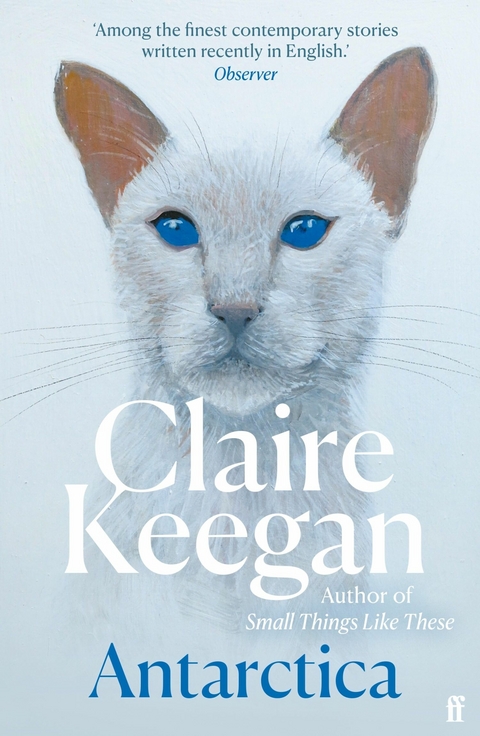
Antarctica (eBook)
224 Seiten
Faber & Faber (Verlag)
978-0-571-31379-2 (ISBN)
Claire Keegan's works of fiction are critically acclaimed international bestsellers - and have been translated into more than thirty-five languages. Antarctica won the Rooney Prize for Irish Literature. Walk the Blue Fields won the Edge Hill Prize for the finest collection of stories published in the British Isles. Foster won the Davy Byrnes Award - the world's richest prize for a short story. Small Things Like These, a New York Times Best Book of the 21st Century, was shortlisted for the Booker Prize and the Rathbones Folio Prize and won the Orwell Prize for Political Fiction and the Kerry Group Irish Novel of the Year Award. So Late in the Day was published in the New Yorker and shortlisted for the British Book Awards. Keegan was awarded Woman of the Year for Literature in Ireland in 2022, Author of the Year 2023, the Seamus Heaney Award for Arts and Letters 2024 and most recently the Siegfried Lenz Prize.
The stunning debut story collection from the author of Foster and the Booker Prize shortlisted Small Things Like These'A beautiful, tender work of great clarity.' Sebastian Barry'Simply put, Claire Keegan is one of the greatest fiction writers in the world.' George Saunders'Among the finest contemporary stories written recently in English.' ObserverA secret one-night tryst in the city. A sister's revenge. A love-struck doctor. A missing girl. In Antarctica, an astonishing sequence of stories, one of our most gifted writers illuminates human longing and fallibility in all its variety. -------Readers love Antarctica:????? 'This is the best short story collection I have ever read. Trust me she is a real find!''????? 'A skilled writer who immerses us seamlessly in the lives of her characters.'????? 'I have now read every word Claire Keegan has written. That's how much I love her writing.'????? 'With her keen eye and lucid prose, Keegan beguiles, jolts and haunts us beyond the pages.'????? 'The writing is both tender, poetic and authentic ... the stories stay with you long after you have finished reading.'
Claire Keegan was brought up on a farm in Ireland. Her stories have won numerous awards and are translated into more than 20 languages. Foster was named by The Times as one of the top 50 novels to be published in the 21st Century. Keegan is now holding the Briena Staunton Fellowship at Pembroke College, Cambridge.
Every time the happily married woman went away she wondered how it would feel to sleep with another man. That weekend she was determined to find out. It was December; she felt a curtain closing on another year. She wanted to do this before she got too old. She was sure she would be disappointed.
On Friday evening, she took the train into the city, sat reading in a first-class carriage. The crime novel didn’t hold her interest; she could already predict the ending. She stared out beyond the window. A few lighted houses, fiery points, flashed past her in the darkness. She had left a dish of macaroni cheese out for the kids, brought her husband’s suits back from the cleaners. She’d told him she was going shopping for Christmas. He’d no reason not to trust her.
When she reached the city she took a taxi to the hotel. They gave her a small, white room with a view of Vicar’s Close, one of the oldest streets in England, a row of stone houses with tall, granite chimneys where the clergy lived. She sat at the hotel bar that night nursing a tequila and lime, but there was nothing doing. Old men were reading newspapers, business was slow, but she didn’t mind; she needed a good night’s sleep. She fell into her rented bed, into a dreamless sleep, and woke to the sound of bells ringing in the cathedral.
On Saturday she walked to the shopping centre. Families were out, pushing buggies through the morning crowd, a thick stream of people flowing through glass automatic doors. She bought unusual gifts for her children, things she thought they wouldn’t predict. She bought an electric razor for her eldest son – he was getting to that age – an atlas for the girl, and for her husband an expensive gold watch with a plain, white face.
She dressed up in the afternoon, put on a short plum-coloured dress, high heels, her darkest lipstick, and walked back into town. A jukebox song, ‘The Ballad of Lucy Jordan’, lured her into a pub, a converted prison with barred windows and a low, beamed ceiling. Fruit machines blinked in one corner and just as she sat on a bar stool a little battalion of coins fell into a shoot. On the next stool sat a guy in a leather jacket that looked like he should have given it to Oxfam years ago.
‘Hello,’ he said. ‘Haven’t seen you before.’ He had a red complexion, a gold chain dangling inside a Hawaiian print shirt, mud-coloured hair. His glass was almost empty.
‘What’s that you’re drinking?’ she said.
He turned out to be a real talker, told her his life story, how he worked nights at the old folks’ home. How he lived alone, was an orphan, had no relations except a distant cousin he’d never met. There were no rings on his fingers.
‘I’m the loneliest man in the world,’ he said. ‘How about you?’
‘I’m married.’ She said it before she knew what she was saying.
He laughed. ‘Play pool with me.’
‘I don’t know how.’
‘Doesn’t matter,’ he said, ‘I’ll teach you. You’ll be potting that black before you know it.’ He put coins into a slot and pulled something and a little landslide of balls knuckled down into a black hole under the table.
‘Stripes and solids,’ he said, chalking up the cue. ‘You’re one or the other. I’ll break.’
He taught her to lean down low and sight the ball, to watch the cue ball when she took the shot, but he didn’t let her win one game. When she went into the ladies’ room, she was drunk. She couldn’t find the end of the toilet paper. She leaned her forehead against the cool of the mirror. She couldn’t remember ever being drunk like this. They finished off their drinks and went outside. The air spiked her lungs. Clouds smashed into each other in the sky. She hung her head back to look at them. She wished the world could turn into a fabulous, outrageous red to match her mood.
‘Let’s walk,’ he said. ‘I’ll give you the tour.’
She fell into step beside him, listened to his jacket creaking as he led her down a path where the moat curved round the cathedral. An old man stood outside the Bishop’s Palace selling stale bread for the birds. They bought some and stood at the water’s edge feeding five cygnets whose feathers were turning white. Brown ducks flew across the water and landed in a nice skim on the moat. When a black Labrador came bounding down the path, a huddle of pigeons rose as one and settled magically in the trees.
‘I feel like Francis of Assisi,’ she laughed.
Rain began to fall; she felt it falling on her face like small electric shocks. They backtracked through the market-place where stalls were set up in the shelter of tarpaulin. They sold everything: smelly second-hand books and china dishes, big red poinsettias, holly wreaths, brass ornaments, fresh fish with dead eyes lying on a bed of ice.
‘Come home with me,’ he said. ‘I’ll cook for you.’
‘You’ll cook for me?’
‘You eat fish?’
‘I eat everything,’ she said, and he seemed amused.
‘I know your type,’ he said. ‘You’re wild. You’re one of those wild middle-class women.’
He chose a trout that looked like it was still alive. The fishmonger chopped its head off and wrapped it up in foil. He bought a tub of black olives and a slab of feta cheese from the Italian woman with the deli stall at the end. He bought limes and Colombian coffee. Always, as they passed the stalls, he asked her if she wanted anything. He was free with his money, kept it crumpled in his pockets like old receipts, didn’t smooth the notes out even when he was handing them over. On the way home they stopped at the off-licence, bought two bottles of Chianti and a lottery ticket, all of which she insisted on paying for.
‘We’ll split it if we win,’ she said. ‘Go to the Bahamas.’
‘Don’t hold your breath,’ he said, and watched her walk through the door he’d opened for her. They strolled down cobbled streets, past a barber’s where a man was sitting with his head back, being shaved. The streets grew narrow and winding; they were outside the city lights now.
‘You live in suburbia?’ she asked.
He did not answer, kept walking. She could smell the fish. When they came to a wrought-iron gate he told her to ‘hang a left’. They passed under an archway and came out in a dead end. He unlocked a door to a block of flats and followed her upstairs to the top floor.
‘Keep going,’ he said when she stopped on the landings. She giggled and climbed, giggled and climbed again, stopped at the top.
The door needed oil; the hinges creaked when he pushed it back. The walls of his flat were plain and pale, the sills dusty. One stained mug sat lonely in the sink. A white Persian cat jumped off a draylon couch in the living room. It was neglected, like a place where someone used to live; the rubber plant in the lounge crawled across the carpet towards a rectangular pool of streetlight under a high window. Dank smells. No sign of a phone, no photographs, no decorations, no Christmas tree.
A big cast-iron tub stood in the bathroom on blue, steel claws.
‘Some bath,’ she said.
‘You want a bath?’ he said. ‘Try it out. Fill her up and dive in. Go ahead, be my guest.’
She filled the tub, kept the water as hot as she could stand it. He came in and stripped to the waist, and shaved at the handbasin with his back to her. She closed her eyes and listened to him work the lather, tapping the razor against the sink, shaving. It was like they’d done it all before. She thought him the least threatening man she’d ever known. She held her nose and slid underwater, listened to the blood pumping in her head, the rush and cloud in her brain. When she surfaced, he was standing there in the steam, wiping traces of shaving foam off his chin, smiling.
‘Having fun?’ he said.
When he lathered a flannel, she got up. Water fell off her shoulders and trickled down her legs. He began at her feet and worked upwards, washing her in strong, slow circles. She looked good in the yellow shaving light, raised her feet and arms and turned like a child for him. He made her sink back down into the water and rinsed her off, wrapped her in a towel.
‘I know what you need,’ he said. ‘You need looking after. There isn’t a woman on the earth who doesn’t need looking after. Stay there.’ He went out and came back with a comb, began combing the knots from her hair. ‘Look at you,’ he said. ‘You’re a real blonde. You’ve blonde fuzz, like a peach.’ His knuckle slid down the back of her neck, followed her vertebrae.
His bed was brass with a white, goose-down duvet and black pillowcases. She undid his belt, slid it from the loops. The buckle jingled when it hit the floor. She loosened his trousers. Naked, he wasn’t beautiful, yet there was something voluptuous about him, something unbreakable and sturdy in his build. His skin was hot.
‘Pretend you’re America,’ she said. ‘I’ll be Columbus.’
Under the bedclothes, down between the damp of his thighs, she explored his nakedness. His body was a novelty. When her feet became entangled in the sheets, he flung them off. She had surprising strength in bed, an urgency that bruised him. She pulled his head back by the hair, drank in the smell of strange soap on his neck. He kissed her and kissed her. There wasn’t any hurry. His palms were the rough hands of a working man. They battled against their...
| Erscheint lt. Verlag | 7.11.2013 |
|---|---|
| Verlagsort | London |
| Sprache | englisch |
| Themenwelt | Literatur ► Romane / Erzählungen |
| Schlagworte | Andrew O'Hagan • betrayal • Constellations • infidelity • mayflies • Obsession • Sinéad Gleeson |
| ISBN-10 | 0-571-31379-5 / 0571313795 |
| ISBN-13 | 978-0-571-31379-2 / 9780571313792 |
| Informationen gemäß Produktsicherheitsverordnung (GPSR) | |
| Haben Sie eine Frage zum Produkt? |
 EPUB (Adobe DRM)
Kopierschutz: Adobe-DRM
Adobe-DRM ist ein Kopierschutz, der das eBook vor Mißbrauch schützen soll. Dabei wird das eBook bereits beim Download auf Ihre persönliche Adobe-ID autorisiert. Lesen können Sie das eBook dann nur auf den Geräten, welche ebenfalls auf Ihre Adobe-ID registriert sind.
Details zum Adobe-DRM
Dateiformat: EPUB (Electronic Publication)
EPUB ist ein offener Standard für eBooks und eignet sich besonders zur Darstellung von Belletristik und Sachbüchern. Der Fließtext wird dynamisch an die Display- und Schriftgröße angepasst. Auch für mobile Lesegeräte ist EPUB daher gut geeignet.
Systemvoraussetzungen:
PC/Mac: Mit einem PC oder Mac können Sie dieses eBook lesen. Sie benötigen eine
eReader: Dieses eBook kann mit (fast) allen eBook-Readern gelesen werden. Mit dem amazon-Kindle ist es aber nicht kompatibel.
Smartphone/Tablet: Egal ob Apple oder Android, dieses eBook können Sie lesen. Sie benötigen eine
Geräteliste und zusätzliche Hinweise
Buying eBooks from abroad
For tax law reasons we can sell eBooks just within Germany and Switzerland. Regrettably we cannot fulfill eBook-orders from other countries.
aus dem Bereich