


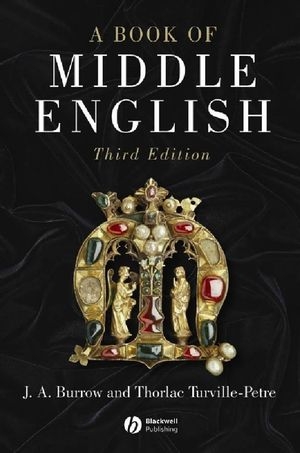
A Book of Middle English (eBook)
John Wiley & Sons (Verlag)
978-1-118-69735-1 (ISBN)
- New, thoroughly revised edition of this essential Middle English textbook.
- Introduces the language of the time, giving guidance on pronunciation, spelling, grammar, metre, vocabulary and regional dialects.
- Now includes extracts from ‘Pearl’ and Chaucer’s ‘Troilus and Criseyde’.
- Bibliographic references have been updated throughout.
- Each text is accompanied by detailed notes.
J.A. Burrow is Emeritus Professor at Bristol University. His many publications include Medieval Writers and their Work (1982) and Gestures and Looks in Medieval Narrative (2002).
Thorlac Turville-Petre is Professor of Medieval English Literature at the University of Nottingham. His previous publications include England the Nation (1996) and The Piers Plowman Electronic Archive, Vol. 2: Trinity College, Cambridge, MS B.15.19 (CD-ROM, 2000).
This essential Middle English textbook, now in its third edition, introduces students to the wide range of literature written in England between 1150 and 1400. New, thoroughly revised edition of this essential Middle English textbook. Introduces the language of the time, giving guidance on pronunciation, spelling, grammar, metre, vocabulary and regional dialects. Now includes extracts from 'Pearl' and Chaucer's 'Troilus and Criseyde'. Bibliographic references have been updated throughout. Each text is accompanied by detailed notes.
J. A. Burrow is Emeritus Professor at Bristol University. His many publications include Medieval Writers and their Work (1982) and Gestures and Looks in Medieval Narrative (2002). Thorlac Turville-Petre is Professor of Medieval English Literature at the University of Nottingham. His previous publications include England the Nation (1996) and The Piers Plowman Electronic Archive, Vol. 2: Trinity College, Cambridge, MS B.15.19 (CD Rom, 2000).
List of illustrations.
Preface to the Third Edition.
Abbreviations.
Part One:.
1 Introducing Middle English.
1.1 The Period.
1.1.1 From Old to Middle English.
1.1.2 From Middle to Modern English.
1.2 Varieties of Middle English.
1.2.1 Regional Dialects.
1.2.2 Early and Late Middle English.
1.2.3 Spelling.
2 Pronouncing Middle English.
2.1 Introduction.
2.2 Vowels.
2.2.1 The Long Vowels.
2.2.2 The Short Vowels.
2.2.3 Unstressed Final -e.
2.2.4 The Diphthongs.
2.3 Consonants.
2.4 Stress.
3 Vocabulary.
3.1 Introduction.
3.2 Scandinavian.
3.3 English, French and Latin.
3.4 Latin Loan-Words.
3.5 French Loan-Words.
4 Inflexions.
4.1 Introduction.
4.1.1 The Inflexional System.
4.1.2 Loss of Inflexional Endings.
4.2 Nouns.
4.2.1 Introduction.
4.2.2 Noun Inflexions: Early Southern Texts.
4.2.3 Developments in Noun Inflexions.
4.2.4 Genitive Singular Without Ending.
4.2.5 Unchanged Plurals.
4.2.6 Mutated Plurals.
4.3 Pronouns and Articles.
4.3.1 Forms of the Personal Pronouns.
4.3.2 First and Second Person Pronouns.
4.3.3 Third Person Pronouns: Masculine and Neuter Singular.
4.3.4 Third Person Pronouns: Feminine Singular.
4.3.5 Third Person Pronouns: Plural.
4.3.6 The Definite Article.
4.3.7 Demonstratives.
4.3.8 The Indefinite Article.
4.4. Adjectives and Adverbs.
4.4.1 Definite and Indefinite Inflexions.
4.4.2 Inflexions for Case.
4.4.3 Comparison of Adjectives.
4.4.4 Comparison of Adverbs.
4.5 Verbs.
4.5.1 Introduction.
4.5.2 Present Tense.
4.5.3 Past Tense and Past Participle.
4.5.4 Past of Weak Verbs.
4.5.5 The Verbs 'Have' and 'Say'.
4.5.6 Past of Strong Verbs.
4.5.7 Irregular Verbs.
4.5.8 The Verb 'To Be'.
5 Syntax.
5.1 Gender.
5.2 Number.
5.3 Use of Cases.
5.3.1 Nominative and Accusative.
5.3.2 Genitive.
5.3.3 Dative.
5.4 Pronouns and Articles.
5.4.1 Dou and e.
5.4.2 Non-expression of Personal Pronouns.
5.4.3 Man.
5.4.4 Self.
5.4.5 Reflexive Pronouns.
5.4.6 Relative Pronouns.
5.4.7 The Articles.
5.5. Adjectives and Adverbs.
5.5.1 Position.
5.5.2 Comparatives and Superlatives.
5.5.3 Adjectives as Nouns.
5.6 Verbs.
5.6.1 Use of Present Tense.
5.6.2 Use of Past Tense.
5.6.3 Auxiliaries of the Past.
5.6.4 Auxiliaries of the Future: shall and will.
5.6.5 The Infinitive.
5.6.6 The Subjunctive.
5.6.7 The Imperative.
5.6.8 Impersonal Verbs.
5.6.9 Verbs of Motion.
5.6.10 The Passive.
5.7 Negation.
5.8 Questions.
5.9 Word-Order.
5.9.1 Inversion.
5.9.2 The Object.
5.9.3 Prepositions.
5.9.4 Relative Clauses.
5.9.5 Adverbial Phrases.
5.9.6 Verb in Final Position.
5.10 Recapitulation and Anticipation.
6 Metre.
6.1 Introduction.
6.2 Rhymed Verse.
6.3 Alliterative Verse.
6.4 Laamon's Brut.
7 From Manuscript to Printed Text.
8 Select Bibliography.
8.1 Bibliographies and Indexes.
8.2 Language Studies.
8.3 General Studies of the Literature.
8.4 Studies of Particular Genres.
8.5 Historical and Social Studies.
Part Two: Prose and Verse Texts:.
Note on Treatment of Texts.
1 The Peterborough Chronicle 1137.
2 The Owl and the Nightingale.
3 Laamon: Brut.
4 Ancrene Wisse.
5 Sir Orfeo.
6 The Cloud of Unknowing.
7 William Langland: Piers Plowman.
8 Patience.
9 Sir Gawain and the Green Knight.
10 Pearl.
11 St Erkenwald.
12 John Trevisa: Dialogue between a Lord and a Clerk.
13 John Gower: Confessio Amantis.
14 Lyrics.
15 The York Play of the Crucifixion.
16 Geoffrey Chaucer: The Parliament of Fowls.
17 Geoffrey Chaucer: Troilus and Criseyde.
18 Geoffrey Chaucer: The Canterbury Tales.
Textual Notes.
Glossary
"Classroom experience with this authoritative and accessible
introduction to Middle English confirms that this is now our best
available vademecum to the subject. The appearance of a
third edition of Burrow and Turville-Petre's Book of Middle
English is good news to teachers and students of Middle
English." Fred Robinson, Yale University
"Currently the most lucid and illuminating introduction to the
language of Middle English, with an excellent selection of literary
texts chosen and annotated to suggest the interest, sophistication,
and variety of Middle English writing from the Peterborough
Chronicle through the works of Chaucer and his contemporaries."
Andrew Galloway, Cornell University
| Erscheint lt. Verlag | 3.4.2013 |
|---|---|
| Sprache | englisch |
| Themenwelt | Literatur |
| Geisteswissenschaften ► Sprach- / Literaturwissenschaft ► Anglistik / Amerikanistik | |
| Geisteswissenschaften ► Sprach- / Literaturwissenschaft ► Literaturwissenschaft | |
| Geisteswissenschaften ► Sprach- / Literaturwissenschaft ► Sprachwissenschaft | |
| Schlagworte | authoritative • Book • Country • Different • england between • Englische Literatur / Alt- u. Mittelenglisch, Mittelalter • English • Geschichte • Geschichte des Mittelalters (500-1500) • History • Introduction • language • Linguistics • Linguistics Special Topics • Literature • Literaturwissenschaft • Medieval History (500-1500) • Middle • Old, Middle & Medieval English Literature • Parts • Period • pieces • Pronunciation • Range • Reader • Readers • representative • Spezialthemen Sprachwissenschaften • Sprachwissenschaften • textbook introduces • Time • wide |
| ISBN-10 | 1-118-69735-9 / 1118697359 |
| ISBN-13 | 978-1-118-69735-1 / 9781118697351 |
| Informationen gemäß Produktsicherheitsverordnung (GPSR) | |
| Haben Sie eine Frage zum Produkt? |
 EPUB (Adobe DRM)
Kopierschutz: Adobe-DRM
Adobe-DRM ist ein Kopierschutz, der das eBook vor Mißbrauch schützen soll. Dabei wird das eBook bereits beim Download auf Ihre persönliche Adobe-ID autorisiert. Lesen können Sie das eBook dann nur auf den Geräten, welche ebenfalls auf Ihre Adobe-ID registriert sind.
Details zum Adobe-DRM
Dateiformat: EPUB (Electronic Publication)
EPUB ist ein offener Standard für eBooks und eignet sich besonders zur Darstellung von Belletristik und Sachbüchern. Der Fließtext wird dynamisch an die Display- und Schriftgröße angepasst. Auch für mobile Lesegeräte ist EPUB daher gut geeignet.
Systemvoraussetzungen:
PC/Mac: Mit einem PC oder Mac können Sie dieses eBook lesen. Sie benötigen eine
eReader: Dieses eBook kann mit (fast) allen eBook-Readern gelesen werden. Mit dem amazon-Kindle ist es aber nicht kompatibel.
Smartphone/Tablet: Egal ob Apple oder Android, dieses eBook können Sie lesen. Sie benötigen eine
Geräteliste und zusätzliche Hinweise
Buying eBooks from abroad
For tax law reasons we can sell eBooks just within Germany and Switzerland. Regrettably we cannot fulfill eBook-orders from other countries.
aus dem Bereich


