Empty Justice (eBook)
340 Seiten
Taylor and Francis (Verlag)
978-1-84314-424-3 (ISBN)
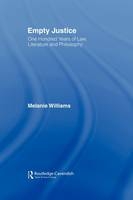
Utilising literature as a serious source of challenges to questions in philosophy and law, this book provides a fresh perspective not only upon the inculcation of the legal subject, but also upon the relationship between modernism, postmodernism and how such concepts might evolve in the construction of community ethics. The creation and role of the legal subject is just one aspect of jurisprudential enquiry now attracting much attention.
How do moral values act upon the subject? How do moral 'systems' impinge upon the subject - jurist and judged - throughout the 20th century, when religious values are called into question, when 'existential' doubt prevails? To what extent do issues of gender and identity inform these questions?
Many sources can provide insights into these issues: this book intends to concentrate upon fiction as just such a resource. However it is not just another law and literature compilation. Spanning the last century, each chapter will attempt to fulfil four objectives: to identify key texts in relation to a given period, to look for linked legal and philosophical developments from that period, to establish fresh links from these sources regarding concrete doctrinal, or practical legal questions, and finally draw a more general inference about the legal subject and the frequently less evident feminine citizen-subject.
Central to this approach will be the consideration of contemporary case law and legal materials as social documents of the relationship between law and the wider community.
Utilising literature as a serious source of challenges to questions in philosophy and law, this book provides a fresh perspective not only upon the inculcation of the legal subject, but also upon the relationship between modernism, postmodernism and how such concepts might evolve in the construction of community ethics. The creation and role of the legal subject is just one aspect of jurisprudential enquiry now attracting much attention. How do moral values act upon the subject? How do moral 'systems' impinge upon the subject - jurist and judged - throughout the 20th century, when religious values are called into question, when 'existential' doubt prevails? To what extent do issues of gender and identity inform these questions? Many sources can provide insights into these issues: this book intends to concentrate upon fiction as just such a resource. However it is not just another law and literature compilation. Spanning the last century, each chapter will attempt to fulfil four objectives: to identify key texts in relation to a given period; to look for linked legal and philosophical developments from that period; to establish fresh links from these sources regarding concrete doctrinal, or practical legal questions, and finally draw a more general inference about the legal subject and the frequently less evident feminine citizen-subject. Central to this approach will be the consideration of contemporary case law and legal materials as social documents of the relationship between law and the wider community.
| Erscheint lt. Verlag | 9.1.2002 |
|---|---|
| Sprache | englisch |
| Themenwelt | Literatur |
| Sachbuch/Ratgeber | |
| Geisteswissenschaften ► Geschichte | |
| Geisteswissenschaften ► Philosophie ► Sprachphilosophie | |
| Geisteswissenschaften ► Sprach- / Literaturwissenschaft ► Anglistik / Amerikanistik | |
| Geisteswissenschaften ► Sprach- / Literaturwissenschaft ► Literaturwissenschaft | |
| Geisteswissenschaften ► Sprach- / Literaturwissenschaft ► Sprachwissenschaft | |
| Recht / Steuern ► Allgemeines / Lexika | |
| Recht / Steuern ► EU / Internationales Recht | |
| Sozialwissenschaften ► Politik / Verwaltung ► Politische Theorie | |
| Sozialwissenschaften ► Soziologie | |
| ISBN-10 | 1-84314-424-7 / 1843144247 |
| ISBN-13 | 978-1-84314-424-3 / 9781843144243 |
| Informationen gemäß Produktsicherheitsverordnung (GPSR) | |
| Haben Sie eine Frage zum Produkt? |
 PDF (Adobe DRM)
Kopierschutz: Adobe-DRM
Adobe-DRM ist ein Kopierschutz, der das eBook vor Mißbrauch schützen soll. Dabei wird das eBook bereits beim Download auf Ihre persönliche Adobe-ID autorisiert. Lesen können Sie das eBook dann nur auf den Geräten, welche ebenfalls auf Ihre Adobe-ID registriert sind.
Details zum Adobe-DRM
Dateiformat: PDF (Portable Document Format)
Mit einem festen Seitenlayout eignet sich die PDF besonders für Fachbücher mit Spalten, Tabellen und Abbildungen. Eine PDF kann auf fast allen Geräten angezeigt werden, ist aber für kleine Displays (Smartphone, eReader) nur eingeschränkt geeignet.
Systemvoraussetzungen:
PC/Mac: Mit einem PC oder Mac können Sie dieses eBook lesen. Sie benötigen eine
eReader: Dieses eBook kann mit (fast) allen eBook-Readern gelesen werden. Mit dem amazon-Kindle ist es aber nicht kompatibel.
Smartphone/Tablet: Egal ob Apple oder Android, dieses eBook können Sie lesen. Sie benötigen eine
Geräteliste und zusätzliche Hinweise
Buying eBooks from abroad
For tax law reasons we can sell eBooks just within Germany and Switzerland. Regrettably we cannot fulfill eBook-orders from other countries.
aus dem Bereich