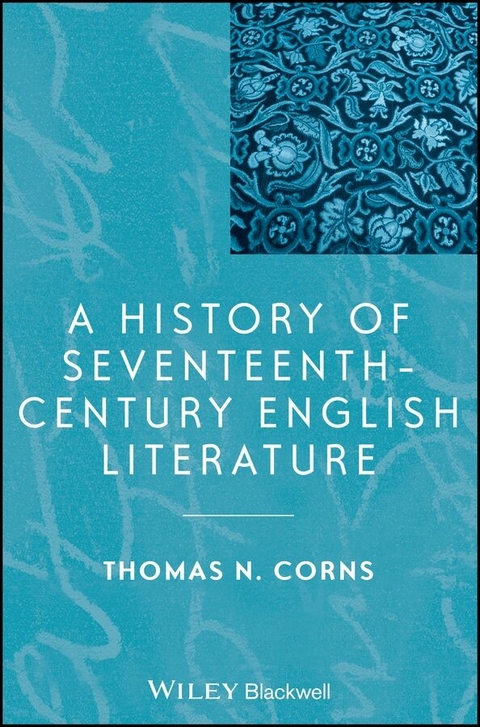
A History of Seventeenth-Century English Literature (eBook)
John Wiley & Sons (Verlag)
978-1-4051-7255-4 (ISBN)
- An energetic and provocative history of English literature from 1603-1690.
- Part of the major Blackwell History of English Literature series.
- Locates seventeenth-century English literature in its social and cultural contexts.
- Considers the physical conditions of literary production and consumption.
- Looks at the complex political, religious, cultural and social pressures on seventeenth-century writers.
- Features close critical engagement with major authors and texts
Thomas Corns is a major international authority on Milton, the Caroline Court, and the political literature of the English Civil War and the Interregnum.
A History of Seventeenth-Century Literature outlines significant developments in the English literary tradition between the years 1603 and 1690. An energetic and provocative history of English literature from 1603-1690. Part of the major Blackwell History of English Literature series. Locates seventeenth-century English literature in its social and cultural contexts. Considers the physical conditions of literary production and consumption. Looks at the complex political, religious, cultural and social pressures on seventeenth-century writers. Features close critical engagement with major authors and texts Thomas Corns is a major international authority on Milton, the Caroline Court, and the political literature of the English Civil War and the Interregnum.
Thomas N. Corns is Professor of English at the University of Wales, Bangor. His publications include A Companion to Milton (ed., Blackwell Publishing, 2001) and, with Gordon Campbell, John Milton: Life, Work, and Thought (2008). With Ann Hughes and David Loewenstein, he edited The Complete Works of Gerrard Winstanley (2009), and he recently edited The Milton Encyclopedia (2012). He is an Honoured Scholar of the Milton Society of America.
List of illustrations ix
Preface x
1 The Last Years of Elizabeth I: Before March 1603 1
Literary Consumption and Production 2
Latin, Neo-Latin and English 14
Manuscript, Performance, Print 16
The Press and its Controls 22
The Final Years of Elizabethan Theatre 26
Patronage and Court Culture 30
2 From the Accession of James I to the Defenestration of Prague: March 1603 to May 1618 33
Changes and Continuities 33
The Making of the Royal Courts 35
Masques and Other Court Entertainments 38
Early Jacobean Theatre 42
Jacobean Shakespeare 45
Other Drama 70
Non-Dramatic Poetry 87
Non-Fictional Prose 113
3 From the Defenestration of Prague to the Personal Rule: May 1618 to March 1629 119
Continental Wars 119
Three Funerals and a Wedding 123
Masques and Pageants 129
Plays and Players 133
Poetry and Prose Romance 151
Non-Fictional Prose 156
News 164
4 The Literature of the Personal Rule: March 1629 to April 1640 167
The Making of the Caroline Court 167
Masques of the Personal Rule 176
Other Entertainments 182
Music and Literature at the Caroline Court 184
Themes, Occasions and Conversations 186
From Manuscript to Print 190
Plays and Players 192
Literature and Laudianism 203
George Herbert 206
The Emblem Books of Quarles and Wither 215
Early Milton 221
5 From the Short Parliament to the Restoration: April 1640 to May 1660 229
Events and Consequences 229
Royalist Poetry 239
Crashaw and Vaughan 264
Mid-Century Drama 273
Sir Thomas Browne 277
Poetry for Parliament and Protectorate 283
Pamphlet Wars 295
Newspapers 311
6 The Literature of the Rule of Charles II: May 1660 to February 1685 317
Dissent, Popery and Arbitrary Government 317
Theatre of the Rule of Charles II 327
Rochesterism 352
The Poetry of Dryden and Butler 360
Marvell After 1660 370
Bunyan, Pepys and Sprat 381
Milton, St Nicholas and Hutchinson 391
Katherine Philips and Margaret Cavendish 405
7 From the Accession of James II: After February 1685 409
James II and the Williamite Revolution 409
Aphra Behn: The Late Works 413
Dryden and James II 416
After 1690 421
Bibliography 429
Index 453
"This "handbook" is, perhaps, more
"textbook" than "reference book", but it is
well done and would be a useful resource for undergraduate
libraries." (Reference Reviews , 2011)
Tom Corns's book is the first of its kind to attempt to
relate literature to the history of its time not merely in broad
abstract terms but in specific detail. He discusses individual
works in such a way that they reoccupy their rightful place among
the social and political events of their time. And so they come
freshly alive. This is not the only story that could be told about
literature, but it is one not to be ignored.
Alastair Fowler, Regius Professor of Rhetoric and English
Literature, University of Edinburgh
Thomas Corns has written an exceptionally fine and remarkably
ambitious history of seventeenth-century English literary culture.
One of its great virtues is that this history begins with the late
Elizabethan period and extends its account to the very end of the
seventeenth century, thereby crossing and reexamining traditional
boundaries of literary historical periodisation. Corns deftly
illuminates the distinctive aesthetic achievements of
seventeenth-century English writers, while precisely situating
their works in their social, political, and religious contexts, as
well as in relation to the other arts. Students and scholars alike
will find this new, wide-ranging literary history of the period
invaluable. It is an outstanding achievement. David Loewenstein,
University of Wisconsin-Madison
Tom Corns's book is the first of its kind to attempt to
relate literature to the history of its time not merely in broad
abstract terms but in specific detail. He discusses individual
works in such a way that they reoccupy their rightful place among
the social and political events of their time. And so they come
freshly alive. This is not the only story that could be told about
literature, but it is one not to be ignored.--Alastair
Fowler, Regius Professor of Rhetoric and English Literature,
University of Edinburgh
Thomas Corns has written an exceptionally fine and remarkably
ambitious history of seventeenth-century English literary culture.
One of its great virtues is that this history begins with the late
Elizabethan period and extends its account to the very end of the
seventeenth century, thereby crossing and reexamining traditional
boundaries of literary historical periodisation. Corns deftly
illuminates the distinctive aesthetic achievements of
seventeenth-century English writers, while precisely situating
their works in their social, political, and religious contexts, as
well as in relation to the other arts. Students and scholars alike
will find this new, wide-ranging literary history of the period
invaluable. It is an outstanding achievement. --David
Loewenstein, University of Wisconsin-Madison
| Erscheint lt. Verlag | 15.4.2008 |
|---|---|
| Reihe/Serie | Blackwell History of Literature | Blackwell History of Literature |
| Sprache | englisch |
| Themenwelt | Literatur |
| Geisteswissenschaften ► Sprach- / Literaturwissenschaft ► Anglistik / Amerikanistik | |
| Geisteswissenschaften ► Sprach- / Literaturwissenschaft ► Literaturwissenschaft | |
| Schlagworte | 17th Century English Literature • Century • Change • Conditions • Consideration • Continues • Disruption • Early Modern History (1500-1780) • Englische Literatur / 17. Jhd. • English • fascinating • Geschichte • Geschichte der frühen Neuzeit (1500-1780) • Geschichte der frühen Neuzeit (1500-1780) • History • House • Inception • literary production • literary tradition • Literature • Literaturwissenschaft • Major • Outlines • seventeenth • seventeenthcentury • significant • thorough • Tudor |
| ISBN-10 | 1-4051-7255-X / 140517255X |
| ISBN-13 | 978-1-4051-7255-4 / 9781405172554 |
| Informationen gemäß Produktsicherheitsverordnung (GPSR) | |
| Haben Sie eine Frage zum Produkt? |
 PDF (Adobe DRM)
Kopierschutz: Adobe-DRM
Adobe-DRM ist ein Kopierschutz, der das eBook vor Mißbrauch schützen soll. Dabei wird das eBook bereits beim Download auf Ihre persönliche Adobe-ID autorisiert. Lesen können Sie das eBook dann nur auf den Geräten, welche ebenfalls auf Ihre Adobe-ID registriert sind.
Details zum Adobe-DRM
Dateiformat: PDF (Portable Document Format)
Mit einem festen Seitenlayout eignet sich die PDF besonders für Fachbücher mit Spalten, Tabellen und Abbildungen. Eine PDF kann auf fast allen Geräten angezeigt werden, ist aber für kleine Displays (Smartphone, eReader) nur eingeschränkt geeignet.
Systemvoraussetzungen:
PC/Mac: Mit einem PC oder Mac können Sie dieses eBook lesen. Sie benötigen eine
eReader: Dieses eBook kann mit (fast) allen eBook-Readern gelesen werden. Mit dem amazon-Kindle ist es aber nicht kompatibel.
Smartphone/Tablet: Egal ob Apple oder Android, dieses eBook können Sie lesen. Sie benötigen eine
Geräteliste und zusätzliche Hinweise
Buying eBooks from abroad
For tax law reasons we can sell eBooks just within Germany and Switzerland. Regrettably we cannot fulfill eBook-orders from other countries.
aus dem Bereich