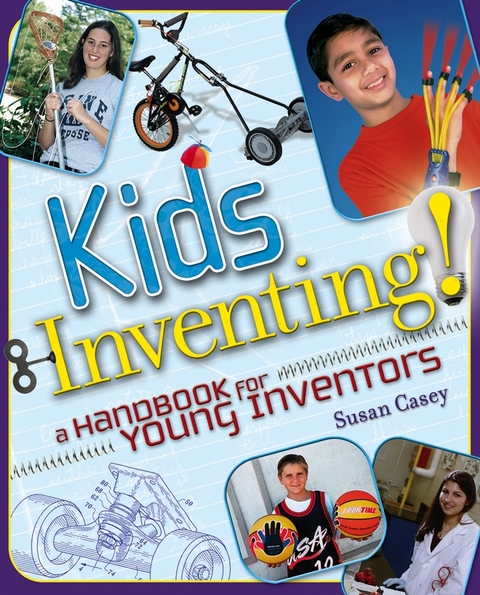
Kids Inventing! (eBook)
144 Seiten
John Wiley & Sons (Verlag)
978-1-118-04020-1 (ISBN)
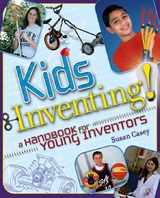
"That could be me!" Well, it certainly could--and this book
shows you how. Kids Inventing! gives you easy-to-follow,
step-by-step instructions for turning your ideas into realities for
fun, competition, and even profit.
From finding an idea and creating a working model to patenting,
manufacturing, and selling your invention, you get expert guidance
in all the different stages of inventing. You'll see how to keep an
inventor's log, present your ideas, and work as part of a team or
with a mentor. You'll meet inspiring kids just like you who
designed their own award-winning inventions. And you'll see how to
prepare for the various state and national invention contests held
each year, as well as international competitions and science
fairs.
SUSAN CASEY is an English teacher, a journalist, a speaker, and the author of Women Invent! Two Centuries of Discovery That Have Shaped Our World. To find out more about Susan, visit her web site at www.susancaseybooks.com.
Foreword vii
by Nicholas D. Frankovits and Leila Gay Evans
Acknowledgments ix
Introduction 1
1 Getting an Idea 3
Look for a Problem to Solve 4
Break Problems into Smaller Parts 5
Think about Improving Something You Already Enjoy 7
Think about Solving a Community Problem 11
Think about the Needs of Others 13
Find an Idea Through Research 15
Find a Use for Something You Discover 18
Is Your Idea an Invention? 20
Activities 20
2 Keeping a Journal or an Inventor's Log and Writing a Report 23
Logs and Journals 23
Reports 34
Inventor's Logs, Journals, and Reports as Part of a Display 35
Activities 36
3 Making a Model 37
Start with a Sketch 39
Make a List of Materials 39
List the Tools You Will Need 40
Estimate Costs 41
Inventory Your Skills and Acquire Others 41
Set up a Workshop 42
Ask for Help and Be Safe 43
Make a Scale Model 45
Activities 46
4 Naming Your Invention 50
Name Your Invention after Yourself 50
Name Your Invention for What It Does 51
Use Word Tricks in Naming Your Invention 52
Name Your Invention for Its Sound 53
Name Your Invention for Its Feel 53
Give Your Invention a Catchy Name 54
Activities 56
5 Participating in Competitions, Programs, and Camps 57
What You Can Gain by Entering an Invention Contest 58
Preparing for Competition 58
Camps 65
Activities 65
6 Inventing as a Team 66
Teamwork Calls for Cooperation and Compromise 66
Small Teams 70
Large Teams 71
Activities 73
7 Learning with a Mentor 74
Mentors Are Guides 74
School Mentor Programs 77
Mentors from the Business Community 78
Activities 81
8 Patenting an Invention 82
How Inventions Are Patented 82
The Patent Search 83
Types of Patents 85
Patent Applications 90
Patent Infringement 91
Activities 94
9 Registering a Trademark 95
Trademarks Are All Around You 95
Trademark Symbols 95
Types of Trademarks 96
Applying for a Trademark 97
Trademarks instead of Patents 98
Activities 101
10 Manufacturing, Packaging, and Selling an Invention 102
Product Development 105
Find the Right Company to Manufacture Your Invention 109
Selling Your Invention 109
Licensing Your Invention 111
Activities 114
Appendix A: Suggested Reading 116
Appendix B: Useful Web Sites 117
Appendix C: Invention Competitions, Programs, and Camps 119
Index 129
Photo Credits 134
Inventions solve problems in daily life, and this nifty book solves
the problems of how to go about inventing. From identifying a
problem in your work to thinking about how to solve it, the
information is broken down into small solvable parts.
So how do you come up with a problem? Hone your observational
skills and look around. Stories of inventions developed by young
scientists who responded to their own needs or those of their
community provide the backbone and wonder of this inspirational
book.
Some ideas come through observation, some through research, and
some from searching for a use for something. Next, the inventor can
turn to journaling or model making or can learn with a mentor. For
those really great ideas, the book discusses patenting, designing a
trademark, and manufacturing and selling the product. There are
many websites, programs, competitions, and camps found in the
appendices.
Students can be great inventors because life is newer to them
and they take less for granted. Awareness is the first step to
discovery. What a wonderful little book for showing children other
children as inventors... and they can learn how to become one
themselves!
--NSTA Recommends
| Erscheint lt. Verlag | 14.12.2010 |
|---|---|
| Sprache | englisch |
| Themenwelt | Literatur |
| Kinder- / Jugendbuch ► Bilderbücher | |
| Kinder- / Jugendbuch ► Sachbücher ► Naturwissenschaft / Technik | |
| Kinder- / Jugendbuch ► Spielen / Lernen ► Lernen / Lernspiele | |
| Schulbuch / Wörterbuch | |
| Schlagworte | Children's • Children's Science • Kinder • Naturwissenschaft f. Kinder |
| ISBN-10 | 1-118-04020-1 / 1118040201 |
| ISBN-13 | 978-1-118-04020-1 / 9781118040201 |
| Informationen gemäß Produktsicherheitsverordnung (GPSR) | |
| Haben Sie eine Frage zum Produkt? |
 EPUB (Adobe DRM)
Kopierschutz: Adobe-DRM
Adobe-DRM ist ein Kopierschutz, der das eBook vor Mißbrauch schützen soll. Dabei wird das eBook bereits beim Download auf Ihre persönliche Adobe-ID autorisiert. Lesen können Sie das eBook dann nur auf den Geräten, welche ebenfalls auf Ihre Adobe-ID registriert sind.
Details zum Adobe-DRM
Dateiformat: EPUB (Electronic Publication)
EPUB ist ein offener Standard für eBooks und eignet sich besonders zur Darstellung von Belletristik und Sachbüchern. Der Fließtext wird dynamisch an die Display- und Schriftgröße angepasst. Auch für mobile Lesegeräte ist EPUB daher gut geeignet.
Systemvoraussetzungen:
PC/Mac: Mit einem PC oder Mac können Sie dieses eBook lesen. Sie benötigen eine
eReader: Dieses eBook kann mit (fast) allen eBook-Readern gelesen werden. Mit dem amazon-Kindle ist es aber nicht kompatibel.
Smartphone/Tablet: Egal ob Apple oder Android, dieses eBook können Sie lesen. Sie benötigen eine
Geräteliste und zusätzliche Hinweise
Buying eBooks from abroad
For tax law reasons we can sell eBooks just within Germany and Switzerland. Regrettably we cannot fulfill eBook-orders from other countries.
aus dem Bereich