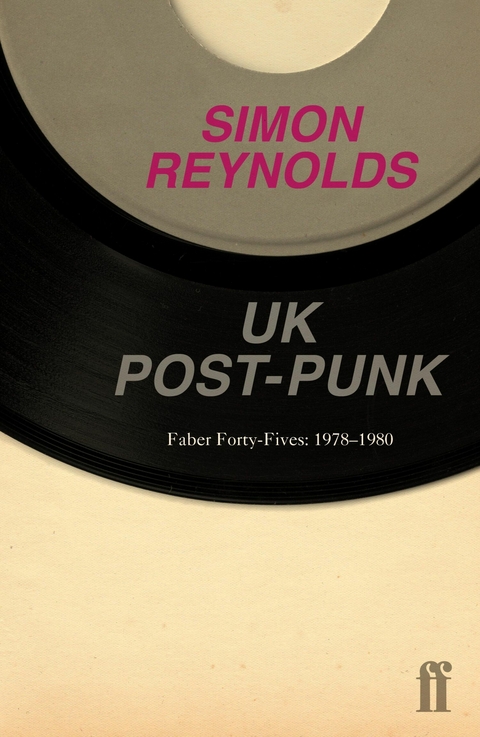
UK Post-Punk (eBook)
96 Seiten
Faber & Faber (Verlag)
978-0-571-29653-8 (ISBN)
Simon Reynolds is the author of Energy Flash: A Journey through Rave Music and Dance Culture, Blissed Out: The Raptures of Rock, The Sex Revolts: Gender, Rebellions and Rock and Roll (co-written with Joy Press), Rip it Up and Start Again: Postpunk 1978 - 1984 and, most recently, Bring the Noise: Twenty Years of Hip Hop and Hip Rock.
UK Post-Punk is a selection of five essays that represents Simon Reynolds's astute and thought-provoking commentary on the musical fallout of the punk explosion. Diversity is the watchword, with groups as stylistically varied as PiL, Joy Division and the Specials tackling the new musical terrain that had opened up. Often highly political - both overtly and through challenging the prevailing conservatism of the times - these groups were the soundtrack to the last days of socialism, national recession and the arrival of an aggressive new form of politics: Thatcherism.
Simon Reynolds is the author of seven books about music and pop culture, including Rip It Up and Start Again: Post-Punk 1978-1984, Energy Flash: A Journey through Rave Music and Dance Culture and Blissed Out: The Raptures of Rock. Born in London, resident in New York for most of the nineties and noughties, he now lives in Los Angeles.
1
PUBLIC IMAGE BELONGS TO ME: John Lydon and PiL
Public Image Ltd
‘Ever get the feeling you’ve been cheated?’
Johnny Rotten’s infamous parting shot to the audience at Winterland, San Francisco, on 14 January 1978, was not a question so much as a confession. Despite being the frontman of the most dangerous band in the world, Johnny was bored – sick of The Sex Pistols’ music, tired of his own ‘Rotten’ persona, disappointed with how punk as a whole had panned out. Winterland was the last date of the Pistols’ turbulent debut tour of America, and a few days later the band disintegrated in acrimonious confusion.
Rotten’s disillusionment had been brewing for months. The first public sign occurred during ‘The Punk and His Music’, a 16 July 1977 show on London’s Capital Radio, during which Rotten voiced his frustration with the predictability of most punk bands: ‘You do feel cheated. There should be loads of different things.’ Spliced together from interview chat and records selected by Rotten, the show also revealed that the singer had far more diverse and sophisticated taste in music than his public image suggested. If you tuned in anticipating nothing but punk, you were immediately thrown for a loop by the first selection, Tim Buckley’s ‘Sweet Surrender’ – a lush, sensual R&B song swathed with orchestral strings. Over the next ninety minutes Rotten further tweaked expectations, playing languid roots reggae, solo efforts by former Velvet Underground members Lou Reed, John Cale and Nico, a surprising amount of hippie-tinged music by Can, Captain Beefheart and Third Ear Band, and two tracks by his hero Peter Hammill, a full-blown progressive rocker.
Just about everything Lydon played on Capital gave the lie to Punk Myth #1: the early seventies as cultural wasteland. And, if this were not treasonous enough, he also broke with his Malcolm McLaren-scripted role as cultural terrorist by effectively outing himself as an aesthete. Along with his hipster music choices, the interview revealed a sensitive, thoughtful individual rather than the thug-monster of tabloid legend.
For Rotten, this image makeover was a matter of survival. A month before his radio appearance, the Pistols’ anti-Jubilee single ‘God Save the Queen’ had defied airwave bans and record-store embargoes to become the best-selling single in the country. Demonized by the tabloids, Rotten was repeatedly attacked by enraged royalist thugs. Scared, scarred, in practical terms almost under house arrest, he decided to take control of his destiny. His anarchist/Antichrist persona – originally Rotten’s own creation, but hyped by Pistols manager McLaren and distorted by a media eager to believe the worst – had spiralled out of control. Agreeing to do the Capital Radio interview without consulting his management, Lydon embarked on the process of persona demolition that would soon result in ‘Public Image’ (the song) and Public Image Ltd (the group).
During ‘The Punk and His Music’, Lydon sounded frail and vulnerable as he discussed the street attacks: ‘It’s very easy for a gang to pick on … one person and smash his head in – it’s a big laugh for them, and it’s very easy for them to say, “What a wanker, look at him run away!” … I mean, what’s he meant to do?’ Positioning himself as victim and revealing his feelings of humiliation, Rotten deliberately rehumanized himself.
This naturally incensed McLaren, who accused Rotten of dissipating ‘the band’s threat’ by revealing himself as a ‘man of taste’. McLaren saw the Pistols as anti-music, but here was the group’s frontman waxing lyrical about his eclectic record collection and gushing, ‘I just like all music … I love my music,’ like a fucking hippie! From that point onwards, McLaren decided that Rotten was at heart ‘a constructive sissy rather than a destructive lunatic’, and he focused his energy on moulding the more suggestible Sid Vicious into the Pistols’ true star, a cartoon psychopath, wanton and self-destructive.
In the latter months of 1977, a chasm grew between Rotten and the other Sex Pistols that mirrored the polarization of punk as a whole into arty bohemians versus working-class street toughs. Rotten came from an impeccably deprived background, but his sensibility was much closer to that of the art-school contingent. He wasn’t the unemployed guttersnipe mythologized by The Clash, but earned decent money alongside his construction-worker dad at a sewage plant, and worked at a playschool during the summer. And, although he often professed to hate art and despise intellectuals, he was well read (Oscar Wilde was a favourite) with fierce opinions (Joyce was not). Where Steve Jones and Paul Cook were early school-leavers, Rotten had even made a brief foray into further education, studying English literature and art at Kingsway College. Above all, Rotten was a music connoisseur. He couldn’t play an instrument or write melodies, but he had a real sonic sensibility and a sense of possibilities much more expansive than those of his fellow-Pistols.
The reggae and art-rock that Rotten played on ‘The Punk and His Music’ sketched out the emotional and sonic template for Public Image Ltd. When he talked about identifying with Dr Alimantado’s ‘Born for a Purpose’, a song about being persecuted as a Rasta, you got an advance glimpse of PiL’s aura of paranoia and prophecy: Rotten as visionary outcast, an internal exile in Babylon UK. Musically, what he loved about Beefheart and the dub producers was their experimental playfulness: ‘They just love sound; they like using any sound.’ Effectively, ‘The Punk and His Music’ offered a listening list for a post-punk movement yet to be born; hints and clues for where next to take the music.
Punk seemed to be ‘over’ almost before it had really begun. For many early participants, the death knell came on 28 October 1977 with the release of Never Mind the Bollocks. Had the revolution come to this, something as prosaic and conventional as an album? Bollocks was product, eminently consumable. Rotten’s lyrics and vocals were incendiary, but Steve Jones’s fat guitar sound and Chris Thomas’s superb production – thickly layered, glossy, well organized – added up to a disconcertingly orthodox hard rock that gave the lie to the group’s reputation for chaos and ineptitude. Lydon later blamed McLaren for steering the rest of the band towards ‘a regressive mod vibe’, while admitting that his own ideas for how the record should have sounded would have rendered it ‘unlistenable for most people because they wouldn’t have had a point of reference’.
Journalist Jon Savage reviewed Bollocks for Sounds and recalls it feeling ‘like a tombstone … airless, no spaces in the music’ – a comment that pinpoints the record’s failure as a deficiency of dub. Compared to the mirage-like unreality of reggae production, all glimmering reverb haze, disorienting FX and flickering ectoplasmic wisps, most punk records sounded retarded: stuck in the mid-sixties; before 24-track psychedelia; before stereo. The sharper bands coming out of punk knew they had some serious catching up to do. Some, like The Clash and The Ruts, picked up mostly on the protest aspect of roots reggae – the blunt sloganeering and sermonizing of The Wailers’ ‘Get Up Stand Up’, the radical chic of Peter Tosh’s Rasta guerrilla persona. At the other extreme from this ‘roots rock rebel’ version of reggae, the more experimental post-punk bands responded to reggae as a purely sonic revolution: an Africanized psychedelia, shape-shifting and perception-altering. During the half-decade from 1977 to 1981, reggae’s spatialized production and sophisticated-yet-elemental rhythms provided the template for sonically radical post-punk – a privileged status rivalled only by funk.
In Jamaica itself, though, roots militancy and dub ethereality were two sides of the same cultural coin, indivisible. The glue that held them together, Rasta, is a millenarian creed – ‘part journalism, part prophecy’ in the words of James A. Winders, ultimately anti-political and theocratic. Rasta spirituality was something most white Britons couldn’t buy into easily, partly because of its illiberal traits (it possesses a nasty streak of anti-feminism) but mostly because the absolutism of its blood-and-fire visions was temperamentally alien to a secular British youth whose idea of religion generally derives from Anglicanism: non-committal, wishy-washy, as close to being agnostic as you can get without pissing off God. Out of the cadres of post-punk, perhaps only one person really tapped into a spiritual ferocity to rival Rasta: Johnny Rotten.
Raised in London as the child of Irish Catholic immigrants, he had his own window into the postcolonial dislocation of the former British Empire’s neglected subjects. It’s no coincidence that his autobiography bears the subtitle No Irish, No Blacks, No Dogs – what many English landlords put in ‘room vacant’ ads before the Race Relations Act outlawed the practice. Rotten’s identification with the black British experience of ‘sufferation’ and ‘downpression’ and his passion for Jamaican riddim and bass-pressure suffused his post-Pistols music, desolating PiL’s sound with eerie space and heavy dread.
The ex-Pistol Rotten arrived back in Britain after the band’s disastrous American tour only to be immediately invited to board another jet by Virgin Records supremo Richard Branson – this one heading to Jamaica. Rotten, renowned for his reggae expertise,...
| Erscheint lt. Verlag | 7.6.2012 |
|---|---|
| Reihe/Serie | Faber Forty-Fives | Faber Forty-Fives |
| Verlagsort | London |
| Sprache | englisch |
| Themenwelt | Literatur |
| Kunst / Musik / Theater ► Musik ► Klassik / Oper / Musical | |
| Kunst / Musik / Theater ► Musik ► Pop / Rock | |
| Geisteswissenschaften ► Geschichte | |
| ISBN-10 | 0-571-29653-X / 057129653X |
| ISBN-13 | 978-0-571-29653-8 / 9780571296538 |
| Informationen gemäß Produktsicherheitsverordnung (GPSR) | |
| Haben Sie eine Frage zum Produkt? |
 EPUB (Adobe DRM)
Kopierschutz: Adobe-DRM
Adobe-DRM ist ein Kopierschutz, der das eBook vor Mißbrauch schützen soll. Dabei wird das eBook bereits beim Download auf Ihre persönliche Adobe-ID autorisiert. Lesen können Sie das eBook dann nur auf den Geräten, welche ebenfalls auf Ihre Adobe-ID registriert sind.
Details zum Adobe-DRM
Dateiformat: EPUB (Electronic Publication)
EPUB ist ein offener Standard für eBooks und eignet sich besonders zur Darstellung von Belletristik und Sachbüchern. Der Fließtext wird dynamisch an die Display- und Schriftgröße angepasst. Auch für mobile Lesegeräte ist EPUB daher gut geeignet.
Systemvoraussetzungen:
PC/Mac: Mit einem PC oder Mac können Sie dieses eBook lesen. Sie benötigen eine
eReader: Dieses eBook kann mit (fast) allen eBook-Readern gelesen werden. Mit dem amazon-Kindle ist es aber nicht kompatibel.
Smartphone/Tablet: Egal ob Apple oder Android, dieses eBook können Sie lesen. Sie benötigen eine
Geräteliste und zusätzliche Hinweise
Buying eBooks from abroad
For tax law reasons we can sell eBooks just within Germany and Switzerland. Regrettably we cannot fulfill eBook-orders from other countries.
aus dem Bereich