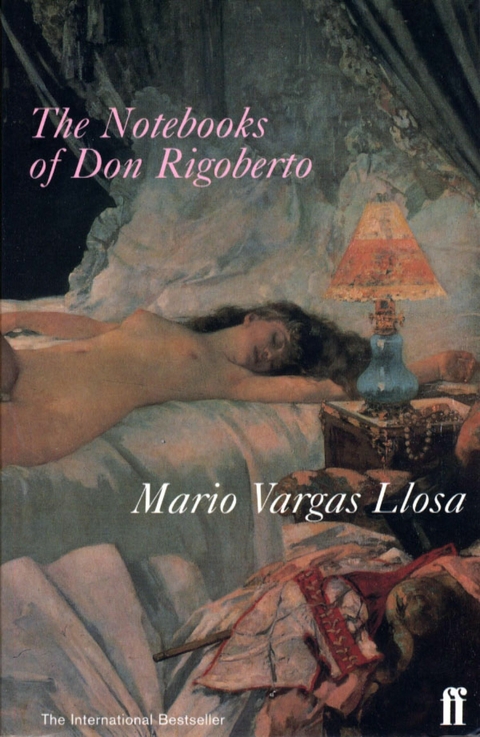
Notebooks of Don Rigoberto (eBook)
200 Seiten
Faber & Faber (Verlag)
978-0-571-26813-9 (ISBN)
Mario Vargas Llosa was awarded the Nobel Prize in Literature in 2010. He also won the Cervantes Prize, the most distinguished literary honour in the Spanish-speaking world. His many works include The Feast of the Goat, The Bad Girl and Aunt Julia and the Scriptwriter as well as several collections of essays, journalism and plays. He died in April 2025.
WINNER OF THE NOBEL PRIZE IN LITERATUREDon Rigoberto - by day a grey insurance executive, by night a pornographer and sexual enthusiast - misses Lucrecia, his estranged second wife. The pair separated following a sexual encounter between Lucrecia and Alfonso, Rigoberto's son. To compensate for her absence, Rigoberto fills his notebooks with memories, fantasies and unsent letters. Meanwhile, Alfonso visits Lucrecia, determined to win her love. In The Notebooks of Don Rigoberto, Mario Vargas Llosa keeps the reader guessing which episodes are real and which issue from Rigoberto's imagination. The novel, a wonderful mix of reality and fantasy, is sexy, funny, disquieting, and unfailingly compelling.
With novels including The War of the End of the World, Aunt Julia and the Scriptwriter, The Notebooks of Don Rigoberto and The Feast of the Goat, Mario Vargas Llosa has established an international reputation as one of the Latin America's most important authors.
The Return of Fonchito
The doorbell rang, Doña Lucrecia went to see who was there, and like a portrait in the open doorway, with the twisted gray trees of the Olivar de San Isidro as the background, she saw the golden ringlets and blue eyes of Fonchito’s head. The world began to spin.
“I miss you very much, Stepmamá,” chirped the voice she remembered so well. “Are you still angry with me? I came to ask your forgiveness. Do you forgive me?”
“You, it’s you?” Still holding the doorknob, Doña Lucrecia had to lean against the wall. “Aren’t you ashamed to come here?”
“I sneaked out of the academy,” the boy insisted, showing her his sketchbook, his colored pencils. “I missed you very much, really I did. Why are you so pale?”
“My God, my God.” Doña Lucrecia staggered and dropped to the faux-colonial bench next to the door. White as a sheet, she covered her eyes.
“Don’t die!” shouted the boy in fright.
And Doña Lucrecia—she felt herself passing out—saw the small, childish figure cross the threshold, close the door, fall to his knees at her feet, grasp her hands, and rub them in bewilderment. “Don’t die, don’t faint, please.”
She made an effort to collect her wits and regain her self-control. She took a deep breath before speaking. Her words came slowly, for she thought her voice would break at any moment. “Nothing’s wrong, I’m fine now. Seeing you here was the last thing I expected. How did you have the nerve? Don’t you feel any remorse?”
Still on his knees, Fonchito tried to kiss her hand.
“Say you forgive me, Stepmamá,” he begged. “Say it, say it. The house isn’t the same since you left. I came here so many times after school just to catch a glimpse of you. I wanted to ring the bell but I didn’t have the courage. Won’t you ever forgive me?”
“Never,” she said firmly. “I’ll never forgive what you did, you wicked boy.”
But, belying her own words, her large, dark eyes scrutinized with curiosity, some pleasure, perhaps even with tenderness, the tousled curls, the thin blue veins in his neck, the tips of his ears visible among the blond ringlets, the slim graceful body tightly encased in the blue jacket and gray trousers of his school uniform. Her nostrils breathed in that adolescent odor of soccer games, hard candies, and d’Onofrio ice cream; her ears recognized the high-pitched breaks, the changing voice that still echoed in her memory. Doña Lucrecia’s hands resigned themselves to being dampened by the baby-bird kisses of that sweet mouth.
“I love you very much, Stepmamá,” Fonchito whimpered. “And even if you don’t think so, my papá does too.”
Just then Justiniana appeared, a lithe, cinnamon-colored figure wrapped in a flowered smock, with a kerchief around her head and a feather duster in her hand. She stood, frozen, in the hallway leading to the kitchen.
“Master Alfonso,” she murmured in disbelief. “Fonchito! I can’t believe it!”
“Imagine, imagine!” Doña Lucrecia exclaimed, determined to display more indignation than she actually felt. “He has the gall to come to this house. After ruining my life and hurting Rigoberto so. To ask for my forgiveness and shed his crocodile tears. Have you ever seen anything so shameless, Justiniana?”
But even now she did not pull away the slender fingers that Fonchito, shaken by his sobs, continued to kiss.
“Go on, Master Alfonso,” said the girl, so confused that without realizing it she now began to address him with the more familiar tú. “Can’t you see how much you’re upsetting the señora? Go on, leave now, Fonchito.”
“I’ll go if she says she forgives me,” pleaded the boy, sighing, his head resting on Doña Lucrecia’s hands. “And you, Justita, you don’t even say hello, you start right in insulting me? What did I ever do to you? I love you too, a lot; I love you so much I cried all night when you left.”
“Quiet, you liar, I don’t believe a word you say.” Justiniana smoothed Doña Lucrecia’s hair. “Shall I bring you a cloth and some alcohol, Señora?”
“Just a glass of water. Don’t worry, I’m all right now. But seeing the boy here in this house gave me such a shock.”
And, at last, very gently, she withdrew her hands from Fonchito’s grasp. The boy remained at her feet, not crying now, struggling to suppress his sobs. His eyes were red and tears had streaked his face. A thread of saliva hung from his mouth. Through the mist that fogged her eyes, Doña Lucrecia observed his chiseled nose, well-defined lips, small, imperious cleft chin, the brilliant whiteness of his teeth. She wanted to slap him, scratch that Baby Jesus face. Hypocrite! Judas! Even bite his neck and suck his blood like a vampire.
“Does your father know you’re here?”
“What an idea, Stepmamá,” the boy answered immediately, in a conspiratorial tone. “Who knows what he’d do to me. He never talks about you, but I know how much he misses you. I swear you’re all he thinks about, night or day. I came here in secret, I sneaked out of the academy. I go three times a week, after school. Do you want me to show you my drawings? Say you forgive me, Stepmamá.”
“Don’t say anything, throw him out, Señora.” Justiniana had come back with a glass of water; Doña Lucrecia took several sips. “Don’t let him fool you with his pretty face. He’s Lucifer in person, and you know it. He’ll play another evil trick on you worse than the first one.”
“Don’t say that, Justita.” Fonchito looked ready to burst into tears again. “I swear I’m sorry, Stepmamá. I didn’t know what I was doing, honest. I didn’t want anything to happen. Do you think I wanted you to go away? That I wanted my papá and me to be left all alone?”
“I didn’t go away,” Doña Lucrecia muttered, contradicting him. “Rigoberto threw me out as if I were a whore. And it was all your fault!”
“Don’t say dirty words, Stepmamá.” The boy raised both hands in horror. “Don’t say them, they don’t suit you.”
Despite her grief and anger, Doña Lucrecia almost smiled. Cursing didn’t suit her! A perceptive, sensitive child? Justiniana was right: he was Beelzebub, a viper with the face of an angel.
The boy exploded with jubilation. “You’re laughing, Stepmamá! Does that mean you forgive me? Then say it, say you have, Stepmamá.”
He clapped his hands, and in his blue eyes the sadness had cleared and a savage little light was flashing. Doña Lucrecia noticed the ink stains on his fingers. Despite herself, she was touched. Was she going to faint again? How absurd. She saw her reflection in the foyer mirror: her expression had regained its composure, but a light blush tinged her cheeks, and her breast rose and fell in agitation. With an automatic gesture she closed the neckline of her dressing gown. How could he be so shameless, so cynical, so perverse, when he was still so young? Justiniana read her thoughts. She looked at her as if to say, “Don’t be weak, Señora, don’t forgive him. Don’t be a fool!” Hiding her embarrassment, she took a few more sips of water; it was cold and did her good. The boy quickly grasped her free hand and began to kiss it again, talking all the while.
“Thank you, Stepmamá. You’re so good, but I knew that, that’s why I had the courage to ring the bell. I want to show you my drawings. And talk to you about Egon Schiele, about his life and his paintings. And tell you what I’ll be when I grow up, and a thousand other things. Can you guess? A painter, Stepmamá! That’s what I want to be.”
Justiniana shook her head in alarm. Outside, motors and horns disturbed the San Isidro twilight, and through the sheer curtains in the dining alcove, Doña Lucrecia caught a glimpse of the bare branches and knotted trunks of the olive trees; they had become a friendly presence. Enough indecisiveness, it was time to act.
“All right, Fonchito,” she said, with a severity her heart no longer demanded of her. “Now make me happy. Please go away.”
“Yes, Stepmamá.” The boy leaped to his feet. “Whatever you say. I’ll always listen to you, I’ll always obey you in everything. You’ll see how well I can behave.”
His voice and expression were those of someone who has eased himself of a heavy burden and made peace with his conscience. A golden lock of hair brushed his forehead, and his eyes sparkled with joy. Doña Lucrecia watched as he put a hand into his back pocket, took out a handkerchief, blew his nose, and then picked up his book bag, his portfolio of drawings, his box of pencils from the floor. With all that on his shoulder, he backed away, smiling, toward the door, not taking his eyes off Doña Lucrecia and Justiniana.
“As soon as I can, I’ll sneak away again and come and visit you, Stepmamá,” he warbled from the doorway. “And you too, Justita, of course.”
When the street door closed, both women stood motionless and silent. Soon the bells of the Virgen del Pilar Church began to ring in the distance. A dog barked.
“It’s incredible,” murmured Doña Lucrecia. “I can’t believe he had the nerve to show his face in this house.”
“What’s incredible is how good you are,” the girl replied indignantly. “You’ve forgiven him, haven’t you? After the way he tricked you into fighting with the señor. There’s a place reserved for you in heaven, Señora!”
“I’m not even certain it was a trick, or that he planned it all out ahead of...
| Erscheint lt. Verlag | 16.8.2012 |
|---|---|
| Übersetzer | Edith Grossman |
| Verlagsort | London |
| Sprache | englisch |
| Themenwelt | Literatur ► Romane / Erzählungen |
| Schlagworte | eroticism • Gabriel Garcia Marquez • infidelity • In Praise of the Stepmother • Madame Bovary • Sex • Spanish romance |
| ISBN-10 | 0-571-26813-7 / 0571268137 |
| ISBN-13 | 978-0-571-26813-9 / 9780571268139 |
| Informationen gemäß Produktsicherheitsverordnung (GPSR) | |
| Haben Sie eine Frage zum Produkt? |
 EPUB (Adobe DRM)
Kopierschutz: Adobe-DRM
Adobe-DRM ist ein Kopierschutz, der das eBook vor Mißbrauch schützen soll. Dabei wird das eBook bereits beim Download auf Ihre persönliche Adobe-ID autorisiert. Lesen können Sie das eBook dann nur auf den Geräten, welche ebenfalls auf Ihre Adobe-ID registriert sind.
Details zum Adobe-DRM
Dateiformat: EPUB (Electronic Publication)
EPUB ist ein offener Standard für eBooks und eignet sich besonders zur Darstellung von Belletristik und Sachbüchern. Der Fließtext wird dynamisch an die Display- und Schriftgröße angepasst. Auch für mobile Lesegeräte ist EPUB daher gut geeignet.
Systemvoraussetzungen:
PC/Mac: Mit einem PC oder Mac können Sie dieses eBook lesen. Sie benötigen eine
eReader: Dieses eBook kann mit (fast) allen eBook-Readern gelesen werden. Mit dem amazon-Kindle ist es aber nicht kompatibel.
Smartphone/Tablet: Egal ob Apple oder Android, dieses eBook können Sie lesen. Sie benötigen eine
Geräteliste und zusätzliche Hinweise
Buying eBooks from abroad
For tax law reasons we can sell eBooks just within Germany and Switzerland. Regrettably we cannot fulfill eBook-orders from other countries.
aus dem Bereich