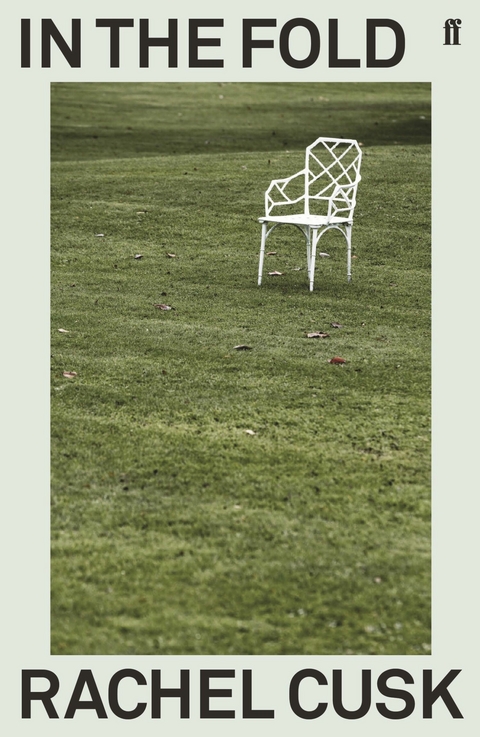
In the Fold (eBook)
200 Seiten
Faber & Faber (Verlag)
978-0-571-26717-0 (ISBN)
Rachel Cusk is the author of Second Place (Prix Femina étranger), the Outline trilogy, the memoirs A Life's Work and Aftermath, and several other works of fiction and nonfiction, including her most recent novel Parade (Goldsmiths Prize, 2024). She is a Guggenheim Fellow, the recipient of the 2024 Malaparte Prize, and has been awarded the title of Chevalier de l'ordre des arts et des lettres. She lives in Paris.
LONGLISTED FOR THE BOOKER PRIZE'Cusk can pinpoint something profound with the merest detail.'Independent'A warning against idealism, brilliantly plotted and eloquently narrated.'Scotsman'This deft, haunting work compels on every page.'Daily MailWhen eighteen-year-old Michael visits the Hanbury's remote family home he is captivated by their bohemian lifestyle. Years later, when he marries the strong-willed, beautiful Rebecca, he is secretly hoping to create his own version of that free-thinking family, but after the birth of their first child, their marriage begins to flounder. The chance to escape once more to his friend's country house comes as a welcome relief, until he discovers a family changed and his own romantic notions of country life disintegrating.
This is a book beautifully written on many levels. The dialogue is breathtakingly sharp, yet moving, about how we live today and relate to each other. A joy to read.
A deeply resonant novel from a gifted writer.
What shines in Rachel Cusk's writing is the sheer precision of her observation, the way she can pinpoint something profound with the merest detail.
[A] perceptive unravelling of the allure of wealthy bohemian lifestyles.
Cusk's prose perfectly captures the claustrophobia of a family crippled by the conflicting demands of property and propriety ... the result is compelling. This is Cusk at her very best.
No one does relentlessly unhappy characters, and relentlessly analytical and garrulous unhappiness, like Rachel Cusk ... her observations are now startling in their metaphorical exactness, the texture of details cracklingly crisp and new, and the insight into the hell of human relationships too close to the bone for comfort.
Elements of Rachel Cusk's prose have the beauty and resonance of a Cartier-Bresson photograph ... she can snatch one fleeting moment and use it to illuminate a life.
This is a finely wrought novel: [Cusk] has a sharp eye for social nuance and the complexities of family relationships and the pitfalls of modern marriage are acutely observed.
Cusk's elegant and vivid descriptions frequently have a terrific freshness. Her careful use of words, to describe the downturn of a mouth, the wayward construction of Egypt, or the pointed speechlessness of a little boy in a troubled marriage, is a pleasure.
I first met the Hanburys when Adam Hanbury’s sister Caris invited me to her eighteenth birthday party. The invitation read as follows:
Caris Hanbury
invites you to celebrate her eighteenth birthday
at Egypt
on Saturday 21 July at 8pm
Carriages at Dawn
RSVP
‘Where’s that?’ I asked Adam.
‘What?’
‘Where’s “Egypt”?’
‘It’s where we live,’ he said, after a pause.
‘Why’s it got that name?’
‘I don’t know. Everyone’s always called it that.’
‘Well, how are you meant to find it when it doesn’t say where it is?’
There wasn’t an address or a map or any directions. There wasn’t even a telephone number.
‘Everyone knows where it is,’ said Adam.
Adam Hanbury and I occupied adjacent rooms in the university hall of residence: I had surmised, vaguely, that he was different from me, but such differences I regarded as somehow ornamental; as though, suspended between the involuntary world of childhood and the open road of adult life, our student characteristics were a temporary form of self-adornment. We were like a bank of flowers in their season, a waving mass of contemporaneous heads whose stalks and roots were for the time being obscured. The other two rooms on our floor were occupied by a pair of girls called Fiona and Juliet, who spoke in accents of biting gentility and were generally amiable, except in matters pertaining to the shared bathroom, where they exercised flaying powers of discrimination with which I now see they were biologically equipped and which, as they got older, no doubt unfolded into the visible characteristics of a social type. At the end of the year Fiona and Juliet wrote Adam and me a letter which they pinned to Adam’s door:
Dear Boys, it read
Out of sympathy for your neighbours next year we thought it might interest you to hear some HOME TRUTHS about yourselves, as it is obvious no one ever loved you enough to tell you how not to disgust and revolt people, and there is obviously no chance of you getting girlfriends, who might have told you that if you want people to like you it’s a good idea not to do your washing up in the bath, or at least to clean the bath out afterwards so that the next person doesn’t think they’ve stumbled on a scene from the TEXAS CHAINSAW MASSACRE. Also not to leave pubic hairs in the sink, lest people wonder how they got there. We’ve counted at least ten – it’s actually quite off-putting when you’re trying to clean your teeth. On that subject …! Did your mothers abandon you at birth, or have they just forgotten to tell you that using other people’s toothbrushes is unhygienic and rude, and in fact these days is tantamount to a criminal offence. Haven’t you heard of AIDS?!!! Come to think of it, you always seemed suspiciously close. Though on second thoughts at least gays are meant to be TIDY. Is this some kind of double bluff we’ve uncovered here? I think we should be told.
Yours, Fifi and Jules
A few years later I met one of them at a party and she expressed a surprising depth of regret for this missive. I had forgotten it by then but she gave the impression of having thought of little else in the intervening period than how stupid, how pathetic she was to write it. I told her I didn’t see why it worried her so much, when everything it said was basically correct. For some reason this observation actually intensified her remorse. I remembered once opening the door to her room to drop off her post in the mistaken belief that she was out, and finding her standing there naked except for high heels and some items of exotic underwear that she was in the process of fastening. I apologised and was shutting the door again, but she said hello and gave me a horsy, hostessy smile, so with a thudding heart I handed over her letters. The other one, her friend, was always talking about her mother, who was tyrannical and upset her strangely, and who reported her to the college dean for staying overnight with her boyfriend, even though there was no rule against doing this.
‘Don’t you think that’s a bit pretentious?’ I said to Adam.
‘Not particularly,’ he said.
‘Well, what about people who don’t know where it is? What are they supposed to do?’
‘I think it’s more the opposite. It suggests the only people she’s inviting are friends of my parents.’
‘She’s never even met me,’ I said, though at that time it was not in my constitution to refuse invitations. ‘Why is she inviting someone she’s never even met?’
We drove there in Adam’s car, which was so decrepit that the doors were tied shut with string, so that the only way to get in and out was through the windows. When people saw you doing this they clearly thought something criminal was occurring, although they could never establish exactly what it was. Inside, the car was warm and rancid-smelling, and the compostable matter worked into its floor and upholstered surfaces gave off a rich atmosphere, generating heat as it lived out its cycle of maturity and decay. I often experienced feelings of comfort and security in Adam’s car. Being driven in it was like being carried in the warm, smelly mouth of a kindly animal. We drove south and west from Bristol, and then for more than an hour along a narrow road that dallied interminably down the coast, above intermittent glimpses of a marbled sea. The road was like a pointless, rambling sentence that never succeeds in conveying information or reaching any meaningful conclusion. Under a heavy, grey summer sky it passed by ragged farms and fields, by the static contemplation of cows and sheep, by yards strewn with the muddied metal skeletons of farm machinery, by more farms and fields and villages, neither diminishing nor increasing but always in more or less the same quantity, so that a feeling I often used to have in those days was gradually forced on me, the feeling that I had unintentionally left the proper path of my life and was now lost and far from home. At that time there seemed a constant risk of this occurring. It was as though my existence were a small room in a huge, complicated building, to which at the end of every day I was presented with the challenge of finding my way back. It began to oppress me that Adam kept his foot on the accelerator. I saw us worrying the seam of the meandering road with an inexplicable persistence. I began to look down every little lane we passed, glimpsing in the shady, silent tributaries a deep, expectant anonymity, like a dark body of water waiting at the bottom of an irresistible slope. I guessed that ‘Egypt’ was not going to be found down one of these lanes. We thundered by them without a backward glance. I received in that moment an intimation of the notion of privilege: of a world set apart from the world that was at hand.
After a while we came over a rise and the countryside opened out before us, sloping, green and wooded, with the flat, calm spread of the sea around it. The grey, wadded sky stayed behind us, stolid, diminishing, and ahead a great arc of blue stood over everything. A town was clustered around the small bay, and the sun cast shadows on its buildings so that it seemed highly contoured and quaint, like a toy town, with its little bright boats in the harbour and its houses splashed up the hill behind it.
‘This is Doniford,’ said Adam. He sat up straight and put his face close to the windscreen.
‘Should I have heard of that too?’
‘It’s a hilarious place, actually.’
I was to hear this repeated often by the Hanburys, that Doniford was ‘hilarious’. I still don’t really know what they meant by it, which is a pity, because I’m sure they only said it for the benefit of visitors such as myself.
‘Does that mean it doesn’t have a pub?’
‘Of course it has a pub.’
We went to a pub overlooking the little harbour, which Adam reached by driving the car right up on to the wooden esplanade and jettisoning it directly outside the entrance, a strategy which proved useful an hour later when we were forced to search the disgusting interior for money to pay for our drinks. Afterwards we climbed back in through the windows, in view of a small crowd of people that had gathered around the car on the esplanade. There was no communication between Adam and these people. The only thing that suggested his familiarity here was the confidence with which he ignored them. He careered off the esplanade and roared on through the town with his window rolled down and his open shirt flapping madly at his neck in the sun. A cavalier spirit seemed to have seized his body. He drove faster, until the houses looked askew, like great trees falling in our path, and the road undulated crazily in front of us.
...| Erscheint lt. Verlag | 22.12.2010 |
|---|---|
| Verlagsort | London |
| Sprache | englisch |
| Themenwelt | Literatur ► Romane / Erzählungen |
| Schlagworte | Deception • Divorce • Identity • marriage • Three Women Lisa Taddeo |
| ISBN-10 | 0-571-26717-3 / 0571267173 |
| ISBN-13 | 978-0-571-26717-0 / 9780571267170 |
| Informationen gemäß Produktsicherheitsverordnung (GPSR) | |
| Haben Sie eine Frage zum Produkt? |
 EPUB (Adobe DRM)
Kopierschutz: Adobe-DRM
Adobe-DRM ist ein Kopierschutz, der das eBook vor Mißbrauch schützen soll. Dabei wird das eBook bereits beim Download auf Ihre persönliche Adobe-ID autorisiert. Lesen können Sie das eBook dann nur auf den Geräten, welche ebenfalls auf Ihre Adobe-ID registriert sind.
Details zum Adobe-DRM
Dateiformat: EPUB (Electronic Publication)
EPUB ist ein offener Standard für eBooks und eignet sich besonders zur Darstellung von Belletristik und Sachbüchern. Der Fließtext wird dynamisch an die Display- und Schriftgröße angepasst. Auch für mobile Lesegeräte ist EPUB daher gut geeignet.
Systemvoraussetzungen:
PC/Mac: Mit einem PC oder Mac können Sie dieses eBook lesen. Sie benötigen eine
eReader: Dieses eBook kann mit (fast) allen eBook-Readern gelesen werden. Mit dem amazon-Kindle ist es aber nicht kompatibel.
Smartphone/Tablet: Egal ob Apple oder Android, dieses eBook können Sie lesen. Sie benötigen eine
Geräteliste und zusätzliche Hinweise
Buying eBooks from abroad
For tax law reasons we can sell eBooks just within Germany and Switzerland. Regrettably we cannot fulfill eBook-orders from other countries.
aus dem Bereich