


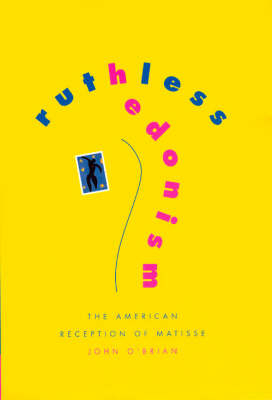
Ruthless Hedonism
The American Reception of Matisse
Seiten
1999
University of Chicago Press (Verlag)
978-0-226-61626-1 (ISBN)
University of Chicago Press (Verlag)
978-0-226-61626-1 (ISBN)
- Titel z.Zt. nicht lieferbar
- Versandkostenfrei
- Auch auf Rechnung
- Artikel merken
This study argues that Henri Matisse's sober presentations of himself were calculated to fit with the social constraints and ideological demands of the times. It shows how the way Matisse's work was viewed changed as attention shifted away from the subject matter to the seductiveness of his paint.
In this study, John O'Brian argues that Henri Matisse's sober presentations of himself were calculated to fit with the social constraints and ideological demands of the times. Matisse's strategy included co-operating with museums, cultivating private collectors, playing off dealers one against another, and reassuring the media that, whatever his reputation as an avant-gardist, the conduct of his life was solidly bourgeois. Moving from the late 1920s, when Matisse's output was shedding its outlaw reputation, to the early 1950s, when his work was canonized, O'Brian shows how the way Matisse's work was viewed changed as attention shifted away from the seductiveness of his subject matter to the seductiveness of his paint. The art's resolute rejection of political concerns, its deployment of decorative design for visual satisfaction, and its representations of pleasure encouraged American audiences, who in the 1930s deemed the art disreputable, to celebrate its gratifications by the early years of the Cold War.
In this study, John O'Brian argues that Henri Matisse's sober presentations of himself were calculated to fit with the social constraints and ideological demands of the times. Matisse's strategy included co-operating with museums, cultivating private collectors, playing off dealers one against another, and reassuring the media that, whatever his reputation as an avant-gardist, the conduct of his life was solidly bourgeois. Moving from the late 1920s, when Matisse's output was shedding its outlaw reputation, to the early 1950s, when his work was canonized, O'Brian shows how the way Matisse's work was viewed changed as attention shifted away from the seductiveness of his subject matter to the seductiveness of his paint. The art's resolute rejection of political concerns, its deployment of decorative design for visual satisfaction, and its representations of pleasure encouraged American audiences, who in the 1930s deemed the art disreputable, to celebrate its gratifications by the early years of the Cold War.
John O'Brian is professor of art history at the University of British Colombia.
| Erscheint lt. Verlag | 2.7.1999 |
|---|---|
| Sprache | englisch |
| Maße | 17 x 26 mm |
| Gewicht | 907 g |
| Themenwelt | Literatur ► Biografien / Erfahrungsberichte |
| Kunst / Musik / Theater ► Kunstgeschichte / Kunststile | |
| Kunst / Musik / Theater ► Malerei / Plastik | |
| ISBN-10 | 0-226-61626-6 / 0226616266 |
| ISBN-13 | 978-0-226-61626-1 / 9780226616261 |
| Zustand | Neuware |
| Informationen gemäß Produktsicherheitsverordnung (GPSR) | |
| Haben Sie eine Frage zum Produkt? |
Mehr entdecken
aus dem Bereich



aus dem Bereich
unser Eingliederungsversuch in eine geschlossene Gesellschaft
Buch | Softcover (2025)
Knaur (Verlag)
CHF 25,20


