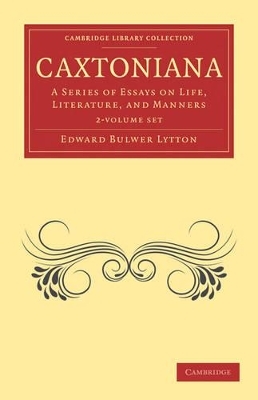
Caxtoniana 2 Volume Paperback Set
Cambridge University Press
978-1-108-07280-9 (ISBN)
- Keine Verlagsinformationen verfügbar
- Artikel merken
In 1849 Edward Bulwer Lytton published the popular novel The Caxtons, about an eccentric family who claimed descent from the printer William Caxton. Its hero, Pisistratus Caxton, was named as the author of two subsequent works, My Novel (1853) and What Will He Do With It? (1859) which were less successful. Bulwer Lytton was referring to those novels when he named this two-volume collection of literary and philosophical essays Caxtoniana, first published in 1863 and here reprinted from the 1864 edition. They were the result of his wide reading on scientific, philosophical and occult subjects which he made use of in several of his works, particularly the supernatural A Strange Story (1862). Many of the essays in Caxtoniana deal with morality and the artist, others with literary style, psychology, politics and readership. Lytton claimed that these subjects were expressed in the form of romance in the 'Caxton' novels.
Volume 1: 1. On the increased attention to outward nature in the decline of life; 2. On the differences between the urban and rural temperament; 3. On monotony in occupation as a source of happiness; 4. On the normal clairvoyance of the imagination; 5. On intellectual conduct as distinct from moral: the 'superior man'; 6. On shyness; 7. On the management of money (addressed chiefly to the young); 8. On rhythm in prose, as conducive to precision and clearness; 9. On style and diction; 10. Hints on moral culture; 11. On the moral effect of writers; 12. On the distinction between active thought and reverie; 13. On the spirit in which new theories should be received; 14. On essay-writing in general, and these essays in particular; 15. The sanguine temperament; 16. The organ of weight; 17. The sympathetic temperament; 18. Faith and charity; or, the union, in practical life, of sincerity and conciliation; 19. Upon the efficacy of praise (in supplement to the preceding essay); 20. On self-control; 21. The modern misanthrope. Volume 2: 1. On the increased attention to outward nature in the decline of life; 2. On the differences between the urban and rural temperament; 3. On monotony in occupation as a source of happiness; 4. On the normal clairvoyance of the imagination; 5. On intellectual conduct as distinct from moral: the 'superior man'; 6. On shyness; 7. On the management of money (addressed chiefly to the young); 8. On rhythm in prose, as conducive to precision and clearness; 9. On style and diction; 10. Hints on moral culture; 11. On the moral effect of writers; 12. On the distinction between active thought and reverie; 13. On the spirit in which new theories should be received; 14. On essay-writing in general, and these essays in particular; 15. The sanguine temperament; 16. The organ of weight; 17. The sympathetic temperament; 18. Faith and charity; or, the union, in practical life, of sincerity and conciliation; 19. Upon the efficacy of praise (in supplement to the preceding essay); 20. On self-control; 21. The modern misanthrope.
| Erscheint lt. Verlag | 17.3.2011 |
|---|---|
| Reihe/Serie | Cambridge Library Collection - Literary Studies |
| Zusatzinfo | Worked examples or Exercises |
| Verlagsort | Cambridge |
| Sprache | englisch |
| Maße | 140 x 216 mm |
| Gewicht | 940 g |
| Themenwelt | Literatur ► Essays / Feuilleton |
| Geisteswissenschaften ► Sprach- / Literaturwissenschaft ► Anglistik / Amerikanistik | |
| ISBN-10 | 1-108-07280-1 / 1108072801 |
| ISBN-13 | 978-1-108-07280-9 / 9781108072809 |
| Zustand | Neuware |
| Informationen gemäß Produktsicherheitsverordnung (GPSR) | |
| Haben Sie eine Frage zum Produkt? |
aus dem Bereich