


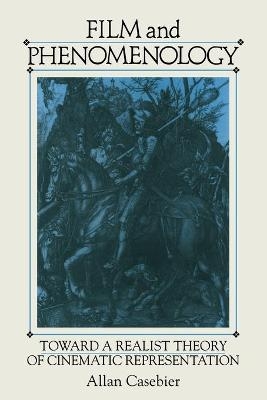
Film and Phenomenology
Towards a Realist Theory of Cinematic Representation
Seiten
2009
Cambridge University Press (Verlag)
978-0-521-10854-6 (ISBN)
Cambridge University Press (Verlag)
978-0-521-10854-6 (ISBN)
Film and Phenomenology presents a new approach to the question of cinematic representation, which runs contrary to the course of contemporary film theory.Film and Phenomenology presents a new approach to the question of cinematic representation which runs contrary to the course of contemporary film theory.
In Film and Phenomenology, Allan Casebier develops a theory of representation first indicated in the writings of the father of phenomenology, Edmund Husserl, and then applies it to the case of cinematic representation. This work provides one of the clearest expositions of Husserl's highly influential but often obscure thought. It also demonstrates the power of phenomenology to illuminate the experience of the art form unique to the twentieth-century cinema. Film and Phenomenology is intended as an antidote to all hitherto existing theories about the nature of cinematic representation, whether issuing from classic sources such as the film theory of Andre Bazin or the post-structuralist synthesis of Lacanian psychoanalysis, Barthesian textual analysis and Metzean cine-semiotics. Casebier shows how a phenomenological account of representation will further the aims of any film theory. Developing a viable feminist film theory, legitimising the documentary, answering the challenge of Derridean deconstruction, properly theorising narrativity, Film and Phenomenology argues that theory of film must be Realist both with respect to epistemology and ontological issues. In this way, this work runs contrary to the whole course of contemporary film theory, which has been deeply anti-Realist.
In Film and Phenomenology, Allan Casebier develops a theory of representation first indicated in the writings of the father of phenomenology, Edmund Husserl, and then applies it to the case of cinematic representation. This work provides one of the clearest expositions of Husserl's highly influential but often obscure thought. It also demonstrates the power of phenomenology to illuminate the experience of the art form unique to the twentieth-century cinema. Film and Phenomenology is intended as an antidote to all hitherto existing theories about the nature of cinematic representation, whether issuing from classic sources such as the film theory of Andre Bazin or the post-structuralist synthesis of Lacanian psychoanalysis, Barthesian textual analysis and Metzean cine-semiotics. Casebier shows how a phenomenological account of representation will further the aims of any film theory. Developing a viable feminist film theory, legitimising the documentary, answering the challenge of Derridean deconstruction, properly theorising narrativity, Film and Phenomenology argues that theory of film must be Realist both with respect to epistemology and ontological issues. In this way, this work runs contrary to the whole course of contemporary film theory, which has been deeply anti-Realist.
Acknowledgements; Introduction; 1. Phenomenological theory; 2. A phenomenology of fictional representation; 3. A phenomenology of documentary representation; Selected bibliography; Filmography; Index.
| Erscheint lt. Verlag | 9.4.2009 |
|---|---|
| Reihe/Serie | Cambridge Studies in Film |
| Zusatzinfo | Worked examples or Exercises |
| Verlagsort | Cambridge |
| Sprache | englisch |
| Maße | 152 x 229 mm |
| Gewicht | 270 g |
| Themenwelt | Kunst / Musik / Theater ► Film / TV |
| ISBN-10 | 0-521-10854-3 / 0521108543 |
| ISBN-13 | 978-0-521-10854-6 / 9780521108546 |
| Zustand | Neuware |
| Informationen gemäß Produktsicherheitsverordnung (GPSR) | |
| Haben Sie eine Frage zum Produkt? |
Mehr entdecken
aus dem Bereich


aus dem Bereich
Buch | Hardcover (2025)
MACK and Important Flowers (Verlag)
CHF 43,60


