


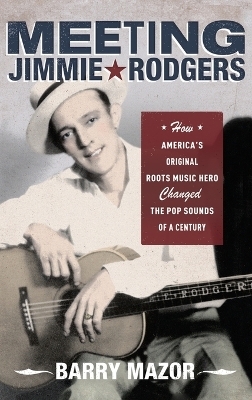
Meeting Jimmie Rodgers
How America's Original Roots Music Hero Changed the Pop Sounds of a Century
Seiten
2009
Oxford University Press Inc (Verlag)
978-0-19-532762-5 (ISBN)
Oxford University Press Inc (Verlag)
978-0-19-532762-5 (ISBN)
In Meeting Jimmie Rodgers, Barry Mazor traces our ever-evolving response to the performing songwriter who has influenced country, rock, and blues for 80 years, as transformed by artists from Ernest Tubb to Bill Monroe, Jerry Lee Lewis, and Bob Dylan. This is a provocative, colorful 21st century re-examination of the roots music hero's impact.
In the nearly eight decades since his death from tuberculosis at age thirty-five, singer-songwriter Jimmie Rodgers has been an inspiration for numerous top performers--from Woody Guthrie, Lead Belly, Bill Monroe and Hank Williams to Elvis Presley, Johnny Cash, Dolly Parton, Bob Dylan, and Beck. How did this Mississippi-born vaudevillian, a former railroad worker who performed so briefly so long ago, produce tones, tunes, and themes that have had such broad influence and made him the model for the way American roots music stars could become popular heroes?
In Meeting Jimmie Rodgers, the first book to explore the deep legacy of "The Singing Brakeman" from a twenty-first century perspective, Barry Mazor offers a lively look at Rodgers' career, tracing his rise from working-class obscurity to the pinnacle of renown that came with such hits as "Blue Yodel" and "In the Jailhouse Now." As Mazor shows, Rodgers brought emotional clarity and a unique sense of narrative drama to every song he performed, whether tough or sentimental, comic or sad. His wistful singing, falsetto yodels, bold flat-picking guitar style, and sometimes censorable themes---sex, crime, and other edgy topics--set him apart from most of his contemporaries. But more than anything else, Mazor suggests, it was Rodgers' shape-shifting ability to assume many public personas--working stiff, decked-out cowboy, suave ladies' man--that connected him to such a broad public and set the stage for the stars who followed him.
Mazor goes beyond Rodgers's own life to map the varied places his music has gone, forever changing not just country music but also rock and roll, blues, jazz, bluegrass, Western, commercial folk, and much more. In reconstructing this far-flung legacy, Mazor enables readers to meet Rodgers and his music anew--not as an historical figure, but as a vibrant, immediate force.
In the nearly eight decades since his death from tuberculosis at age thirty-five, singer-songwriter Jimmie Rodgers has been an inspiration for numerous top performers--from Woody Guthrie, Lead Belly, Bill Monroe and Hank Williams to Elvis Presley, Johnny Cash, Dolly Parton, Bob Dylan, and Beck. How did this Mississippi-born vaudevillian, a former railroad worker who performed so briefly so long ago, produce tones, tunes, and themes that have had such broad influence and made him the model for the way American roots music stars could become popular heroes?
In Meeting Jimmie Rodgers, the first book to explore the deep legacy of "The Singing Brakeman" from a twenty-first century perspective, Barry Mazor offers a lively look at Rodgers' career, tracing his rise from working-class obscurity to the pinnacle of renown that came with such hits as "Blue Yodel" and "In the Jailhouse Now." As Mazor shows, Rodgers brought emotional clarity and a unique sense of narrative drama to every song he performed, whether tough or sentimental, comic or sad. His wistful singing, falsetto yodels, bold flat-picking guitar style, and sometimes censorable themes---sex, crime, and other edgy topics--set him apart from most of his contemporaries. But more than anything else, Mazor suggests, it was Rodgers' shape-shifting ability to assume many public personas--working stiff, decked-out cowboy, suave ladies' man--that connected him to such a broad public and set the stage for the stars who followed him.
Mazor goes beyond Rodgers's own life to map the varied places his music has gone, forever changing not just country music but also rock and roll, blues, jazz, bluegrass, Western, commercial folk, and much more. In reconstructing this far-flung legacy, Mazor enables readers to meet Rodgers and his music anew--not as an historical figure, but as a vibrant, immediate force.
Barry Mazor has been writing about American music since the 1970s. A long-time senior editor for the roots and pop music magazine and website No Depression, he writes frequently on country and pop music for The Wall Street Journal. He lives in Nashville, Tennessee.
INTRODUCTION: MEETING JIMMIE RODGERS HALFWAY
| Erscheint lt. Verlag | 30.7.2009 |
|---|---|
| Zusatzinfo | 15 black and white halftones |
| Verlagsort | New York |
| Sprache | englisch |
| Maße | 236 x 155 mm |
| Gewicht | 678 g |
| Themenwelt | Kunst / Musik / Theater ► Musik |
| ISBN-10 | 0-19-532762-4 / 0195327624 |
| ISBN-13 | 978-0-19-532762-5 / 9780195327625 |
| Zustand | Neuware |
| Informationen gemäß Produktsicherheitsverordnung (GPSR) | |
| Haben Sie eine Frage zum Produkt? |
Mehr entdecken
aus dem Bereich



aus dem Bereich


