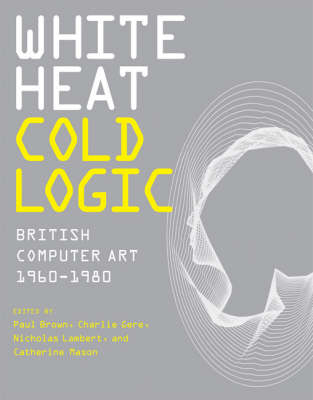
White Heat Cold Logic
MIT Press (Verlag)
978-0-262-02653-6 (ISBN)
- Titel ist leider vergriffen;
keine Neuauflage - Artikel merken
Technological optimism, even utopianism, was widespread at midcentury; in Britain, Harold Wilson in 1963 promised a new nation "forged from the white heat of the technological revolution." In this heady atmosphere, pioneering artists transformed the cold logic of computing into a new medium for their art, and played a central role in connecting technology and culture. White Heat Cold Logic tells the story of these early British digital and computer artists-and fills in a missing chapter in contemporary art history.
In this heroic period of computer art, artists were required to build their own machines, collaborate closely with computer scientists, and learn difficult computer languages. White Heat Cold Logic's chapters, many written by computer art pioneers themselves, describe the influence of cybernetics, with its emphasis on process and interactivity; the connections to the constructivist movement; and the importance of work done in such different venues as commercial animation, fine art schools, and polytechnics.
The advent of personal computing and graphical user interfaces in 1980 signaled the end of an era, and today we do not have so many dreams of technological utopia. And yet our highly technologized and mediated world owes much to these early practitioners, especially for expanding our sense of what we can do with new technologies.
Contributors
Roy Ascott, Stephen Bell, Paul Brown, Stephen Bury, Harold Cohen, Ernest Edmonds, Maria Fernandez, Simon Ford, John Hamilton Frazer, Jeremy Gardiner, Charlie Gere, Adrian Glew, Beryl Graham, Stan Hayward, Grisham Howard, Richard Ihnatowicz, Nicholas Lambert, Malcolm Le Grice, Tony Longson, Brent MacGregor, George Mallen, Catherine Mason, Jasia Reichardt, Stephen A. R. Scrivener, Brian Reffin Smith, Alan Sutcliffe, Doron D. Swade, John Vince, Richard Wright, Aleksandar Zivanovic
Paul Brown is Visiting Professor of Art and Technology at the University of Sussex. Charlie Gere is Professor of Media Theory and History in the Lancaster Institute for Contemporary Arts, Lancaster University. He is the author of Digital Culture; Art, Time and Technology; and Unnatural Theology: Religion, Art, and Media after the Death of God. Nicholas Lambert is Research Officer, School of History of Art, Film, and Visual Media, at Birkbeck College, University of London. Catherine Mason is an art historian at work on a book about computers and artistic practice in art schools and academic institutions. Jasia Reichardt, a writer on art, has worked as an assistant editor at the London-based Art News and Review, Assistant Director of the influential Institute of Contemporary Art in London, and Director of the Whitechapel Gallery in London. Since 1990, she has organized and edited the catalog of the Themerson archive with her husband, the art historian and artist Nick Wadley (1935-2017). Catherine Mason is an art historian at work on a book about computers and artistic practice in art schools and academic institutions. Paul Brown is Visiting Professor of Art and Technology at the University of Sussex. Ernest Edmonds is an artist who has pioneered the use of computers and computational ideas in his art. He has exhibited in the US, UK, Australia, Russia, China, and many other countries. He is the author of The Art of Interaction: What HCI Can Learn from Interactive Art, and other books. He was awarded the 2017 ACM SIGGRAPH Distinguished Artist Award for Lifetime Achievement in Digital Art. Beryl Graham, an arts organizer and educator, is Professor of New Media Art at the University of Sunderland, and coeditor of CRUMB (the Curatorial Resource for Upstart Media Bliss Web site).
| Reihe/Serie | Leonardo |
|---|---|
| Co-Autor | Roy Ascott |
| Zusatzinfo | 63 b&w illus.; 126 Illustrations |
| Verlagsort | Cambridge, Mass. |
| Sprache | englisch |
| Maße | 178 x 229 mm |
| Gewicht | 907 g |
| Themenwelt | Kunst / Musik / Theater ► Kunstgeschichte / Kunststile |
| ISBN-10 | 0-262-02653-8 / 0262026538 |
| ISBN-13 | 978-0-262-02653-6 / 9780262026536 |
| Zustand | Neuware |
| Informationen gemäß Produktsicherheitsverordnung (GPSR) | |
| Haben Sie eine Frage zum Produkt? |
aus dem Bereich