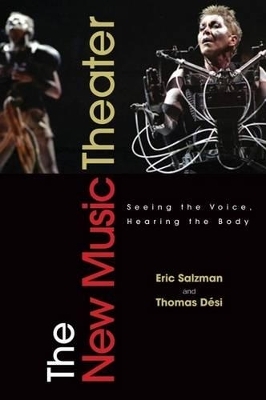
The New Music Theater
Oxford University Press Inc (Verlag)
978-0-19-509936-2 (ISBN)
Authors Salzman and Desi consider the subject of music theatre from a social as well as artistic point of view, exploring how theater works in culture, and how music works in the theater. In the first part of the book, they treat the origins of theater itself, putting forth insightful discussions about the relationship between language and music, song and speech, story-telling and expression, theatrical movement and dance. Their exploration then moves into the crucial relationships between high art forms and popular culture, and between entertainment and instruction. The authors proceed in the book's second part to the forms that music theater has taken from ancient times to the present day, investigating its gradual transformations from popular theater to more structured high art forms, to the eclectic mixture of forms which flourish today. This brings the reader into the third part, in which Salzman and Dészy trace the contemporary music theater renaissance from the cubist, dadaist, and futurist experiments of the 20s and 30s to the inter-arts movements of the 50s and 60s. Here they survey the increasingly pervasive impact of media and technology and the influence of jazz, pop, and world beat on new theatre forms and styles of today. This section also features a special section on vocal style and language, and extended vocal techniques. The final and fourth part of the book assesses the present state of music theater. Illuminating their discussion with illustrations from current artists and their works, the authors sum up what we have learned, and respond to such questions as: How does music work in theater? What does it mean when people get up on stage and sing instead of speak? And how much of this is universal? Through this process, The New Music Theater both describes where we have been and points the way to the future of this all-encompassing art form.
Eric Salzman is a composer, writer, director, producer, dramaturg, and performer, and he has been involved in over 50 major productions. He is also the author of Twentieth Century Music: An Introduction (Prentice-Hall, 1967; 4th edition, 2001), one of the most successful 20th Century music texts. Thomas Desi is an Austrian composer, director, and writer.
Introduction: What is Music Theater? ; Part I: Music in Music Theater / 1. The Voice / 2. Where the Sound Comes From / 3. The Music / Entr'acte I: Is there such a thing as progress in music and music theater? ; Part II: Theater in Music Theater / 4. Theater, Music, and Culture / 5. Text / Entr'acte II: The Language of Kathakali / 6. Visual Strategies / 7. Space / Entr'acte III: A Theater of Warm Bodies? ; Part III: Putting it all together: La Mise en Scene / 8. The American Eccentrics / 9. Germany and Austria / 10. The Italians / Entr'acte IV: The In Between / 11. Music Theater in France / 12. Great Britain and Northern Europe / 13. Downtown / 14. Minimalism / 15. The Show Music Go On / 16. Extended Voice / 17. Media and Music Theater ; Part V. After the Show: Taking it Apart / Entr'acte V: Criticism and Journalism / 18. Towards a Theory of Music Theater / 19. Notation vs. Improvisation / 20. The Ingredients / 21. Popular or High Art? / 22. Is Anyone Listening? ; Coda / Appendix / Bibliography
| Erscheint lt. Verlag | 26.2.2009 |
|---|---|
| Zusatzinfo | 53 halftones |
| Verlagsort | New York |
| Sprache | englisch |
| Maße | 236 x 157 mm |
| Gewicht | 717 g |
| Themenwelt | Kunst / Musik / Theater ► Musik ► Klassik / Oper / Musical |
| ISBN-10 | 0-19-509936-2 / 0195099362 |
| ISBN-13 | 978-0-19-509936-2 / 9780195099362 |
| Zustand | Neuware |
| Informationen gemäß Produktsicherheitsverordnung (GPSR) | |
| Haben Sie eine Frage zum Produkt? |
aus dem Bereich