


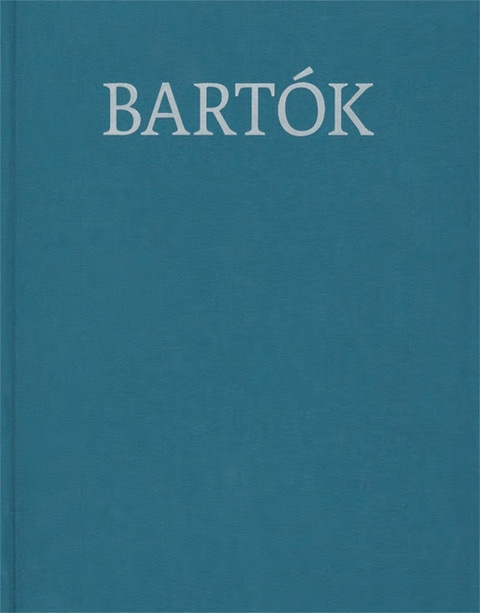
Béla Bartók - Bd. 41 | Mikrokosmos
Besetzung: Klavier zu zwei Händen
Seiten
2021
Henle, Günter (Verlag)
979-0-2018-6204-0 (ISMN)
Henle, Günter (Verlag)
979-0-2018-6204-0 (ISMN)
- Titel nicht im Sortiment
- Artikel merken
In Zusammenarbeit mit Editio Musica Budapest Zeneműkiadó
Many sources for Bartók's Mikrokosmos have survived, in which the origins of this highly interesting collection can be traced – from the first drafts to the copies used by Bartók in concert and the first edition. The Critical Commentary, published in a separate volume of the Complete Edition, therefore contains not only a description of the sources and the readings of the edition, but also an extensive chapter The Compositional Process, in which the genesis is described in detail for the first time, based on the sources in numerous diplomatic transcriptions. In the appendix to the volume, transcriptions of Bartók's own recordings as well as earlier versions are presented for some of the pieces. In addition, Bartók's later explanations of his work to his student Ann Chenée are documented. Many sources for Bartók's Mikrokosmos have survived, in which the origins of this highly interesting collection can be traced – from the first drafts to the copies used by Bartók in concert and the first edition. The Critical Commentary, published in a separate volume of the Complete Edition, therefore contains not only a description of the sources and the readings of the edition, but also an extensive chapter The Compositional Process, in which the genesis is described in detail for the first time, based on the sources in numerous diplomatic transcriptions. In the appendix to the volume, transcriptions of Bartók's own recordings as well as earlier versions are presented for some of the pieces. In addition, Bartók's later explanations of his work to his student Ann Chenée are documented. Zu Bartóks Mikrokosmos haben sich viele Quellen erhalten, in denen die Entstehung dieser hochinteressanten Sammlung nachvollziehbar ist – von den ersten Entwürfen über die von Bartók im Konzert gebrauchten Kopien bis hin zur Erstausgabe. Daher enthält der in einem eigenen Band der Gesamtausgabe veröffentlichte Critical Commentary (nur Englisch) neben der Quellenbeschreibung und den Lesarten zur Edition auch ein umfangreiches Kapitel The Compositional Process, in dem diese Entstehung erstmals minutiös auf Quellenbasis in zahlreichen diplomatischen Übertragungen dargelegt wird. Im Anhang des Bandes werden für einige Stücke Transkriptionen von Bartóks eigenen Aufnahmen sowie frühere Versionen dargeboten. Zudem werden Bartóks spätere Erläuterungen zu diesem Werk gegenüber seiner Schülerin Ann Chenée dokumentiert.
Many sources for Bartók's Mikrokosmos have survived, in which the origins of this highly interesting collection can be traced – from the first drafts to the copies used by Bartók in concert and the first edition. The Critical Commentary, published in a separate volume of the Complete Edition, therefore contains not only a description of the sources and the readings of the edition, but also an extensive chapter The Compositional Process, in which the genesis is described in detail for the first time, based on the sources in numerous diplomatic transcriptions. In the appendix to the volume, transcriptions of Bartók's own recordings as well as earlier versions are presented for some of the pieces. In addition, Bartók's later explanations of his work to his student Ann Chenée are documented. Many sources for Bartók's Mikrokosmos have survived, in which the origins of this highly interesting collection can be traced – from the first drafts to the copies used by Bartók in concert and the first edition. The Critical Commentary, published in a separate volume of the Complete Edition, therefore contains not only a description of the sources and the readings of the edition, but also an extensive chapter The Compositional Process, in which the genesis is described in detail for the first time, based on the sources in numerous diplomatic transcriptions. In the appendix to the volume, transcriptions of Bartók's own recordings as well as earlier versions are presented for some of the pieces. In addition, Bartók's later explanations of his work to his student Ann Chenée are documented. Zu Bartóks Mikrokosmos haben sich viele Quellen erhalten, in denen die Entstehung dieser hochinteressanten Sammlung nachvollziehbar ist – von den ersten Entwürfen über die von Bartók im Konzert gebrauchten Kopien bis hin zur Erstausgabe. Daher enthält der in einem eigenen Band der Gesamtausgabe veröffentlichte Critical Commentary (nur Englisch) neben der Quellenbeschreibung und den Lesarten zur Edition auch ein umfangreiches Kapitel The Compositional Process, in dem diese Entstehung erstmals minutiös auf Quellenbasis in zahlreichen diplomatischen Übertragungen dargelegt wird. Im Anhang des Bandes werden für einige Stücke Transkriptionen von Bartóks eigenen Aufnahmen sowie frühere Versionen dargeboten. Zudem werden Bartóks spätere Erläuterungen zu diesem Werk gegenüber seiner Schülerin Ann Chenée dokumentiert.
Mikrokosmos - Kritischer Bericht
| Erscheinungsdatum | 08.01.2026 |
|---|---|
| Reihe/Serie | Bartók Gesamtausgabe |
| Mitarbeit |
General-Herausgeber: Yusuke Nakahara |
| Zusatzinfo | ?In Zusammenarbeit mit Editio Musica Budapest Zenemukiadó |
| Verlagsort | München |
| Sprache | englisch |
| Maße | 250 x 325 mm |
| Gewicht | 1440 g |
| Themenwelt | Kunst / Musik / Theater ► Musik ► Musikgeschichte |
| Schlagworte | henle • Klassik • Musik • Musikalien • Noten • Urtext |
| Zustand | Neuware |
| Informationen gemäß Produktsicherheitsverordnung (GPSR) | |
| Haben Sie eine Frage zum Produkt? |
Mehr entdecken
aus dem Bereich


aus dem Bereich
das Gesamtkunstwerk Kraftwerk
Buch | Softcover (2024)
C.W. Leske Verlag
CHF 29,90
Fakten, Mythen, Halbwahrheiten
Buch | Softcover (2024)
Anton Pustet (Verlag)
CHF 29,90


