


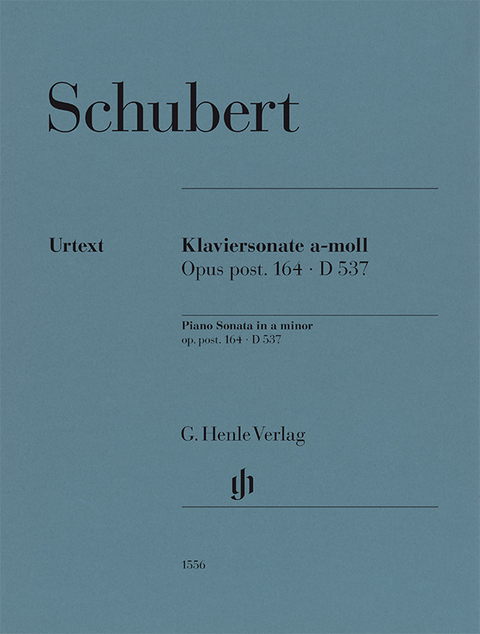
Franz Schubert - Klaviersonate a-moll op. post 164 D 537
Besetzung: Klavier zu zwei Händen
Seiten
2025
Henle, Günter (Verlag)
979-0-2018-1556-5 (ISMN)
Henle, Günter (Verlag)
979-0-2018-1556-5 (ISMN)
- Titel nicht im Sortiment
- Artikel merken
Franz Schubert seems to have been particularly attracted to a-minor. Not just one but three of his piano sonatas are in this key. The earliest of them, D 537, was composed in March 1817 and was simultaneously his first completed piano sonata ever. It is characterised by concise brevity. The three-movement form dispenses with the usual scherzo. It is far removed from the drama of its a-minor sibling works; meandering modulations often lead to distant harmonic regions and lighten the mood to major – significantly, the sonata also ends in A major.
Henle’s Urtext edition is based on the autograph, which is preserved in the Bibliothèque nationale in Paris; a contemporary manuscript copy and the posthumous first edition were only used for comparison purposes. The preface by Schubert expert Andrea Lindmayr-Brandl and the detailed comment section provide information about the work’s genesis and about open questions concerning the musical text. The fingerings by renowned Schubert interpreter Martin Helmchen are a further plus point of this new edition. Schubert semble avoir éprouvé une attirance particulière pour la tonalité de la mineur: non moins de trois de ses sonates pour piano sont écrites dans cette tonalité. La plus ancienne, D 537, fut composée en mars 1817 et est aussi sa toute première sonate pour piano achevée. Elle se distingue par sa brièveté. La forme tripartite renonce au scherzo habituel. Contrairement au ton dramatique de ses œuvres sœurs, ses longues modulations mènent souvent à des contrées harmoniques éloignées et éclairent l’atmosphère d’accents en majeur – il est d’ailleurs notable que la sonate s’achève sur une tonalité de La majeur.
L’édition Henle Urtext s’appuie sur le manuscrit autographe conservé à la Bibliothèque nationale à Paris. Une copie contemporaine et la première édition posthume furent également consultées, mais uniquement à titre de comparaison. La préface de l’experte de Schubert Andrea Lindmayr-Brandl ainsi que des commentaires détaillés reviennent sur la genèse de l’œuvre et sur les questions laissées en suspens par la partition. Autre avantage de cette nouvelle édition: les doigtés de Martin Helmchen, interprète renommé de Schubert. A-moll scheint Franz Schubert besonders angezogen zu haben. Gleich drei seiner Klaviersonaten stehen in dieser Tonart. Die früheste von ihnen, D 537, entstand im März 1817 und ist zugleich seine erste vollendete Klaviersonate überhaupt. Sie zeichnet sich durch prägnante Kürze aus. Die dreisätzige Form verzichtet auf das sonst übliche Scherzo. Fern liegt ihr die Dramatik der a-moll-Schwesterwerke, weitschweifende Modulationen führen oft in entfernte harmonische Regionen und hellen die Stimmung nach Dur auf – bezeichnenderweise endet die Sonate auch in A-dur.
Die Urtextausgabe von Henle beruht auf dem Autograph, das in der Pariser Bibliothèque nationale aufbewahrt wird; lediglich zum Vergleich wurden eine zeitgenössische Abschrift und die postume Erstausgabe herangezogen. Das Vorwort der Schubert-Expertin Andrea Lindmayr-Brandl und der detaillierte Bemerkungsteil geben Auskunft zur Werkentstehung und zu offenen Fragen des Notentextes. Als weiteren Pluspunkt bietet diese Neuausgabe den Fingersatz des renommierten Schubert-Interpreten Martin Helmchen.
Henle’s Urtext edition is based on the autograph, which is preserved in the Bibliothèque nationale in Paris; a contemporary manuscript copy and the posthumous first edition were only used for comparison purposes. The preface by Schubert expert Andrea Lindmayr-Brandl and the detailed comment section provide information about the work’s genesis and about open questions concerning the musical text. The fingerings by renowned Schubert interpreter Martin Helmchen are a further plus point of this new edition. Schubert semble avoir éprouvé une attirance particulière pour la tonalité de la mineur: non moins de trois de ses sonates pour piano sont écrites dans cette tonalité. La plus ancienne, D 537, fut composée en mars 1817 et est aussi sa toute première sonate pour piano achevée. Elle se distingue par sa brièveté. La forme tripartite renonce au scherzo habituel. Contrairement au ton dramatique de ses œuvres sœurs, ses longues modulations mènent souvent à des contrées harmoniques éloignées et éclairent l’atmosphère d’accents en majeur – il est d’ailleurs notable que la sonate s’achève sur une tonalité de La majeur.
L’édition Henle Urtext s’appuie sur le manuscrit autographe conservé à la Bibliothèque nationale à Paris. Une copie contemporaine et la première édition posthume furent également consultées, mais uniquement à titre de comparaison. La préface de l’experte de Schubert Andrea Lindmayr-Brandl ainsi que des commentaires détaillés reviennent sur la genèse de l’œuvre et sur les questions laissées en suspens par la partition. Autre avantage de cette nouvelle édition: les doigtés de Martin Helmchen, interprète renommé de Schubert. A-moll scheint Franz Schubert besonders angezogen zu haben. Gleich drei seiner Klaviersonaten stehen in dieser Tonart. Die früheste von ihnen, D 537, entstand im März 1817 und ist zugleich seine erste vollendete Klaviersonate überhaupt. Sie zeichnet sich durch prägnante Kürze aus. Die dreisätzige Form verzichtet auf das sonst übliche Scherzo. Fern liegt ihr die Dramatik der a-moll-Schwesterwerke, weitschweifende Modulationen führen oft in entfernte harmonische Regionen und hellen die Stimmung nach Dur auf – bezeichnenderweise endet die Sonate auch in A-dur.
Die Urtextausgabe von Henle beruht auf dem Autograph, das in der Pariser Bibliothèque nationale aufbewahrt wird; lediglich zum Vergleich wurden eine zeitgenössische Abschrift und die postume Erstausgabe herangezogen. Das Vorwort der Schubert-Expertin Andrea Lindmayr-Brandl und der detaillierte Bemerkungsteil geben Auskunft zur Werkentstehung und zu offenen Fragen des Notentextes. Als weiteren Pluspunkt bietet diese Neuausgabe den Fingersatz des renommierten Schubert-Interpreten Martin Helmchen.
Klaviersonate a-moll op. post. 164 D 537
| Erscheinungsdatum | 08.01.2026 |
|---|---|
| Reihe/Serie | G. Henle Urtext-Ausgabe |
| Mitarbeit |
General-Herausgeber: Dominik Rahmer Technischer Herausgeber: Martin Helmchen |
| Vorwort | Andrea Lindmayr-Brandl |
| Verlagsort | München |
| Sprache | englisch; französisch; deutsch |
| Maße | 235 x 310 mm |
| Gewicht | 118 g |
| Themenwelt | Kunst / Musik / Theater ► Musik ► Musikalien |
| Schlagworte | henle • Klassik • Musik • Musikalien • Noten • Urtext |
| Zustand | Neuware |
| Informationen gemäß Produktsicherheitsverordnung (GPSR) | |
| Haben Sie eine Frage zum Produkt? |
Mehr entdecken
aus dem Bereich


aus dem Bereich
Buch | Hardcover (2024)
E Reinhold (Verlag)
CHF 41,70
San Giovanni Nepomuceno, Oratorio Melodrammatico Sacro
Buch | Hardcover (2024)
Hollitzer Wissenschaftsverlag
CHF 95,15


