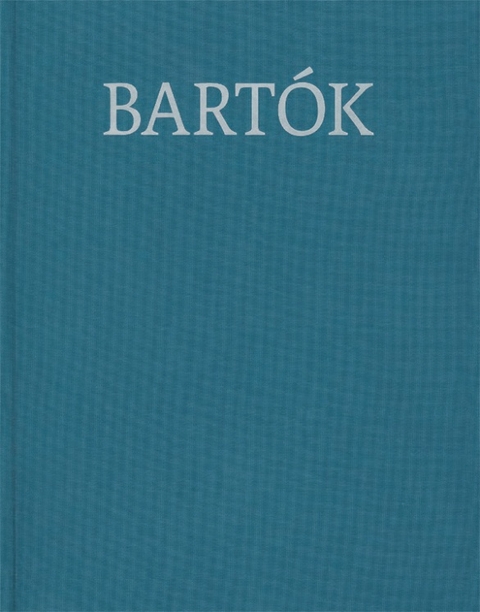
Alongside Mikrokosmos, and following For Children (HN 6200) and Works for Piano 1914–1920 (HN 6202), the third volume of piano works and another major work by Bartók is now appearing in the Complete Edition. It was edited by Japanese musicologist Yusuke Nakahara, who was trained at the Liszt Academy in Budapest. As an expert on Bartók, he has worked intensively on Mikrokosmos and supported the work at the Complete Edition at the Budapest Bartók Institute for several years. The collection, which is designed for teaching with a gradual increase in difficulty, deals not only with technical aspects of playing but also with the basics of a composer´s work: ranging from compositional techniques as in Ostinato, Free Variations or Imitation and Reversal to programmatic ideas in From the Diary of a Fly or the famous Six Dances in Bulgarian Rhythm, which form the furious conclusion to this central 20th century-work. The 153 numbers of the main text are supplemented by the exercises Bartók designed for individual pieces, as well as his preface and some notes he wrote down for the first edition. The detailed introduction to the Complete Edition volume by Yusuke Nakahara (English / Hungarian / German) not only deals with the genesis of the work and its biographical context, but also provides – as always in the Bartók Complete Edition – a separate chapter on Notation and Performance, which provides important information on the practical performance of the musical text. The footnotes to the musical text point out and classify musically interesting variants from the extensive tradition. Alongside Mikrokosmos, and following For Children (HN 6200) and Works for Piano 1914–1920 (HN 6202), the third volume of piano works and another major work by Bartók is now appearing in the Complete Edition. It was edited by Japanese musicologist Yusuke Nakahara, who was trained at the Liszt Academy in Budapest. As an expert on Bartók, he has worked intensively on Mikrokosmos and supported the work at the Complete Edition at the Budapest Bartók Institute for several years. The collection, which is designed for teaching with a gradual increase in difficulty, deals not only with technical aspects of playing but also with the basics of a composer´s work: ranging from compositional techniques as in Ostinato, Free Variations or Imitation and Reversal to programmatic ideas in From the Diary of a Fly or the famous Six Dances in Bulgarian Rhythm, which form the furious conclusion to this central 20th century-work. The 153 numbers of the main text are supplemented by the exercises Bartók designed for individual pieces, as well as his preface and some notes he wrote down for the first edition. The detailed introduction to the Complete Edition volume by Yusuke Nakahara (English / Hungarian / German) not only deals with the genesis of the work and its biographical context, but also provides – as always in the Bartók Complete Edition – a separate chapter on Notation and Performance, which provides important information on the practical performance of the musical text. The footnotes to the musical text point out and classify musically interesting variants from the extensive tradition. Mit Mikrokosmos erscheint nun, nach Für Kinder (HN 6200) und den Klavierwerken 1914–1920 (HN 6202), bereits der dritte Band mit Klavierwerken und ein weiteres Hauptwerk Bartóks in der wissenschaftlichen Gesamtausgabe. Herausgeben wurde diese von dem an der Budapester Liszt-Akademie ausgebildeten japanischen Musikwissenschaftler Yusuke Nakahara, der sich als Bartók-Experte intensiv mit dem Mikrokosmos befasst hat und seit mehreren Jahren am Budapester Bartók-Institut die Arbeit an der Gesamtausgabe unterstützt. Die als Unterrichtswerk in aufsteigendem Schwierigkeitsgrad angelegte Sammlung behandelt neben spieltechnischen Aspekten auch die Grundlagen kompositorischer Arbeit: von satztechnischen Kategorien wie Ostinato, Freie Variationen oder Imitation und Umkehrung bis hin zu programmatischen Ideen in Aus dem Tagebuch einer Fliege oder den berühmten Sechs Tänzen im bulgarischen Rhythmus, die den furiosen Abschluss dieses Jahrhundertwerks bilden. Die 153 Nummern des Haupttextes werden ergänzt durch die von Bartók zu einzelnen Stücken erstellten Übungen, sowie sein Vorwort und einige Anmerkungen, die er für die Erstausgabe festhielt. Die ausführliche Einleitung des Gesamtausgaben-Bandes von Yusuke Nakahara (Englisch / Ungarisch / Deutsch) behandelt nicht nur die Entstehung des Werkes und den biographischen Kontext, sondern liefert auch – wie immer bei der Bartók-Gesamtausgabe – in einem eigenen Kapitel Notation und Aufführung wichtige Hinweise zur spielpraktischen Umsetzung des Notentextes. Die Fußnoten zum Notentext weisen auf musikalisch interessante Varianten der umfangreichen Überlieferung hin und ordnen diese ein.
Mikrokosmos I-II
Sechs Melodien im Unisono, Nr. 1
Sechs Melodien im Unisono, Nr. 2
Sechs Melodien im Unisono, Nr. 3
Sechs Melodien im Unisono, Nr. 4
Sechs Melodien im Unisono, Nr. 5
Sechs Melodien im Unisono, Nr. 6
Punktierte Noten
Tonwiederholung (1)
Synkopen (1)
Mit alternierenden Händen
Parallele Bewegung
Spiegelbild
Positionsänderung
Frage und Antwort
Dorflied
Parallele Bewegung mit Positionsänderung
Gegenbewegung (1)
Vier Melodien im Unisono, Nr. 1
Vier Melodien im Unisono, Nr. 2
Vier Melodien im Unisono, Nr. 3
Vier Melodien im Unisono, Nr. 4
Imitation und Kontrapunkt
Imitation und Umkehrung (1)
Pastorale
Imitation und Umkehrung (2)
Tonwiederholung (2)
Synkopen (2)
Kanon in der Oktave
Imitation im Spiegelbild
Kanon in der Unterquint
Tanzstück im Kanon
Im dorischen Modus
Langsamer Tanz
Im phrygischen Modus
Choral
Freier Kanon
Im lydischen Modus
Staccato und Legato (1)
Staccato und Legato (2, Kanon)
Nach jugoslawischer Art
Melodie mit Begleitung
Begleitung in gebrochenen Dreiklängen
Nach ungarischer Art
Gegenbewegung (2)
Méditation
Anwachsen - Abnehmen
Jahrmarkt
Im mixolydischen Modus
Crescendo - Diminuendo
Minuetto
Wellenbewegung
Einstimmigkeit mit alternierenden Händen
Nach siebenbürgische Art
Chromatische Tonfolgen
Triolen im lydischen Modus
Melodie in Dezimen
Akzente
Nach orientalischer Art
Dur und Moll
Kanon mit gehaltenen Noten
Pentatonische Melodie
Kleine Sexten in Parallel-Bewegung
Gesumme
Linie gegen Punkt
Dialog
Melodie in Verteilung
Mikrokosmos III-IV
Terzen gegen eine Stimme
Ungarischer Tanz
Akkordstudie
Melodie gegen Doppelgriffe
Terzen
Tanz der Drachen
Sexten und Dreiklänge
Ungarisches Lied
Triolen
Dreistimmig
Kleine Studie
Fünfstufige Skala
Hommage à J. S. B.
Hommage à R. Sch.
Umherirren
Scherzo
Melodie mit Unterbrechungen
Spielerei
Gebrochene Akkorde
Zwei Dur-Pentachorde übereinander
Variationen
Pfeifenduett
Vierstimmig (1)
Nach russischer Art
Chromatische Invention (1)
Chromatische Invention (2)
Vierstimmig (2)
Erzählung
Lied vom Fuchs
Stockungen
Notturno
Daumen untersetzen
Mit gekreuzten Händen
Wie ein Volkslied
Verminderter Quintenabstand
Obertöne
Moll und Dur
Gang durch die Tonarten
Spiellied (mit zwei pentatonischen Leitern)
Einfache Weise
Melodie im Nebel
Ringen
Auf der Insel Bali
Es klirren Töne aneinander
Intermezzo
Variationen über ein Volkslied
Bulgarischer Rhythmus (1)
Thema und Umkehrung
Bulgarischer Rhythmus (2)
Melodie
Bourée
Triolen im 9/8-Takt
Tanz im 3/4-Takt
Quint-Akkorde
Zweistimmige Studie
Mikrokosmos V-VI
Akkorde mit- und gegeneinander
Staccato und Legato (3)
Staccato
Kahnfahrt
Taktwechsel
Neu-Ungarisches Volkslied
Stampf-Tanz
Alternierende Terzen
Ländlicher Scherz
Quarten
Große Sekunden in der Chromatik
Synkopen (3)
Doppelgriffstudien
Perpetuum mobile
Ganztonleiter
Unisono
Sackpfeifermusik
Hanswurst
Freie Variationen
Bild und Spiegelbild
Aus dem Tagebuch einer Fliege
Verteilte Arpeggien
Kleine Sekunden - große Septimen
Chromatische Invention (3)
Ostinato
Marsch
Sechs Tänze in bulgarischem Rhythmus, Nr. 1
Sechs Tänze in bulgarischem Rhythmus, Nr. 2
Sechs Tänze in bulgarischem Rhythmus, Nr. 3
Sechs Tänze in bulgarischem Rhythmus, Nr. 4
Sechs Tänze in bulgarischem Rhythmus, Nr. 5
Sechs Tänze in bulgarischem Rhythmus, Nr. 6
| Erscheinungsdatum |
08.01.2026
|
| Reihe/Serie |
Bartók Gesamtausgabe
|
| Mitarbeit |
General-Herausgeber: Yusuke Nakahara
|
| Verlagsort |
München |
| Sprache |
englisch |
| Maße |
250 x 325 mm |
| Gewicht |
1889 g |
| Themenwelt
|
Kunst / Musik / Theater ► Musik ► Musikgeschichte |
| Schlagworte |
henle • Klassik • Musik • Musikalien • Noten • Urtext |
| Zustand |
Neuware |