


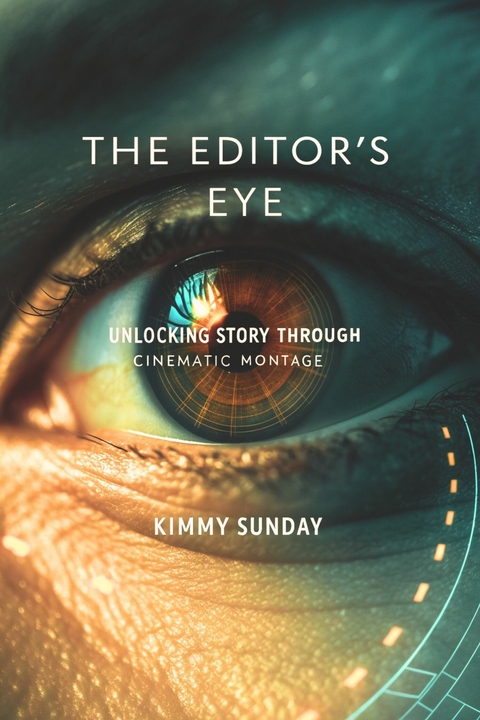
The Editor's Eye (eBook)
168 Seiten
JNR Publishing (Verlag)
978-0-00-113132-3 (ISBN)
The Editor's Eye: Unlocking Story Through Cinematic Montage by Kimmy Sunday
See Film Differently: Master the Art of Storytelling with The Editor's Eye
Discover the transformative power of the cut in The Editor's Eye, Kimmy Sunday's insightful guide to unlocking narrative potential through cinematic montage. This book reveals how editing shapes not just the pace, but the very meaning and emotional core of a film, bridging the essential crafts of screenwriting and post-production.
Move beyond basic cutting techniques and delve into the rich history, theory, and practice of montage. Explore the groundbreaking ideas of Soviet masters like Kuleshov and Eisenstein, understand the disruptive energy of the French New Wave, feel the kinetic pulse of Hong Kong action cinema, and learn how these global perspectives continue to shape filmmaking today. The Editor's Eye provides a comprehensive framework for understanding how juxtaposition creates meaning.
With this guide, you will:
Learn how screenwriting choices directly impact editing possibilities and vice-versa.
Master different montage typologies: metric, rhythmic, tonal, overtonal, and intellectual.
Apply practical techniques like cutting on action, J-cuts, L-cuts, and strategic sound design.
Effectively handle exposition, training sequences, time jumps, and parallel narratives.
Understand the cognitive and emotional impact of editing choices on your audience.
Navigate the ethical complexities of montage in documentary and narrative filmmaking.
Explore the future of editing in VR, interactive media, and AI-assisted workflows.
The Editor's Eye is designed for filmmakers, screenwriters, editors, and passionate cinephiles who want to grasp the profound artistry behind the cuts. It is filled with practical examples, historical context, and thought-provoking analysis. Learn why the Kuleshov Effect is fundamental to audience perception, how Eisenstein used collision to spark ideas, why Vertov championed the 'cinema-eye', and how Pudovkin constructed emotional resonance through linkage.
Go beyond the basics with chapters exploring 'Montage and Narrative Structure', 'Practical Editing Techniques', 'Global Perspectives on Montage', and 'Experimental Montage in New Media'. Each chapter builds your understanding, empowering you to make deliberate, impactful choices in your own work.
Whether you're aiming to direct, write, or edit, developing your 'Editor's Eye' is crucial for crafting films that truly connect. This book provides the insights and tools to elevate your cinematic storytelling.
Ready to transform your understanding of film? Get your copy of The Editor's Eye now and start seeing stories in a whole new light!
1
CHAPTER 1: FOUNDATIONS OF CINEMATIC STORYTELLING AND MONTAGE
The Grand Purpose of Storytelling
Welcome to a journey that merges two mighty rivers of cinematic art: the power of montage in film editing and the narrative architecture of screenwriting. If that sounds grandiose, it’s because it is. Telling stories with images, sounds, and words might very well be humanity’s oldest pastime, other than cooking questionable soup over a campfire. From ancient myths chiseled into stone to Hollywood blockbusters projected onto towering screens, narratives have always been the lens through which we interpret the world, each other, and ourselves.
Before we dive into the theoretical and historical intricacies of montage, or the nitty-gritty craft behind writing gripping scenes, let’s pause to honor the overarching reason stories matter. A story without purpose is like a camera with no lens: you can keep rolling film, but you won’t capture anything meaningful. Storytelling, as an art form, can transform random events into cohesive arcs, characters into believable humans (or at least humanoids), and abstract ideas into resonant themes. It is the glue that holds human civilization together—an elaborate game of make-believe that helps us explore the truths of the human condition.
In our cinematic context, the magic of storytelling unfolds on two complementary planes. The first is screenwriting, which shapes the story’s architecture: the characters, their goals, the conflicts, and the emotional or philosophical themes that underpin the drama. The second is montage, or film editing, which is the art of manipulating time, space, and rhythm in order to convey meaning and evoke emotions. One shapes the skeleton of the narrative, the other stitches the flesh together. We want our cinematic beast to rise from the table, Frankenstein-like, and declare its power to the world. Fortunately for us, we can do so without the sparks of lightning. A good set of editing tools will do just fine.
Bridging Screenwriting and Montage
Why bother learning both, you might ask? Can’t a writer just write, and an editor just edit? Absolutely—many successful professionals specialize. However, we stand firmly in the camp that deeper understanding of both disciplines yields synergy. A screenwriter who appreciates how editors slice and rearrange footage may craft scripts with purposeful transitions, clever use of time jumps, or visually dynamic sequences. Conversely, a film editor well-versed in narrative structure can spot when a scene’s conflict is undercooked or a character’s motivation is muddled.
In other words, the cinematic process is an ecosystem. Each step in the chain thrives on an awareness of the rest. Film is a collaborative medium: if the screenwriter hands off a script that is all talk and no visually arresting moments, the montage wizard (the editor) is forced to rummage for scraps to liven up the final cut. And if the editor is clueless about thematic layering or character arcs, the final product might reduce to an aimless montage of random shots. “Just keep cutting on action, folks, and we’ll see what happens,” is not a mantra that yields greatness—unless your dream is to produce incoherent highlight reels.
Thus, here at the outset, we acknowledge the holy union between writing a story and assembling its final cinematic form. The ultimate goal? To create not merely a collection of scenes that sort of flow, but a living, breathing narrative that resonates on intellectual, emotional, and aesthetic levels, from first draft to final frame.
A Historical Sneak Peek
We will, of course, take you on a historical tour of how montage theory developed—those brilliant Soviet filmmakers like Kuleshov, Eisenstein, Vertov, and Pudovkin, who realized that the juxtaposition of shots could yield meaning far beyond what any single shot could accomplish alone. Along the way, we’ll chat about early cinematic pioneers (like Georges Méliès, who had a flair for trick edits that turned him into a cinematic magician), and we’ll see how these earlier innovators laid the groundwork for modern editing styles, from French New Wave jump cuts to rapid-fire blockbuster sequences.
Simultaneously, we’ll examine the shape of narrative structures in screenwriting, from the mighty trifecta of Goals-Actions-Conflict to the swirl of subtext, backstory, foreshadowing, theme, and all the secret sauces that breathe life into a script. Yes, we’ll discuss how to craft strong objectives for characters, how to pit them against seemingly insurmountable stakes, and how to tie it all together with a theme that lingers well after the credits roll. At times, we’ll repeat certain core concepts, but fear not: each time we do so, we’ll add a fresh perspective, comedic twist, or real-world example that hopefully cements your understanding more profoundly than the last mention ever could.
Our Plan for this Chapter
This first chapter, ironically, is both an introduction and a foundational statement. Think of it as the first scene in a well-edited cinematic experience, establishing the environment and tone while hinting at the major conflicts we’ll explore. We’ll delve into the primal reasons humans crave stories, how we harness that craving in cinema, and how montage has historically become a core strategy to convey time, space, and emotional synergy. Grab your notepad, your sense of humor, and a surplus of popcorn. We’re forging onward.
Before we get too lost, let’s dissect our core philosophical stance that editing (montage) is not purely a mechanical exercise, nor is screenwriting purely about penning witty lines. Both revolve around a deeper capacity for manipulating audience perception—and we mean that in the noblest sense, of course. We’ll show you how to do it ethically, responsibly, and for the good of humankind—at least unless your script requires some villainous propaganda. (In which case, please label it “fiction” if you can.)
The Universal Story-Drive: Why We All Love a Good Yarn
Stories, in any medium, do more than entertain. They are a coping mechanism for the complexities of existence, a time machine for traveling to other eras or worlds, a moral barometer for deciding how we feel about certain characters or dilemmas, and an emotional amplifier that can make us cry about a robot losing his friend in outer space. Cinematic storytelling, in particular, supercharges these qualities through the potent combination of visual images, recorded performances, and skillfully designed editing. One moment we’re in ancient Mesopotamia; the next, we’re in a neon-lit cyber-future. All it takes is a well-placed cut, a shift in lighting, and a strong narrative throughline to keep audiences grounded yet enthralled.
As we build this foundation, keep in mind that you, dear reader, are stepping into the vantage point of both writer and editor, the one who conceptualizes the story’s skeleton and the one who weaves the cinematic tapestry. And by tapestry, we mean all those careful alignments of images and sounds that raise goosebumps on arms, tears in eyes, or laughter in unsuspecting throats. If that’s not power, we don’t know what is.
A Quick Word on Terminology
We’ll frequently switch between referring to “filmmakers,” “directors,” “editors,” “screenwriters,” and “cinematic storytellers.” Realistically, you may wear many hats or just one. This book’s approach sees film production as a holistic endeavor, so we will often speak in inclusive ways that apply to everyone shaping a movie—yet we’ll also point out specialized tasks and considerations. Similarly, if you see phrases like “juxtaposition,” “goal-driven protagonist,” or “the emotional arc,” don’t panic if it’s not second nature yet. We’ll define, elaborate, reference real examples, and repeat them from slightly different angles throughout upcoming chapters.
The Joy of Repetition... With Variation
Yes, we will repeat. The problem with many “concise” guides is they cut corners by skipping repetition, assuming you’ll remember everything after hearing it once. That might save trees in paperback form, but ironically it can cost you the deeper layers of comprehension. In this text, we’ll sometimes circle back, ensuring that each re-visitation of a concept offers more context, examples, or comedic analogies. This approach is deliberate, so please be patient if you come across a paragraph explaining again how a cut from one shot to another can create meaning. Each time, we’ll attempt to highlight a slightly different dimension—maybe how that cut plays with comedic timing or how it might reveal subtext about a character’s mood.
The good news? You’re welcome to speed-read or skim if you feel confident in your knowledge. But do know that mastery sometimes emerges from hearing something from multiple vantage points. If that means we add an extra thousand or so words to your reading journey—fantastic! Let’s welcome the super-thick approach for a richer immersion in the craft.
The Skeleton and the Flesh: An Overview
We like to think of the underlying structure of the story (the domain of screenwriting) as the skeleton, giving shape, proportion, and unity to what would otherwise be a...
| Erscheint lt. Verlag | 1.1.2026 |
|---|---|
| Sprache | englisch |
| Themenwelt | Kunst / Musik / Theater ► Malerei / Plastik |
| ISBN-10 | 0-00-113132-X / 000113132X |
| ISBN-13 | 978-0-00-113132-3 / 9780001131323 |
| Informationen gemäß Produktsicherheitsverordnung (GPSR) | |
| Haben Sie eine Frage zum Produkt? |
 EPUB (Adobe DRM)
Größe: 1,9 MB
Kopierschutz: Adobe-DRM
Adobe-DRM ist ein Kopierschutz, der das eBook vor Mißbrauch schützen soll. Dabei wird das eBook bereits beim Download auf Ihre persönliche Adobe-ID autorisiert. Lesen können Sie das eBook dann nur auf den Geräten, welche ebenfalls auf Ihre Adobe-ID registriert sind.
Details zum Adobe-DRM
Dateiformat: EPUB (Electronic Publication)
EPUB ist ein offener Standard für eBooks und eignet sich besonders zur Darstellung von Belletristik und Sachbüchern. Der Fließtext wird dynamisch an die Display- und Schriftgröße angepasst. Auch für mobile Lesegeräte ist EPUB daher gut geeignet.
Systemvoraussetzungen:
PC/Mac: Mit einem PC oder Mac können Sie dieses eBook lesen. Sie benötigen eine
eReader: Dieses eBook kann mit (fast) allen eBook-Readern gelesen werden. Mit dem amazon-Kindle ist es aber nicht kompatibel.
Smartphone/Tablet: Egal ob Apple oder Android, dieses eBook können Sie lesen. Sie benötigen eine
Geräteliste und zusätzliche Hinweise
Buying eBooks from abroad
For tax law reasons we can sell eBooks just within Germany and Switzerland. Regrettably we cannot fulfill eBook-orders from other countries.
aus dem Bereich


